

China Nuts Supplier Export Guide: How to Source with Confidence
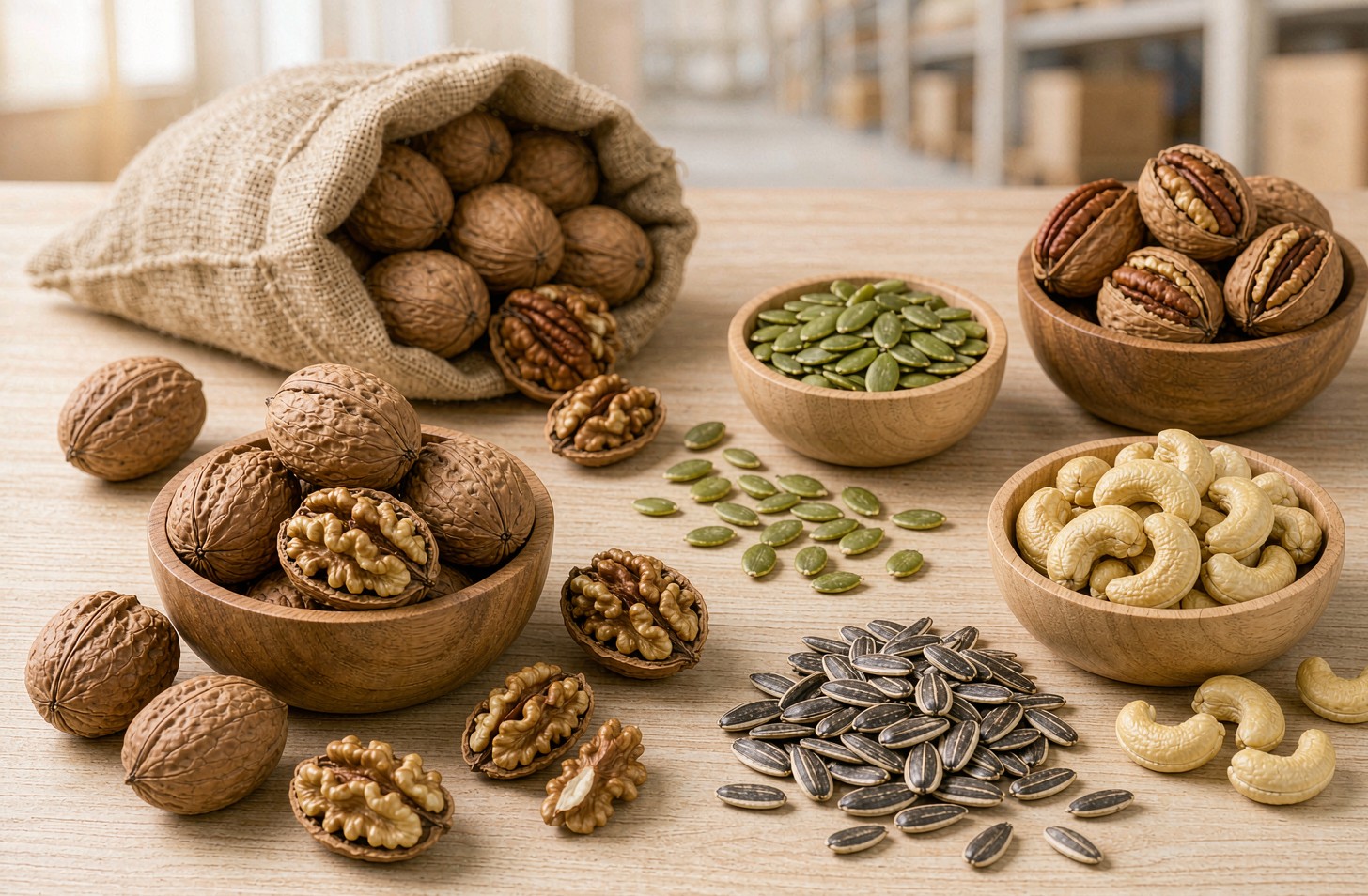
Choosing the right China nuts supplier export partner means finding a manufacturer that combines certified food-safety systems, modern processing capacity, and a proven record of shipping edible nuts and seeds to regulated markets in Europe, North America, the Middle East, and Asia. China is one of the world’s most important origins for walnuts, walnut kernels, pumpkin seeds, sunflower seeds, pecans, and cashews, and its leading processing hubs are concentrated in Inner Mongolia, where a dry climate, long sunshine hours, and large-scale farming keep quality high and costs competitive. This guide explains how China’s nut export supply chain works, what specifications and documents to expect, and how to qualify a supplier before your first container order.
If you are a wholesale distributor, food manufacturer, bakery, or snack brand buying tree nuts and edible seeds in bulk, the framework below will help you move from first inquiry to repeat orders with far fewer surprises — and it reflects how an experienced exporter like Ouji International actually runs its export operation.
Why Source Nuts and Seeds from China
China’s nut and seed industry has matured dramatically over the past decade. Buyers around the world continue to consolidate their sourcing here for four structural reasons:
- Scale of cultivation — Inner Mongolia and neighboring regions are among the world’s largest producing areas for sunflower seeds and pumpkin seeds, while walnuts from Yunnan, Xinjiang, and Shanxi supply global kernel markets year-round;
- Modern processing — leading exporters run automatic cleaning, grading, color-sorting, shelling, and metal-detection lines that meet the expectations of European and North American food manufacturers;
- Competitive landed cost — efficient farm-to-plant logistics and high kernel yields keep FOB pricing attractive even after freight and tariffs;
- Export experience — Chinese nut exporters ship to more than 100 countries and are familiar with phytosanitary, customs, and labeling requirements across major markets.
The real risk in this market is not product quality at origin — it is supplier inconsistency: mixed lots between shipments, substituted grades, or paperwork delays that hold containers at port. A structured vetting process, covered at the end of this guide, is the practical answer.
What a Full-Line China Nuts Supplier Should Offer
A serious export partner should be able to quote and consistently supply multiple product families, so you can consolidate containers instead of juggling five small suppliers. Typical B2B product lines include:
| Product | Common Forms | Typical B2B Use | Key Specs Buyers Check |
|---|---|---|---|
| Walnuts & walnut kernels | In-shell; halves; pieces; light halves | Bakery, confectionery, retail packs | Kernel color, halves ratio, moisture, defect rate |
| Pumpkin seeds | Shine Skin, GWS, Snow White; hulled kernels | Snack roasting, bakery toppings, health foods | Size (seeds/100 g), purity 99%+, moisture ≤ 9% |
| Sunflower seeds | In-shell (striped/black/white); kernels | Snack production, bird food, oil crushing | Size grading, purity, unsaturated-fat content |
| Pecans | In-shell; halves; pieces | Premium bakery, nut mixes | Kernel color, size count, shell-out ratio |
| Cashews | W240/W320/W450 grades; splits | Snacks, dairy alternatives, food service | Grade count, color scoring, moisture |
If a supplier only handles one commodity and outsources the rest, you inherit their procurement risk. Integrated processors that clean, grade, and pack multiple product families under one roof give you a single point of accountability.
Inside a Modern Export Operation: The Ouji International Profile
To make this guide concrete, here is what a typical mid-to-large Chinese nut exporter looks like on paper. Ouji International, based in Hohhot, Inner Mongolia, has been exporting nuts and edible seeds since 2013:
| Item | Detail |
|---|---|
| Founded | 2013 — 10+ years of continuous export history |
| Location | Hohhot, Inner Mongolia — core growing region for sunflower and pumpkin seeds |
| Facilities | 2 processing plants, 6 automatic production lines |
| Core products | Walnuts, walnut kernels, pecans, cashews, pumpkin seeds, sunflower seeds |
| Export markets | Europe, USA, Japan, South Korea, Middle East, North Africa, South America |
| Certifications | HALAL, Kosher; HACCP-based quality management; third-party inspection on request |
Use these benchmarks when you screen candidates: years of export history, number of owned plants and lines, breadth of product families, and whether certifications are held by the processing plant itself rather than an affiliated trading company.
The Nuts Export Process from China, Step by Step
Understanding the workflow helps you plan lead times and spot suppliers who cut corners. A standard export order runs through seven stages:
- Inquiry and specification sheet — you send target specs (variety, grade, size, purity, moisture, packing); the supplier confirms feasibility and quotes FOB, CFR, or CIF for your port;
- Samples and confirmation — pre-shipment samples are couriered; you verify color, taste, uniformity, and against the written spec sheet;
- Contract and deposit — proforma invoice signed; typical terms are 30% T/T deposit with balance against B/L copy, or L/C at sight for larger orders;
- Production and processing — raw material is cleaned, sieved, color-sorted, shelled or hulled as needed, metal-detected, and graded on automatic lines;
- Quality control and inspection — in-house QC checks moisture, admixture, and defect rates; third-party inspection (SGS, Bureau Veritas, Intertek) can be arranged before loading;
- Packing and container loading — 25/50 kg PP bags or custom packaging are loaded into 20 ft or 40 ft containers, with photos and loading reports shared;
- Documents and shipment — commercial invoice, packing list, certificate of origin, phytosanitary certificate, and B/L are issued; goods sail to your port.
Typical lead time after deposit is 15–25 days depending on season and volume, with major shipping routes from Tianjin and Qingdao ports.
Quality Standards and Certifications to Require
Edible nuts and seeds are regulated food products. Before contracting, require written evidence of:
- HACCP or ISO 22000 food-safety management at the processing plant — the baseline system recognized worldwide (see ISO 22000);
- ISO 9001 quality management certification;
- HALAL and Kosher certificates for Middle Eastern, Southeast Asian, and Jewish-market supply chains;
- Phytosanitary certificate issued per shipment, plus certificate of origin for tariff benefits under applicable trade agreements;
- Pre-shipment inspection reports covering moisture, purity, admixture, aflatoxin (where applicable), and heavy metals;
- Traceability — ability to trace each lot back to farm procurement records.
Ask for the certifying body name and certificate validity date, and confirm the scope covers the exact plant that will produce your goods. This single check eliminates most weak suppliers on the first pass.
Packaging and Logistics Options for Bulk Orders
| Packaging | Typical Use | Notes |
|---|---|---|
| 25 kg / 50 kg PP woven bags | Standard bulk export | Lined with PE inner bag; 17–20 t per 20 ft container |
| Vacuum-packed cartons | Kernels, premium halves | Extends shelf life for long sea routes |
| Custom retail packaging | Private-label programs | OEM printed bags, labels per destination-market rules |
For long-distance routes (South America, Europe, North America), confirm the supplier’s moisture-control discipline — moisture below 8–9% for most seeds and kernels — and request vacuum or lined packing to prevent mold and rancidity in transit.
5-Point Checklist to Vet a China Nuts Exporter
- Verify plant-level certifications — certificate number, issuing body, scope, validity;
- Test with samples and a small trial order — 1–2 tons before committing to full containers;
- Ask for export references in your market — a supplier already shipping to your region knows the local documentation rules;
- Confirm inspection options — willingness to accept SGS/BV/Intertek inspection is a strong honesty signal;
- Check communication quality — specific answers within 24 hours, correct Incoterms quotes, and complete document lists.
Suppliers that fail two or more of these checks rarely improve after the first shipment. Move on.
FAQ
What is the minimum order quantity (MOQ) for nuts exported from China?
Most Chinese nut exporters set an MOQ of 1–5 tons per product for trial orders, with better pricing from one full 20 ft container (around 17–20 tons for in-shell seeds).
Which certifications should a China nuts supplier have?
At minimum: HACCP or ISO 22000 food-safety management, ISO 9001, and HALAL/Kosher certificates if your market requires them. Each shipment should also carry a phytosanitary certificate and certificate of origin.
How long does shipping nuts from China take?
Production takes 15–25 days after deposit; sea freight adds roughly 20–35 days to Europe or North America, 15–25 days to the Middle East, and 25–40 days to South America.
What payment terms are standard with Chinese nut exporters?
Typical terms are 30% T/T deposit with the balance paid against the B/L copy. Larger, established buyers often negotiate L/C at sight.
Can I order mixed nut types in one container?
Yes. Full-line suppliers such as Ouji International regularly consolidate walnuts, pumpkin seeds, sunflower seeds, and other products into a single mixed container to reduce your landed cost.
How do I verify a Chinese food supplier is genuine?
Check business license and export records, verify certificate numbers with the issuing bodies, request a live video factory tour, and insist on third-party pre-shipment inspection before your balance payment.
Start Sourcing with a Proven Export Partner
Sourcing nuts from China rewards buyers who verify before they commit. A supplier with owned processing plants, automatic grading lines, plant-level certifications, and a decade of export history will consistently outperform the cheapest quote on the market. Ouji International has been exporting walnuts, pecans, cashews, pumpkin seeds, and sunflower seeds from Hohhot, Inner Mongolia since 2013, with 2 plants, 6 automatic production lines, and customers across Europe, the Americas, the Middle East, and Asia.
Send your specification sheet today to receive a quotation, samples, and full certification package within one business day.