

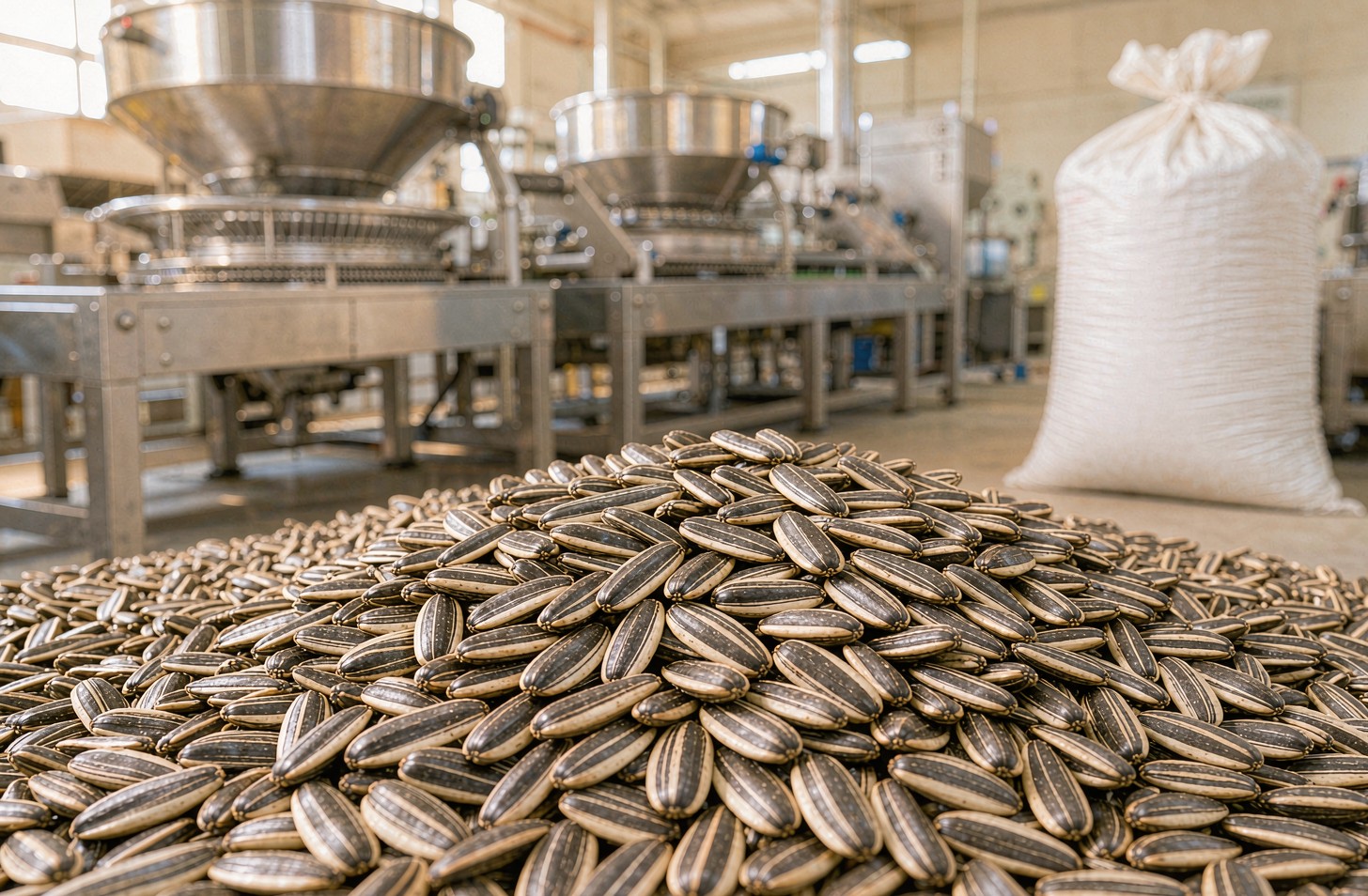
Bulk Sunflower Seeds Supplier China: Specs, Prices & MOQ Guide
Bulk sunflower seeds suppliers in China offer food manufacturers, snack brands, and wholesale distributors a combination of large-scale production, competitive pricing, and export-ready processing. China is the world’s second-largest sunflower seed producer, and Inner Mongolia alone accounts for a major share of global in-shell sunflower seeds supply. For B2B buyers sourcing bulk sunflower seeds from China, the key decisions come down to three things: choosing the right variety (5009, 361, 363, or 601), locking in verifiable specifications (size, purity, moisture), and structuring the order — FOB vs CIF, FCL vs LCL — around a supplier with real processing capacity, not just trading middlemen. This guide walks you through the exact specifications, price drivers, MOQ expectations, and verification steps used by professional importers, so you can request an accurate quotation and avoid costly sourcing mistakes.
Why Importers Source Bulk Sunflower Seeds from China
China’s advantage in the sunflower seed export trade rests on three structural factors:
- Production scale: Inner Mongolia, Xinjiang, and Northeast China form a contiguous growing belt with millions of hectares planted annually. Inner Mongolia — where Ouji International is based in Hohhot — produces the large-sized, uniformly striped seeds that global snack brands prefer for roasting and flavoring.
- Cost competitiveness: Compared with Eastern European or Argentine origins, Chinese bulk sunflower seeds typically deliver a 10–20% landed-cost advantage on comparable grades, driven by mechanized harvesting, lower farm-gate prices, and mature export logistics.
- Processing maturity: Modern Chinese plants run gravity separators, de-stoners, color sorters, and X-ray or laser inspection lines. A factory with 6 automated processing lines — like our two facilities established since 2013 — can grade and pack a 20-ton order to a single specification with consistent lot-to-lot quality.
The FAO tracks sunflower seed production globally, and China consistently ranks among the top origins by volume (FAOSTAT), which is why buyers from the Middle East, North Africa, Europe, Southeast Asia, and the Americas all maintain long-term Chinese supply programs.
Main Sunflower Seed Varieties for Bulk Export
Not all sunflower seeds are interchangeable. Chinese exporters classify in-shell sunflower seeds by cultivar and size, and your choice directly affects pricing, packaging yield, and end-market fit. The four most exported types are:
| Variety | Typical Size | Shell Pattern | Best For | Relative Price |
|---|---|---|---|---|
| 5009 | 24/64″ – 22/64″ (large) | Black & white stripes, bold | Roasted in-shell snacks, flavored seeds (Middle East, Turkey, Russia markets) | Mid to high |
| 361 | 22/64″ – 20/64″ | Striped, uniform | General roasted snack market, retail packaging | Mid |
| 363 | 20/64″ – 18/64″ | Striped, slightly smaller | Cost-sensitive bulk roasting, bird feed blends | Economy |
| 601 | 22/64″ – 20/64″ | Black & white, high gloss | Premium retail brands, bakery toppings | High |
Size is measured in sieve size (inches of width, written as fractions like 22/64″). Larger seeds command higher prices but also deliver better per-bag appearance for retail. When requesting quotes, always specify variety + size — “5009, 22/64″ up” is the single most information-dense line you can put in an RFQ.
Bulk Sunflower Seeds Specifications and Quality Standards
Professional importers never accept a supplier quote without a written specification sheet. Below is a typical export-grade specification table for in-shell sunflower seeds, aligned with common inspection practice:
| Parameter | Export Standard | Test Method |
|---|---|---|
| Purity (seeds of the stated variety) | ≥ 99.0% – 99.5% | Manual sieve & visual sampling |
| Moisture | ≤ 9.0% | Moisture analyzer |
| Broken / damaged kernels (in-shell) | ≤ 1.0% | Sample counting per 500g |
| Foreign matter | ≤ 0.3% | Sieve analysis |
| Immature / shriveled seeds | ≤ 1.5% | Visual inspection |
| Aflatoxin | Per destination-market limit (e.g., EU < 4 ppb B1) | Third-party lab (SGS / Eurofins) |
| Salmonella / TVC | Absent / per contract | Third-party lab |
Food safety compliance matters more than price in regulated markets. A credible supplier should hold ISO 22000 / HACCP-certified processing (read about the ISO 22000 food safety standard) and willingly provide phytosanitary certificates, certificates of origin, and pre-shipment third-party inspection. If a “factory” hesitates to share its certification documents, treat that as a red flag before you negotiate on price.
Confectionery vs Oil-Type: Know the Difference
Export in-shell seeds are confectionery (edible) types — large striped seeds bred for eating, with lower oil content and thicker shells. Oil-type black seeds are smaller, thinner-shelled, and destined for crushing plants; they trade on oil yield, not size. Mixing the two in an RFQ is one of the most common rookie mistakes and immediately distorts quotes by 20–30%.
How Bulk Sunflower Seed Pricing Works
Chinese bulk sunflower seed prices are quoted per metric ton, typically FOB a Chinese port (Tianjin, Qingdao, or Shanghai). Five factors move the number you receive:
- New-crop timing: Harvest runs September–October. Prices soften right after harvest and tighten through the spring as inventories draw down. Buying in October–December usually secures the year’s best basis.
- Variety and size grade: Each step up in sieve size adds a premium; 5009 large grades can run 15–25% above 363 economy grades.
- Specification strictness: Pushing purity from 99% to 99.5% requires extra sorting passes — expect a measurable price impact.
- Freight market: CIF quotes embed ocean freight, which can swing more than the product itself during rate volatility. Always ask for FOB and freight broken out separately.
- Order volume: Full-container orders get materially better pricing than LCL (less-than-container) consolidations.
Typical Container Loading for In-Shell Sunflower Seeds
| Packaging | 20′ FCL | 40′ FCL |
|---|---|---|
| 25 kg PP woven bags | ~17–18 MT | ~25–26 MT (weight-limited) |
| 50 kg PP woven bags | ~17 MT | ~24–25 MT |
| 1 MT jumbo bags | ~17 MT | ~24 MT |
| 10 kg cartons (retail-ready) | ~13–14 MT | ~20–22 MT |
Because seeds are light but bulky, 40′ containers are usually volume-limited before they are weight-limited — your supplier should confirm the exact loadable quantity against your bag size before issuing a final quote.
MOQ and Order Structure Expectations
What should you expect as a realistic minimum order quantity when dealing with an established Chinese bulk sunflower seed supplier?
- First trial order: 1–5 MT via LCL, or a mixed container with other products, is commonly accepted — enough to test quality without overcommitting.
- Regular FCL orders: One 20′ container (~17 MT) is the industry’s standard commercial unit; repeated FCL buyers unlock the best price tiers.
- Annual contracts: Large snack manufacturers often lock 200–500 MT per year across multiple shipments, with quarterly price reviews indexed to the Inner Mongolia farm-gate market.
Payment terms in this trade typically start at 30% T/T advance + 70% against B/L copy. Established relationships can evolve to LC at sight or partial DP. Insist on pre-shipment inspection rights (SGS, Intertek, or your own representative) in the contract — serious suppliers welcome it.
How to Verify a Reliable Bulk Supplier in China
Before wiring an advance payment, run this five-point verification checklist — the same one we recommend in our China nuts supplier export guide:
- Confirm factory vs trading company: Ask for business license, processing equipment list, and a live video walk-through of the sorting and packing lines. Factories will show you their lines; intermediaries will deflect.
- Demand traceable specification sheets: Every quotation should reference variety, sieve size, purity, moisture, and packing — in writing.
- Order pre-shipment samples: A serious supplier sends 1–2 kg samples free of charge (freight collect) and stands behind what ships matching the approved sample.
- Check export history: Ask which markets they currently ship to and request references or copies of phytosanitary certificates from past shipments.
- Verify certifications: ISO 22000, HACCP, HALAL, and Kosher certificates should carry valid dates and audit bodies you can verify independently.
Why B2B Buyers Choose Ouji International
Founded in 2013 in Hohhot, Inner Mongolia — the heart of China’s sunflower seed belt — Hohhot Ouji International Co., Ltd. operates two processing plants with six automated production lines, covering walnuts, walnut kernels, pecans, cashews, pumpkin seeds, and sunflower seeds. Our export program serves wholesale distributors and food manufacturers across Europe, the United States, Japan, South Korea, the Middle East, North Africa, and South America.
- Origin advantage: Direct sourcing from Inner Mongolia farms means fresher new-crop stock and tighter price control.
- Machine-sorted consistency: Gravity separation, color sorting, and manual QC lines deliver 99%+ purity lots, shipment after shipment.
- Flexible bulk formats: From 25 kg export bags to jumbo bags and retail-ready cartons, packed to your market’s requirement.
- Full export documentation: Phytosanitary certificate, certificate of origin, COA, and third-party inspection arranged per shipment.
Ready to price your first container? Send your target variety, size grade, and destination port, and our export team will return a detailed FOB/CIF quotation with specification sheet within one business day. Contact Ouji International to start your bulk sunflower seed sourcing program.
FAQ: Bulk Sunflower Seeds from China
What is the MOQ for bulk sunflower seeds from China?
Most established suppliers accept 1–5 MT for a trial LCL order. Standard commercial pricing applies from one 20′ container (~17 MT). Annual contract buyers of 200 MT+ receive the most competitive tiers.
Which sunflower seed variety is best for roasting and snack brands?
For in-shell roasted snacks, the 5009 variety in 22/64″ or larger is the global benchmark — large, bold-striped seeds that roast evenly and present well in retail packaging. The 601 variety suits premium brands; 361 and 363 fit cost-sensitive programs.
How are sunflower seeds packed for export?
Standard export packing is 25 kg or 50 kg PP woven bags, or 1 MT jumbo bags for industrial buyers. Retail-ready formats (vacuum bags, 10 kg cartons) are available on request. Bags are loaded into 20′ or 40′ FCL containers.
What quality certificates should a Chinese sunflower seed supplier provide?
At minimum: phytosanitary certificate, certificate of origin, and a certificate of analysis. For food-safety assurance, look for ISO 22000/HACCP-certified processing, plus HALAL and Kosher where your market requires them. Aflatoxin and microbiology results should come from third-party labs like SGS.
How long does production and shipping take?
Production for a standard FCL typically takes 7–15 days after deposit, depending on the season. Ocean transit ranges from 20 days (Middle East) to 35–45 days (Europe, Americas). Confirm lead time against new-crop availability between October and March.
Can I mix sunflower seeds with other nuts in one container?
Yes. Mixed-container orders — for example, sunflower seeds with pumpkin seeds or walnut kernels — are common for first-time buyers and help you consolidate freight while testing multiple product lines.