

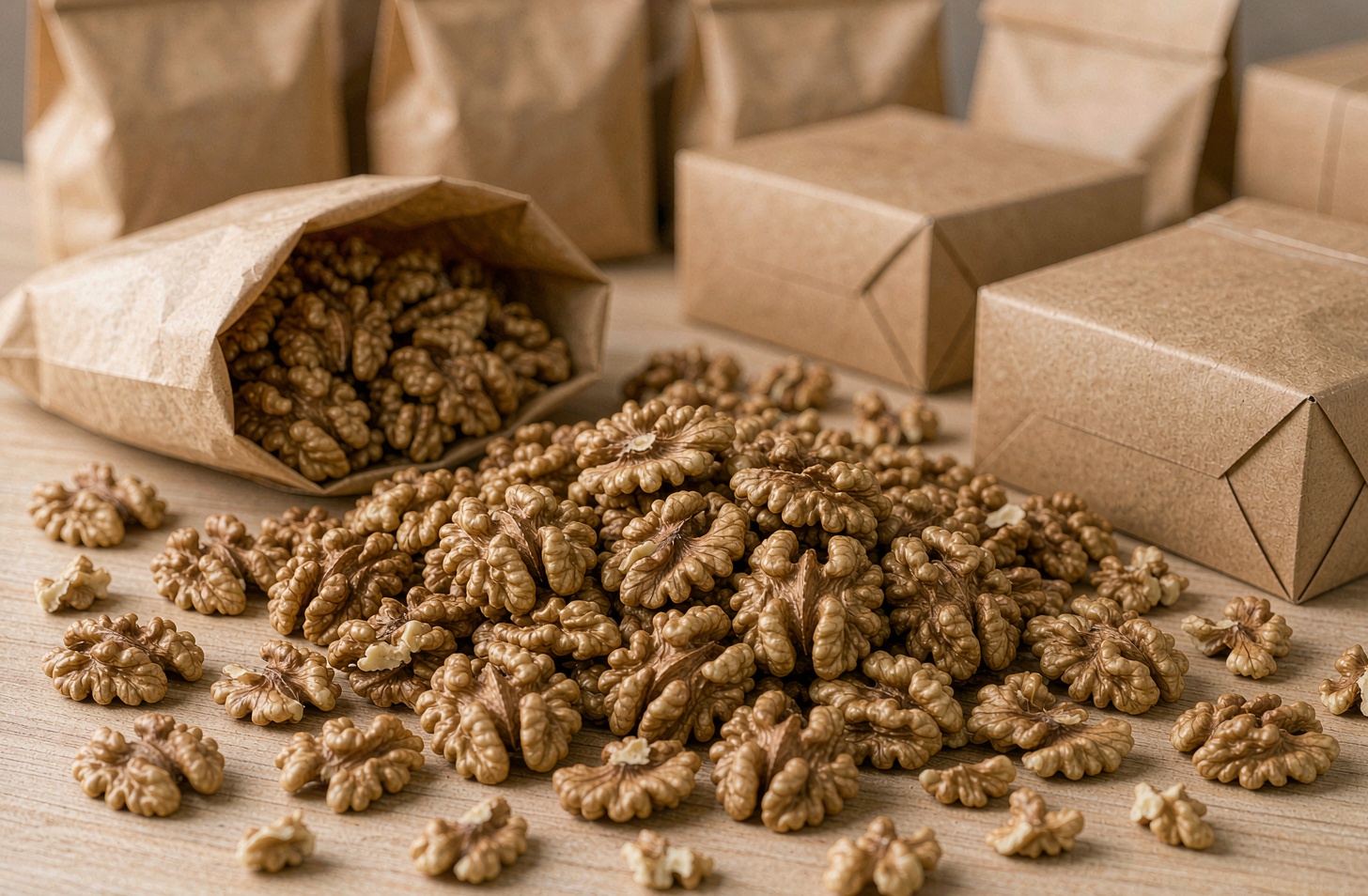
Bulk Walnut Kernels Exporter from China | Ouji International
A bulk walnut kernels exporter is the bridge between Chinese processing plants and overseas food manufacturers, snack brands, and wholesale distributors. Buying walnut kernels in container quantities is not only about price — it is about consistent grade, clean flavor, intact halves, and export paperwork that clears customs without surprises. China is one of the world’s largest walnut origins, and Inner Mongolia in particular produces light-colored, plump kernels that are prized by bakers, confectioners, and nut roasters across Europe, the Middle East, North Africa, and the Americas. This guide explains what a professional exporter does, which grades and certifications matter, and how to evaluate a partner before you place your first bulk order.
Whether you need light halves, amber pieces, or crushed walnut meal for bakery, ice cream, cereal, or retail packs, the same sourcing rules apply: verify the plant, lock the specification, inspect before shipment, and choose an exporter with real production ties.
Why Source Bulk Walnut Kernels from China
China produces roughly half of the world’s walnuts, with major growing belts in Xinjiang, Yunnan, Shanxi, Shaanxi, and Inner Mongolia. Chinese walnut kernels are attractive to importers because they combine scale, variety, and competitive cost structure:
- Multiple varieties in one supply base — 185, Xinjiang No. 2, Yunfeng, and other cultivars offer different shell thicknesses, kernel colors, and oil contents;
- Large processing clusters — modern cracking, sorting, and vacuum-packing lines can handle multi-container orders;
- Year-round availability — cold storage and rotation from different harvest windows keep supply steady;
- Flexible sizing — exporters can supply light halves, mixed pieces, quarter pieces, and meal according to end-use;
- Competitive export pricing — integrated farm-to-factory supply chains reduce handling markups.
The real challenge for overseas buyers is not origin but batch consistency. Kernel color, fat oxidation, and breakage rate can vary between harvests and between processors. A reliable bulk walnut kernels exporter controls these variables with standardized receiving, grading, and pre-shipment inspection.
What a Bulk Walnut Kernels Exporter Actually Does
Not every company that sells walnuts is an exporter. The difference shows up in capability and accountability:
- Raw material sourcing — direct contracts with farms or cooperatives rather than spot purchases from traders;
- Cracking and shelling — mechanical or semi-mechanical lines designed to keep halves intact;
- Grading and color sorting — separating light halves from amber pieces and removing shell fragments;
- Metal detection and X-ray — critical for food-manufacturing customers;
- Vacuum packing and nitrogen flushing — extends shelf life during ocean freight;
- Export documentation — phytosanitary certificates, certificates of origin, HALAL/Kosher letters, and third-party inspection reports.
When you work with a true exporter, you are buying a finished export product, not just a commodity. That is why the same grade name — “light halves” — can look very different from one supplier to another.
Common Grades and Specifications for Bulk Walnut Kernels
| Grade | Description | Typical Use |
|---|---|---|
| Light Halves | Pale golden, mostly intact half kernels; low broken rate | Retail snack packs, premium baking, gift boxes |
| Light Pieces | Smaller light-colored pieces from sizing | Bakery mixes, granola, cereals |
| Amber Halves | Darker kernels; stronger flavor | Food manufacturing, roasting, oil pressing |
| Amber Pieces | Darker broken kernels | Confectionery, fillings, nut butters |
| Walnut Meal / Chips | Crushed kernels or small fragments | Bread, pastries, desserts, animal feed |
Beyond grade, every export contract should list the parameters that affect price and usability:
| Parameter | Common Export Standard |
|---|---|
| Moisture | ≤ 6–8% |
| Broken rate | ≤ 5–10% (varies by grade) |
| Shell / foreign matter | ≤ 0.5% |
| Peroxide value | ≤ 5 meq O₂/kg for fresh kernels |
| Aflatoxin B1 | ≤ 2–5 µg/kg depending on destination regulation |
| Packing | 10 kg / 12.5 kg / 20 kg vacuum cartons, or custom retail packs |
| Shelf life | 12 months under cool, dry, dark storage |
Certifications Every Importer Should Request
Food safety documentation is non-negotiable for walnut kernels. At minimum, a bulk walnut kernels exporter should provide:
- HACCP and/or ISO 22000 — food-safety management systems covering the cracking and packing plant;
- ISO 9001 — quality management baseline;
- HALAL certificate — required for Middle East, North Africa, and Southeast Asian markets;
- Kosher certificate — needed for Jewish-market retail and food manufacturers;
- BRC / IFS — increasingly requested by European retailers and private-label brands;
- Third-party test reports — SGS, Bureau Veritas, or Intertek checks for aflatoxin, pesticides, and heavy metals.
Always confirm the certificate scope, validity date, and certifying body. A certificate issued for a trading office but not the processing plant is a red flag.
How to Evaluate a Bulk Walnut Kernels Exporter
1. Check Production Integration
Ask whether the exporter owns or works under long-term contract with cracking and sorting plants. Integrated exporters can control moisture, breakage, and packing far better than pure traders.
2. Request Samples and a Specification Sheet
Do not buy from photos. A professional exporter will send:
- A sealed sample matching the quoted grade;
- A signed specification sheet with grade, moisture, broken rate, and admixture limits;
- A current certificate copy or third-party test report.
3. Start with a Trial Order
Even a 1-ton trial shipment reveals more than ten video calls. Inspect the arrival lot for color, smell, texture, broken rate, and packaging integrity before scaling to container volume.
4. Confirm Export Experience in Your Region
Different markets have different phytosanitary and labeling rules. An exporter that regularly ships to Europe, the Middle East, or North America will already know the paperwork and transit requirements.
5. Agree on Inspection Terms
Include a pre-shipment inspection clause by a recognized third party. This protects both sides and is standard practice for bulk nut exports.
Red Flags to Avoid
- Prices significantly below the market range — quality is usually cut somewhere;
- Refusal to provide a physical sample or third-party certificate;
- Vague answers about processing plant location or ownership;
- No traceability — inability to state harvest region or lot number;
- Pressure for 100% advance payment on a first order;
- Packing that lacks batch code, production date, or storage instructions.
Why Ouji International Is a Trusted Bulk Walnut Kernels Exporter
Hohhot Ouji International Co., Ltd. (Ouji International) is an agricultural food exporter headquartered in Hohhot, Inner Mongolia, in the heart of China’s walnut and nut-processing corridor. Since 2013, the company has operated 2 production processing plants and 6 automatic production lines, supplying walnut kernels, walnuts, pecans, cashews, pumpkin seeds, and sunflower seeds to buyers in Europe, the Americas, Japan and South Korea, the Middle East, North Africa, and South America.
For buyers looking for a reliable bulk walnut kernels exporter, Ouji offers:
- Origin control — sourcing from established growing regions with harvest-window planning;
- Integrated processing — cracking, grading, color sorting, metal detection, and vacuum packing under managed plants;
- Grade flexibility — light halves, light pieces, amber pieces, and meal supplied to bakery, snack, and manufacturing specs;
- Certification support — HALAL, Kosher, HACCP, ISO, and third-party inspection coordination;
- Export-ready documentation — full customs paperwork and market-specific certificates;
- Multi-time-zone service — fast quotes, sample dispatch, and after-sales follow-up.
Frequently Asked Questions
What is a bulk walnut kernels exporter?
A bulk walnut kernels exporter is a company that purchases, processes, grades, packs, and ships large volumes of walnut kernels — typically measured in tons or containers — from one country to importers, food manufacturers, and distributors in another.
What is the minimum order for bulk walnut kernels?
Most exporters accept trial orders of 1–5 tons. Full container loads usually start at 10–12 tons for vacuum cartons, depending on packing density and grade.
Which walnut kernel grade is best for baking?
Light halves are preferred for premium bakery and confectionery because of their appearance and mild flavor. Light pieces or amber pieces work well for mixes, fillings, and cereals where visual uniformity is less critical.
How do I keep walnut kernels fresh during shipping?
Vacuum packing with nitrogen flushing, moisture below 7%, and cool container storage are the standard methods. Once opened, kernels should be stored in a cool, dry place and used within the stated shelf life.
Do I need HALAL or Kosher certification for walnut kernels?
If you supply Middle Eastern, North African, Southeast Asian, or Jewish-market customers, yes. Most serious buyers in these regions will request HALAL or Kosher certificates as part of their supplier approval process.
How can I verify a Chinese walnut kernels exporter is reliable?
Request samples and certificates, place a small trial order, arrange third-party pre-shipment inspection, and — if volume justifies it — conduct a factory audit or live video tour. A trustworthy exporter will welcome all four steps.
Conclusion
Choosing the right bulk walnut kernels exporter means looking beyond price to grade consistency, food-safety certification, processing capability, and export experience. The best partners control their supply chain from raw nut to packed carton, provide clear specifications, and support every shipment with proper documentation and third-party verification.
If you are sourcing light halves, light pieces, amber pieces, or walnut meal in bulk, contact Ouji International for samples, current specifications, and export pricing. We help importers match the right kernel grade to their market and deliver it reliably anywhere in the world.