

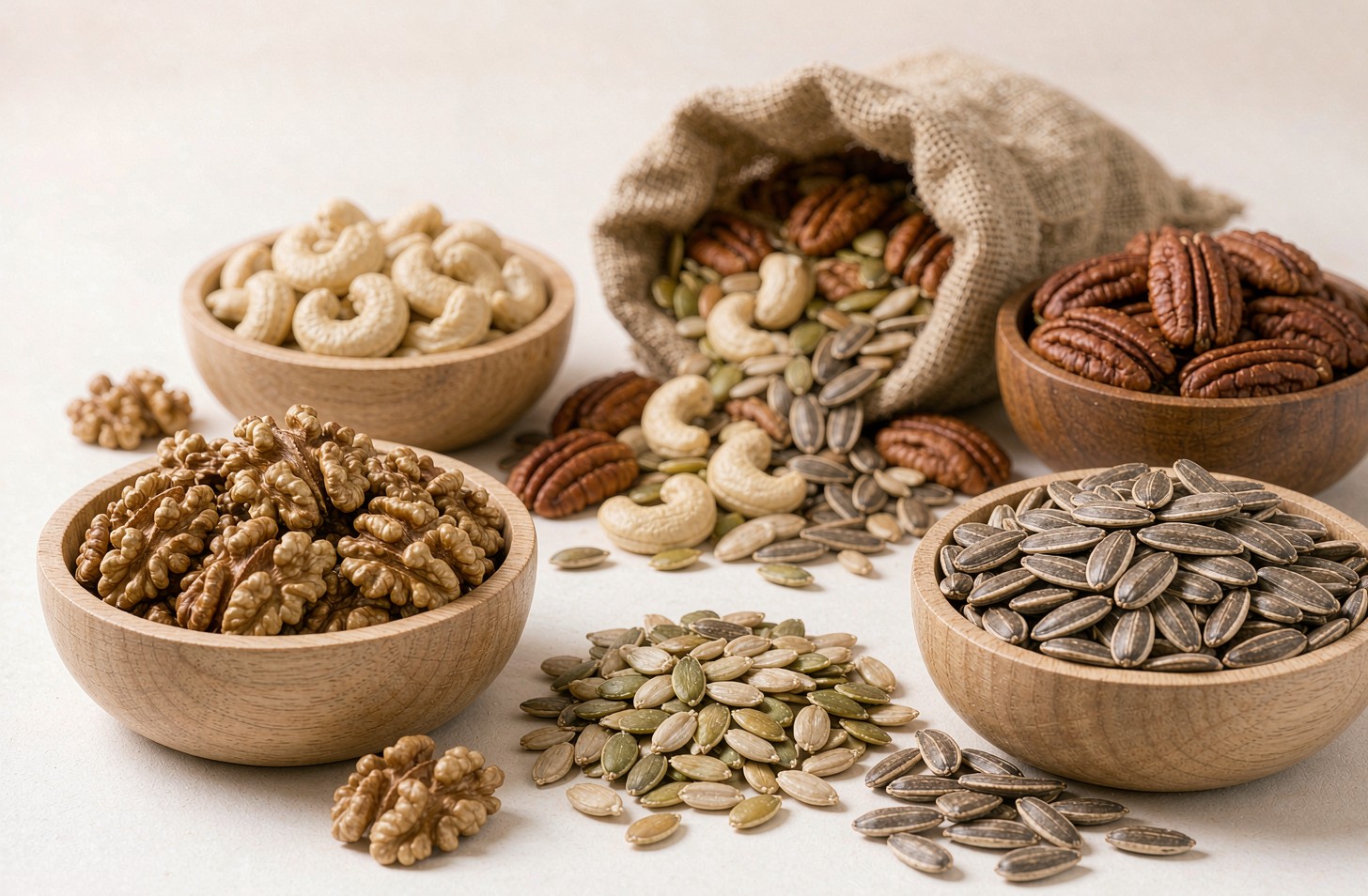
Choosing the right China nuts export company is the single most important decision an importer makes when sourcing walnuts, cashews, pecans, pumpkin seeds, or sunflower seeds from China. A professional export company does far more than move cartons: it controls raw-material sourcing, runs food-grade processing, manages certifications such as HACCP and ISO 22000, and handles the full documentation chain from phytosanitary certificates to bills of lading. This guide explains what a Chinese nuts export company actually does, how it differs from a local trader, which capabilities you should verify before signing a contract, and how to structure a long-term supply partnership that protects your quality and your margins.
When buyers search for a China nuts export company, they are usually looking for a partner that can guarantee three things at once: stable food safety compliance, consistent product specifications, and reliable export logistics. China is one of the world’s largest producers and exporters of tree nuts and edible seeds — walnuts, pumpkin seeds, and sunflower seeds in particular — yet quality varies widely between suppliers. This article breaks down the role of a professional export company, the certifications and documents involved, a practical vetting checklist, and the red flags that should stop a deal. Whether you are a first-time importer or an established distributor looking to consolidate suppliers, the framework below will help you evaluate any Chinese nuts export company with confidence.
What Does a China Nuts Export Company Actually Do?
Many overseas buyers assume an export company is simply a middleman. In reality, a serious nuts export company in China sits at the center of the entire supply chain and takes responsibility for five functions:
- Raw material sourcing: contracting with farms and aggregators in key growing regions — for example, Inner Mongolia for sunflower seeds and pumpkin seeds, and Yunnan and Xinjiang for walnuts — to lock in volume, variety, and harvest-year quality.
- Processing and grading: shelling, size sorting, color sorting, machine sorting, and hand-picking quality control lines that bring kernels to export specifications.
- Quality control and certification: laboratory testing for moisture, aflatoxin, peroxide value, and microbiology; maintaining HACCP, ISO, HALAL, and Kosher programs where required.
- Export documentation: commercial invoice, packing list, certificate of origin, phytosanitary certificate, health certificate, and bill of lading — the paper chain that decides whether your cargo clears customs smoothly.
- Logistics coordination: FCL and LCL container loading plans, fumigation, desiccant and liner-bag packing, and coordination with freight forwarders to meet your delivery windows.
The practical difference shows up when something goes wrong. A factory that only sells domestically may not know how to respond to a customs query in Hamburg or a quality claim in Dubai. A dedicated export company builds that response capability into its daily operations.
China’s Position in the Global Nuts and Seeds Trade
Understanding the supply landscape helps you judge whether a prospective partner is genuinely integrated into it. China is a top-three global producer for several of the products an export company would offer:
| Product | China’s Global Position | Key Production Regions | Typical Export Forms |
|---|---|---|---|
| Walnuts & walnut kernels | World’s largest producer | Xinjiang, Yunnan, Shaanxi | In-shell, light halves, quarters, pieces |
| Pumpkin seeds (Shine Skin, GWS) | Leading producer and exporter | Inner Mongolia, Northeast China | In-shell, kernels, roasted |
| Sunflower seeds (5009, 361, 363, 601) | Top global exporter | Inner Mongolia, Xinjiang | In-shell roasted, bakery-grade kernels |
| Cashews | Major re-processor and exporter | Imported raw, processed domestically | W180–W320 grades, splits |
| Pecans | Growing producer | Yunnan, Anhui, Jiangsu | In-shell, shelled halves |
Regional specialization matters. An export company headquartered in Hohhot, Inner Mongolia — the heart of China’s sunflower and pumpkin seed belt — has shorter, more controllable raw-material chains for seeds than a coastal trading firm buying on the spot market.
Export Company vs. Trading Company vs. Direct Factory
B2B buyers often debate whether to buy from a factory, a trader, or an export company. In the nuts sector the lines blur — many of the best exporters are themselves manufacturers with export licenses — but the roles differ in important ways:
| Criteria | Direct Factory (No Export Team) | Pure Trading Company | Manufacturer-Exporter |
|---|---|---|---|
| Controls processing quality | Yes, but limited to its line | No — depends on sub-suppliers | Yes, full control |
| Export documentation experience | Often weak | Strong | Strong |
| Multi-product sourcing | Single product only | Yes, but unverified sources | Core products + vetted partners |
| Price transparency | Good | Markup can be hidden | Good, with processing value shown |
| Claim response and re-shipment | Slow, inconsistent | Fast on paper, weak on product | Fast and accountable |
For most importers, a manufacturer-exporter — a company that processes in-house and exports directly — offers the best balance of price, quality control, and paperwork reliability.
How to Vet a China Nuts Export Company: A 10-Point Checklist
1. Verify Business Scope and Export History
Ask for the company’s business license, customs registration, and years of export experience. A company exporting since the early 2010s — for example, one founded in 2013 with more than a decade of shipments to Europe, North America, Japan, Korea, the Middle East, North Africa, and South America — has already survived multiple quality audits and market cycles.
2. Inspect Processing Capability
Request a live or recorded video factory tour. Look for dedicated sorting lines, metal detection, X-ray inspection, and separate storage for raw materials and finished goods. A company running multiple automatic production lines across more than one plant can absorb seasonal volume spikes without dropping your order.
3. Confirm Food Safety Certifications
Ask for certificates, not slogans: HACCP, ISO 22000, HALAL, Kosher, and — where applicable — organic certification. Cross-check certificate numbers against the issuing bodies. Reference standards such as ISO 22000 food safety management to understand what the certification actually covers.
4. Demand a Written Specification Sheet
Every quotation should come with a spec sheet: variety, size count, moisture, defects, admixture, and packaging. For pumpkin and sunflower seeds this includes variety (e.g., Shine Skin vs. GWS; 5009 vs. 361) and purity percentage. No spec sheet, no deal.
5. Test Before You Commit
Order samples from the actual production lot, not a “showroom sample.” Retain a sealed counter-sample from the same batch as the contractual quality reference.
6. Review Third-Party Inspection Options
Professional exporters welcome pre-shipment inspection by SGS, Bureau Veritas, or an inspector you appoint. Resistance to third-party inspection is a serious red flag.
7. Check Documentation Competence
Ask for redacted copies of a recent export file set: invoice, packing list, phytosanitary certificate, certificate of origin, and B/L. Errors in this chain cost demurrage and customs delays. Global bodies such as the FAO and national plant-protection authorities govern the phytosanitary requirements your documents must satisfy.
8. Clarify Incoterms and Payment Terms
Most nuts shipments move on FOB or CIF terms with 30% T/T deposit and balance against B/L copy, or L/C for larger volumes. Confirm who arranges fumigation, container stuffing, and insurance.
9. Understand Container Loading Economics
Know your numbers before negotiating: a 20ft container typically carries around 17–19 MT of kernels in bags, while in-shell sunflower seeds may load lighter due to volume. Ask the supplier for their standard loading plan per product.
10. Start Small, Scale Fast
Structure the first order as a trial — one LCL or a mixed container — with clearly agreed specs, then scale to FCL programs once the first two or three shipments land clean.
Red Flags When Evaluating Suppliers
- Prices dramatically below the market range for the stated grade — usually old-crop stock or downgraded goods.
- Reluctance to show the processing facility on video or host an on-site audit.
- Certificates whose numbers cannot be verified, or certifications “in progress” during peak sales season.
- No written spec sheet, or specs that change between quotation and contract.
- One-person operations with no QC staff, no lab access, and no third-party inspection experience.
Why Importers Choose Ouji International
Ouji International (Hohhot Ouji International Co., Ltd.) is a manufacturer-exporter built specifically for this trade model. Founded in 2013 and headquartered in Hohhot, Inner Mongolia — at the center of China’s premium sunflower and pumpkin seed growing region — the company operates two processing plants with six automatic production lines, supplying:
- Walnuts and walnut kernels — in-shell and machine-sorted kernels in all standard grades
- Pumpkin seeds — Shine Skin and GWS, in-shell and kernels, 99%+ purity grades
- Sunflower seeds — 5009, 361, 363, and 601 varieties for roasting and bakery use
- Cashews and pecans — graded kernels for retail and food-industry buyers
With HALAL and Kosher programs in place and long-term shipments to the EU, North America, Japan, Korea, the Middle East, North Africa, and South America, Ouji combines Inner Mongolia raw-material advantage with export-grade processing and documentation. You can review the full product range and specifications on the Ouji International product catalog, or request a quotation with your target grade, volume, and destination port.
Building a Long-Term Supply Partnership
The strongest importers treat their China nuts export company as an extension of their own supply chain:
- Annual contract with seasonal pricing reviews — locks capacity while keeping price exposure fair across the new-crop transition.
- Quarterly quality reports — moisture, defects, and micro results from each shipment build an auditable quality history.
- Joint packaging development — private-label bags, retail-ready formats, and language-specific labeling designed at the factory stage.
- Clear claim resolution terms — agreed inspection windows, evidence standards, and remedy options written into the contract before the first container.
Importers who follow this structure typically move from trial orders to steady monthly or bi-monthly container programs within one season — with fewer disputes and more predictable landed costs.
FAQ
What products can a China nuts export company supply?
A professional exporter typically supplies walnuts, walnut kernels, cashews, pecans, pumpkin seeds, and sunflower seeds — in-shell and kernel forms, in food-grade and export-grade specifications.
How do I verify a Chinese nuts exporter is legitimate?
Check the business license and customs registration, verify certification numbers with issuing bodies, request a video factory audit, and order samples from actual production lots before committing.
What certifications should a nuts export company have?
At minimum HACCP and ISO 22000 food safety management; HALAL and Kosher for relevant markets, and organic certification if you sell into that segment.
What is the minimum order quantity for nuts from China?
Many exporters accept trial LCL orders from 1–5 MT; standard FCL programs are typically 17–19 MT per 20ft container depending on product and packing.
What payment terms are standard with Chinese nut suppliers?
30% T/T deposit with balance against B/L copy is most common; L/C at sight is used for larger contracts. Terms become more flexible as the partnership matures.
How long does shipping take from China to major markets?
Typical transit is 25–35 days to Europe and North America, 15–25 days to the Middle East, and shorter to Japan and Korea, plus production lead time of 1–3 weeks after deposit.
Conclusion
Choosing a China nuts export company is not a price decision — it is a risk-management decision. Focus on processing capability, verifiable certifications, documentation competence, and a supplier’s willingness to be inspected, and you will filter out 90% of the problems importers commonly face. If you are sourcing walnuts, pumpkin seeds, sunflower seeds, cashews, or pecans, contact Ouji International for a specification sheet, samples, and an FCL or LCL quotation tailored to your market.