

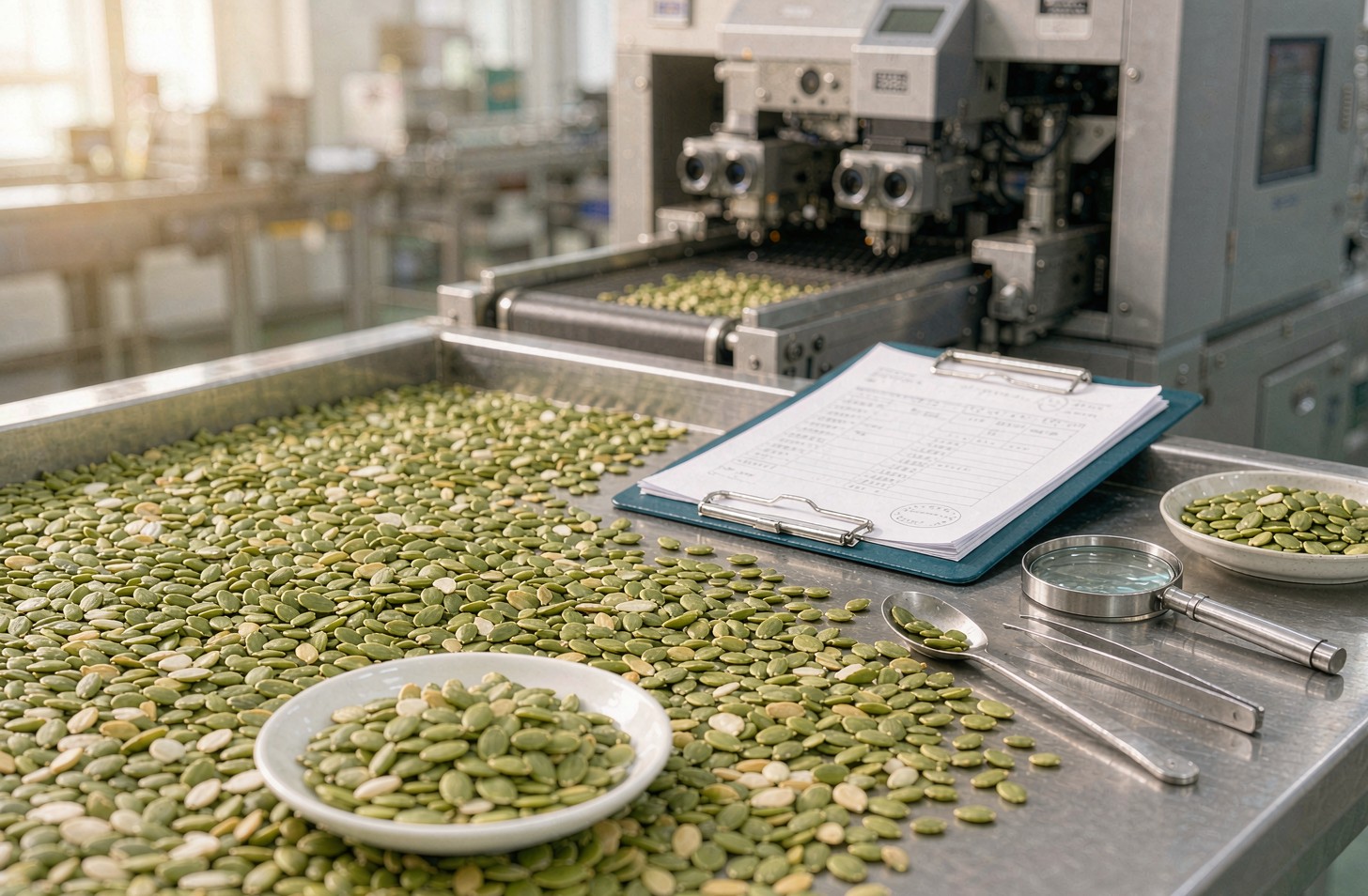
Pumpkin seed quality standards are defined by a short list of measurable parameters: kernel purity (typically 99.5%–99.9% minimum), moisture content (≤ 8%), broken and damaged kernel limits, free fatty acid levels, peroxide value, and strict food-safety ceilings on aflatoxin, pesticide residues, and microbiological contamination. In the Chinese export trade, kernels are graded into AAA, AA, and A classes based on color uniformity, size, and defect count — and every professional purchase order should specify these numbers in a written specification sheet. This guide explains each quality parameter, how grading works, which test methods laboratories use, the compliance limits for major importing markets, and how to verify quality before and after shipment.
For buyers in food manufacturing, bakery, snack, and private-label retail, understanding these standards is the difference between a lot that passes destination inspection and a costly rejection or claim. The reference values below reflect how established exporters — including Ouji International, a pumpkin seed processor and exporter in Hohhot, Inner Mongolia — structure their quality control from raw material intake to container loading.
What Defines Pumpkin Seed Quality? The Key Parameters Explained
Quality in pumpkin seed kernels is judged across three dimensions, and all three belong in your contract:
- Physical quality — purity, size, color, and defect levels;
- Chemical quality — moisture, free fatty acids (FFA), and peroxide value, which together predict shelf life;
- Food safety — aflatoxin, pesticide residues, and microbiology, which are regulated by law in destination markets.
A supplier who can document all three dimensions, lot by lot, is demonstrating real process control. A supplier who only says “top quality” without numbers is asking you to carry all the risk.
The AAA / AA / A Grading System for Pumpkin Seed Kernels
Chinese exporters grade shine skin and hulled kernels into three commercial classes. The exact thresholds vary slightly by supplier, but the table below shows a typical specification sheet used in export contracts:
| Parameter | Grade AAA | Grade AA | Grade A |
|---|---|---|---|
| Purity (whole kernels) | ≥ 99.9% | ≥ 99.5% | ≥ 99.0% |
| Broken kernels | ≤ 1% | ≤ 2% | ≤ 3% |
| Color | Vivid uniform green, glossy | Uniform green, slight variation | Green, minor dull kernels allowed |
| Damaged / spotted kernels | ≤ 0.5% | ≤ 1% | ≤ 2% |
| Best for | Retail packs, premium snack brands | Bakery, food manufacturing | Oil pressing, further processing |
Size grading is a separate specification: shine skin kernels are commonly graded by width (for example 10–11 mm, 11–12 mm, and 12 mm+), which matters for in-shell roasters and uniform retail presentation. Always ask for size distribution on the certificate of analysis, not just “large size”.
Chemical and Physical Specifications That Matter
Beyond visual grading, these measurable parameters determine shelf stability and should appear on every COA:
| Parameter | Typical Export Limit | Why It Matters |
|---|---|---|
| Moisture content | ≤ 8% (7.5% preferred) | Higher moisture drives mold and FFA growth in transit |
| Free fatty acids (as oleic acid) | ≤ 1.0% | Early indicator of rancidity |
| Peroxide value | ≤ 5 meq/kg | Measures oxidation level; rises with age and heat |
| Foreign matter | ≤ 0.1% | Shell fragments, stems, stones |
| Unhulled seeds | ≤ 0.1% | Processing efficiency indicator |
Kernels leaving a modern plant at 7.5% moisture and low FFA have the headroom to survive a 30–45 day ocean transit plus inland distribution and still meet your destination-spec tests on arrival.
Aflatoxin and Pesticide Limits for Major Markets
Food-safety limits are set by destination law, not by supplier preference. Know your market’s requirements before signing:
- European Union: aflatoxin B1 ≤ 2 µg/kg and total aflatoxins ≤ 4 µg/kg for oilseeds under Commission Regulation (EC) No 1881/2006, with maximum residue levels (MRLs) for pesticides set under Regulation (EC) No 396/2005; samples are officially taken at the point of importation for certain consignments;
- United States: FDA action levels for aflatoxins in food (typically 20 ppb total) plus FSMA preventive-controls expectations for foreign suppliers;
- Middle East and North Africa: most Gulf countries align with Codex Alimentarius limits; several require a health certificate and Halal certification;
- Japan and South Korea: strict positive-list pesticide systems — test reports against the destination list are strongly recommended.
Microbiological requirements commonly specified: Salmonella absent in 25 g, E. coli absent, and total plate count within agreed limits. Because kernels are ready-to-eat in most applications, many buyers additionally require a validated heat treatment or sterilization step.
How Quality Is Tested: Methods and Sampling
Reliable numbers depend on correct sampling. A professional process looks like this:
- Raw material intake: moisture and impurity checks on incoming seeds before shelling;
- In-process checks: optical sorters and manual inspection lines remove defects; moisture verified after drying;
- Pre-shipment sampling: samples drawn from multiple bags across the finished lot following a defined pattern (e.g., ISO 24333 for cereals and pulses-style incremental sampling);
- Laboratory testing: moisture by oven or halogen balance, FFA and peroxide value by titration, aflatoxin by HPLC or ELISA quick-test kits, microbiology by plate methods;
- Third-party verification: buyers often appoint SGS, Bureau Veritas, or Intertek for pre-shipment inspection against the agreed specification.
Always request the certificate of analysis (COA) for your specific lot — not a template or an old report — and match the lot number to your packing list.
The Pre-Shipment Quality Checklist for Buyers
Before authorizing shipment, verify every line below:
- Specification sheet signed and referenced in the contract;
- COA for the actual lot: purity, moisture, FFA, peroxide, size distribution;
- Aflatoxin and pesticide results against your destination’s legal limits;
- Microbiology report (Salmonella, E. coli, plate count);
- Third-party inspection report if contracted;
- Bag/carton marking matches: grade, lot number, net weight, packing date;
- Samples retained by both parties for the claim period;
- Photographic or video evidence of loading, if the supplier offers it.
How Ouji International Controls Pumpkin Seed Quality
Hohhot Ouji International Co., Ltd., established in 2013, operates 2 processing plants with 6 automatic production lines in Inner Mongolia — the world’s leading pumpkin seed growing region. Its quality system covers the full chain: farm-gate sourcing inside the growing belt, gravity and color-sorting equipment, hand-inspection lines for premium grades, metal detection, and lot-level laboratory testing with COAs issued per shipment. The company exports AAA/AA/A grade shine skin, GWS, and hulled pumpkin kernels to Europe, the Americas, the Middle East, North Africa, Japan, and South Korea — alongside its walnut kernel, cashew, and sunflower seed product lines, all listed on the Ouji International website.
Buyers are welcome to request samples with COAs before ordering, and to appoint third-party inspection before container loading — a supplier confident in its process will agree.
Frequently Asked Questions
What is the standard purity for export pumpkin seed kernels?
Export contracts typically specify 99.5%–99.9% purity for AAA and AA grades, with A grade at 99.0%. Purity counts whole, intact kernels as a percentage of the sample.
What moisture level should pumpkin seed kernels be shipped at?
8% maximum is the common contract limit; 7.5% or below is preferred for long transits and humid destinations. Higher moisture accelerates mold and free fatty acid development.
What is the aflatoxin limit for pumpkin seeds in the EU?
EU Regulation 1881/2006 sets aflatoxin B1 at 2 µg/kg and total aflatoxins at 4 µg/kg for oilseeds. Shipments are checked against these limits at import.
What is the difference between AAA and AA grade kernels?
AAA grade allows fewer broken and defective kernels (≤ 1% broken, ≤ 0.5% damaged) with vivid uniform color, and commands a premium. AA grade permits slightly more defects and is the workhorse grade for bakery and industrial use.
How do I verify quality before shipment?
Require a lot-specific COA, appoint third-party inspection (SGS, BV, Intertek) against your signed specification sheet, and keep counter-samples for the claim period.
Do pumpkin seed kernels need to be pasteurized?
For ready-to-eat applications in stricter markets, a validated heat treatment or sterilization step is often required by the buyer’s food-safety plan. Discuss this during sourcing, as it affects cost and shelf life.
Conclusion: Buy Against Numbers, Not Promises
Pumpkin seed quality is not an adjective — it is a specification sheet. Define purity, moisture, FFA, peroxide value, grading, and food-safety limits in writing; test against destination-market law; and verify with third-party inspection before loading. Buyers who follow this process consistently receive lots that pass destination inspection and keep their customers’ trust.
Need AAA-grade shine skin or hulled pumpkin kernels with full COA documentation? Contact Ouji International for samples, a specification sheet, and a quotation tailored to your market.