

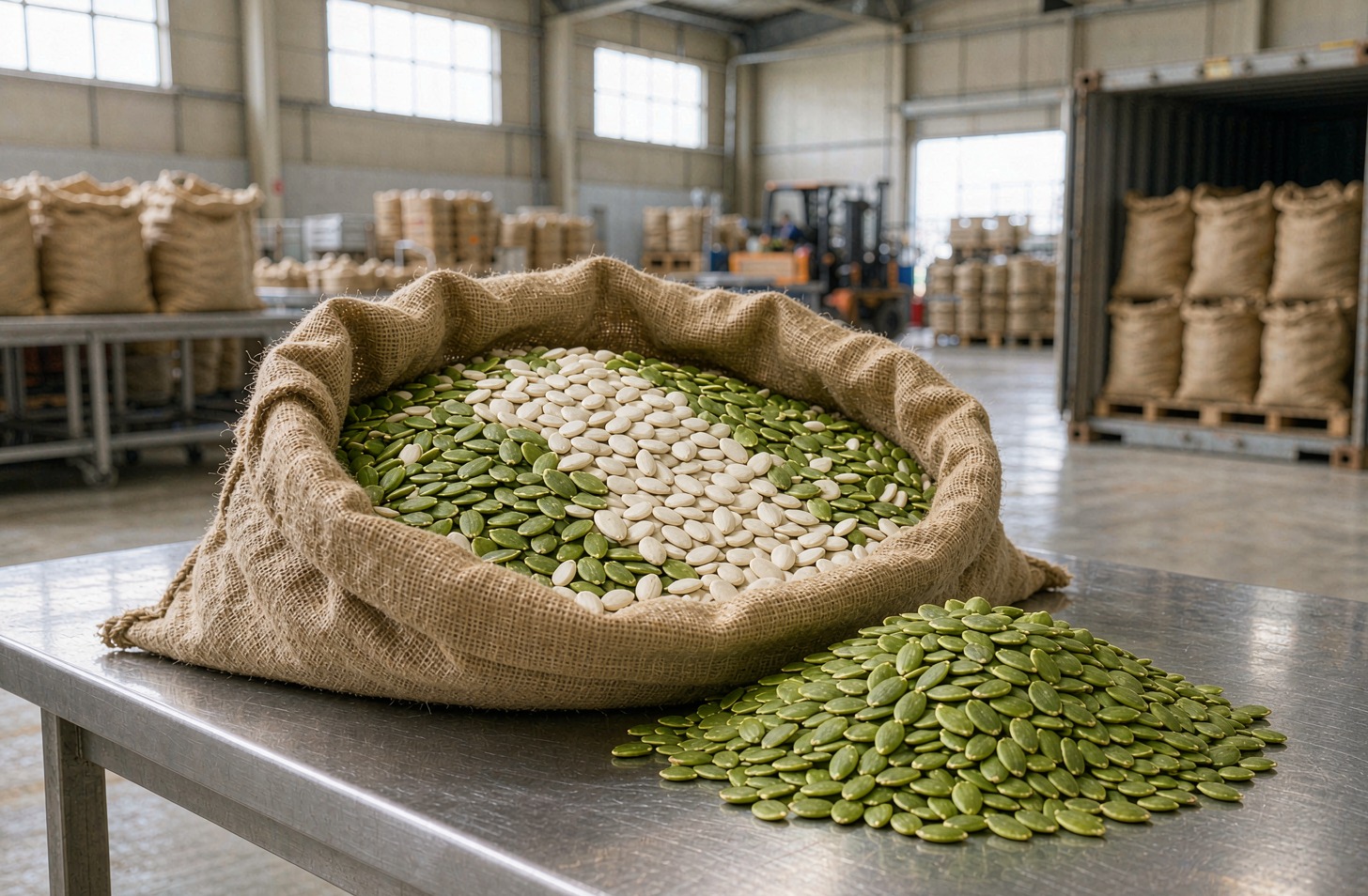
How to Import Pumpkin Seeds from China: Step-by-Step Guide
Importing pumpkin seeds from China involves six core steps: confirming the variety and specification you need, vetting an export-ready supplier, approving pre-shipment samples, agreeing on Incoterms and payment terms, clearing the shipment through customs with complete documentation, and inspecting quality on arrival. China — especially Inner Mongolia, where dry summers and long sunshine hours produce plump, uniform seeds — is one of the world’s most reliable origins for Shine Skin, GWS, Snow White, and hulled pumpkin seed kernels. This guide walks you through the entire import process so that your first container, or your fiftieth, arrives with no surprises.
Whether you are a food manufacturer, a wholesale distributor, or a trading company buying for roasting plants and snack brands in Europe, the Middle East, or the Americas, the workflow below covers what actually matters: documents, timelines, costs, and the checkpoints that prevent quality disputes.
Why Import Pumpkin Seeds from China
China is a leading global exporter of pumpkin seeds and kernels, and its production is concentrated in Inner Mongolia, Xinjiang, and Gansu. Buyers choose Chinese origin for three practical reasons:
- Scale and price stability — large-scale cultivation keeps costs competitive across the crop year, and established export channels mean predictable supply;
- Variety range in one origin — Shine Skin, GWS, Snow White, and green kernels are all produced and processed in the same region, which simplifies mixed-container sourcing;
- Processing maturity — modern plants run automatic cleaning, sieving, color sorting, and metal detection lines, so buyers receive graded, export-ready lots rather than raw farm goods.
The FAO statistics consistently place China among the top world producers of pumpkins and squash, which underpins the depth of the supply chain behind every export quote.
Step 1: Define Your Variety, Specification, and Use Case
Every smooth import starts with a written specification. Before you contact any supplier, decide:
- Variety — Shine Skin (high-gloss, light green shell; the most widely traded type), GWS (snow-white shell, popular in Middle Eastern and European snack markets), Snow White (larger white shell for in-shell roasting), or hulled kernels (green kernels for bakery, confectionery, and health food);
- Grade and purity — AA/AAA grades with 99%+ purity for retail; standard grades for further processing;
- Size — counted in seeds per 100 g (e.g., 200–240, 240–260, 260–280);
- Moisture and admixture — typically ≤ 8–9% moisture and ≤ 0.5–1% admixture for export lots;
- Packing — 25 kg or 50 kg PP bags, or customized retail/vacuum packs.
Typical export specifications are summarized below:
| Parameter | Common Export Standard |
|---|---|
| Moisture | ≤ 8–9% |
| Admixture | ≤ 0.5–1% |
| Purity (kernels) | 99% – 99.9% |
| Size (in-shell) | 200–240 / 240–260 / 260–280 seeds per 100 g |
| Packing | 25 kg / 50 kg PP bags, or custom retail packing |
| Shelf life | 12 months, dry and cool storage |
Putting these numbers in writing — and asking the supplier to sign a specification sheet — is the single best protection against quality disputes later.
Step 2: Find and Vet an Export-Ready Supplier
Look for suppliers who are manufacturers, not just traders: a factory that cleans, grades, and packs under one roof gives you far more consistency than a reseller aggregating from multiple mills. Vet each candidate against four questions:
- Do they hold food-safety certifications? At minimum HACCP / ISO 22000 and ISO 9001; HALAL or Kosher certificates if you serve the Middle East or Jewish-market customers. Verify the certifying body and expiry date.
- Can they show the processing plant? Video factory tours, photos of grading and metal-detection lines, and a verifiable address are all reasonable requests.
- Do they have export experience in your market? A supplier already shipping to your region will know your local labeling and import documentation rules.
- Will they accept third-party inspection? Willingness to book SGS, Bureau Veritas, or Intertek before shipment signals confidence in their own quality.
Step 3: Samples, Trial Order, and Contract
Never place a container order based on photos. The minimum responsible sequence is:
- Request a pre-shipment sample matched to the signed specification sheet;
- Check color, size distribution, moisture, aroma, and taste — ideally with a local lab test for aflatoxin and microbiology;
- Place a trial order of 1–5 tons (or one partial container) and compare the received lot against the sample;
- Sign a sales contract that locks in the specification sheet, tolerance limits, inspection rights, and claim procedures.
Step 4: Agree on Incoterms, Payment, and Lead Time
Most pumpkin seed exports from China are quoted on the following terms:
| Term | What It Means for You | Best For |
|---|---|---|
| FOB (Chinese port) | You arrange freight and insurance | Experienced importers with freight contracts |
| CIF (your port) | Supplier arranges freight + insurance | First-time importers, simpler landed-cost planning |
| CFR (your port) | Supplier arranges freight, you insure | Buyers with their own marine insurance |
For payment, the market norm for established relationships is 30% T/T deposit and 70% against copy of Bill of Lading. For first orders, a Letter of Credit at sight or third-party escrow protects both sides. Typical lead time after deposit: 7–20 days for goods readiness, plus ocean transit (roughly 20–35 days to Europe and the Middle East, 25–40 days to the Americas, depending on the route).
Step 5: Documentation and Customs Clearance
Customs is where first-time importers lose the most time. Make sure your supplier prepares the full document set before the vessel sails:
| Document | Purpose |
|---|---|
| Commercial Invoice | Customs valuation and payment settlement |
| Packing List | Bag count, weights, container loading details |
| Bill of Lading (B/L) | Title document for the shipped goods |
| Certificate of Origin | Confirms Chinese origin; may reduce duty under trade agreements |
| Phytosanitary Certificate | Plant-health proof required by most importing countries |
| Health / Sanitary Certificate | Food-safety proof for human consumption |
| Quality & Weight Certificate | Pre-shipment inspection results (SGS or supplier lab) |
| HALAL / Kosher Certificate | Required for respective market channels |
Check your own country’s requirements early: some markets require importer registration in a food-safety system (e.g., the US FDA’s FSMA framework or prior notice for food shipments; the EU requires RASFF-compatible traceability), and a few require the Chinese plant to be registered with your national food authority. A supplier with experience in your destination will flag these before quoting.
Step 6: Arrival Inspection and Quality Control
When the container lands, do not skip the final checkpoint:
- Check the seal number and container condition against the B/L before opening;
- Sample several bags from different positions for moisture, purity, and foreign matter against the contract specification;
- If anything is out of spec, photograph and document immediately and file a claim within the contract’s validity window — most disputes resolve quickly when the paperwork was done right in Steps 3–5.
Common Mistakes First-Time Importers Make
- Buying on price alone — quotes far below the market range usually mean lower grade, higher admixture, or moisture above spec;
- No written specification sheet — verbal quality agreements are unenforceable;
- Ignoring the destination’s import rules — phytosanitary or registration requirements discovered after shipment cause demurrage and re-export costs;
- Paying 100% in advance for a first order with no inspection or escrow protection;
- Skipping the trial order — one small test shipment is the cheapest insurance in the trade.
Why Importers Choose Ouji International
Hohhot Ouji International Co., Ltd. (Ouji International) is an agricultural food exporter based in Hohhot, Inner Mongolia — the center of China’s pumpkin seed belt. Established in 2013, the company operates 2 processing plants with 6 automatic production lines, exporting pumpkin seeds and kernels, sunflower seeds, walnuts, cashews, and pecans to Europe, the Americas, Japan and South Korea, the Middle East, North Africa, and South America.
For importers, working with Ouji means:
- Origin advantage — sourcing at the farm gate in Inner Mongolia shortens the supply chain and keeps lots fresher;
- Complete export documentation — invoice, packing list, B/L, Certificate of Origin, phytosanitary and health certificates prepared as standard;
- Flexible trade terms — FOB, CFR, and CIF quotations with third-party inspection (SGS, Bureau Veritas, Intertek) on request;
- Market-specific support — HALAL and Kosher certification, custom retail packing, and experience with Middle East, European, and American import procedures.
Browse the product range at Ouji International or request a quotation with your specification — a typical quote with pre-shipment samples takes less than 48 hours.
FAQ: Importing Pumpkin Seeds from China
What is the minimum order quantity (MOQ) for importing pumpkin seeds from China?
Most Chinese suppliers set MOQ at 1 full 20-ft container (about 16–18 tons of in-shell seeds, or 18–20 tons of kernels). Many manufacturers, including Ouji International, accept 1–5 ton trial orders so new buyers can test quality first.
Which pumpkin seed variety should I import?
Shine Skin is the most traded and versatile; GWS and Snow White suit in-shell snack roasting in Middle Eastern and European markets; hulled green kernels are best for bakery, confectionery, and health foods. Choose based on your end product, then fix the grade and size in a specification sheet.
How long does shipping take from China?
Goods readiness typically takes 7–20 days after deposit. Ocean transit is roughly 20–35 days to Europe and the Middle East and 25–40 days to the Americas. Total door timeline for a planned order: 5–8 weeks.
What documents do I need to clear customs?
Standard set: commercial invoice, packing list, Bill of Lading, Certificate of Origin, phytosanitary certificate, and health certificate. Requirements vary by country, so confirm with your customs broker before shipment.
How do I verify pumpkin seed quality before shipment?
Approve a signed specification sheet, inspect a pre-shipment sample, and book third-party inspection (SGS, Bureau Veritas, or Intertek) at the factory. Reputable suppliers welcome inspection — refusal is a red flag.
What payment terms are standard with Chinese pumpkin seed suppliers?
Typically 30% T/T deposit with 70% paid against a copy of the Bill of Lading. For first orders, a sight Letter of Credit or third-party escrow adds protection for both sides.