

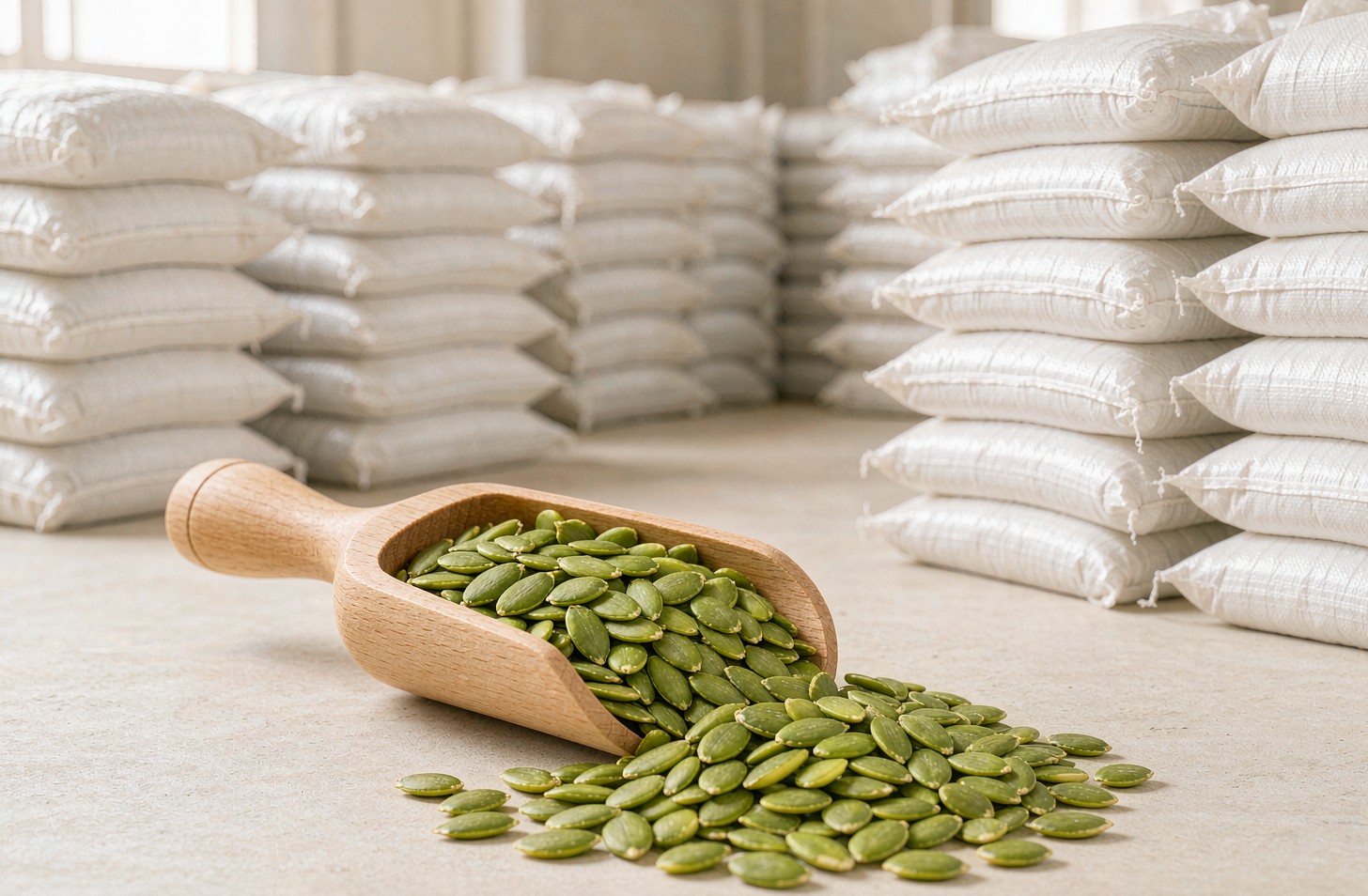
Pumpkin Seeds Supplier Middle East: A Complete Sourcing Guide
Finding a reliable pumpkin seeds supplier for the Middle East means choosing a partner that understands HALAL certification, regional taste preferences, container logistics to Gulf ports, and the strict food-safety standards of Saudi Arabia, UAE, Qatar, Kuwait, and other GCC markets. China is the world’s largest producer of pumpkin seeds and kernels, and exporters based in Inner Mongolia supply a significant share of Middle East demand. This guide explains what Middle East buyers should look for when sourcing pumpkin seeds in bulk, which grades and certifications matter, and how to avoid common import problems.
Whether you are a distributor in Jeddah, a snack manufacturer in Dubai, or a trading company supplying North African retailers, the same sourcing rules apply: verify certifications, lock specifications, inspect before shipment, and choose a supplier that has real export experience to the Gulf.
Why the Middle East Imports Pumpkin Seeds from China
The Middle East is one of the fastest-growing markets for edible seeds. Roasted and salted pumpkin seeds are popular snack items across the GCC, while raw kernels are used in bakeries, confectionery, and breakfast cereals. Local production is limited, so the region depends on imports.
Chinese suppliers dominate this trade for four reasons:
- Volume and variety — China produces Shine Skin, GWS, Snow White, and hulled kernels at scale;
- Competitive landed cost — farm-gate prices in Inner Mongolia are lower than most alternative origins;
- Processing maturity — automatic cleaning, grading, color-sorting, and metal-detection lines meet GCC import standards;
- Established shipping routes — regular container services from Tianjin, Qingdao, and Shanghai to Jebel Ali, Jeddah, Dammam, and Hamad.
The main challenge for Middle East buyers is not finding a supplier — it is finding one that delivers consistent quality, valid HALAL certificates, and complete export paperwork every time.
What Middle East Buyers Typically Order
Different channels in the Middle East buy different product forms. Matching your order to the right market segment improves margins and reduces complaints.
| Market Segment | Common Product | Typical Grade | Packing |
|---|---|---|---|
| Retail snack packs | Roasted in-shell pumpkin seeds | AA / AAA, uniform size | 25 kg bulk or 100–500 g retail bags |
| Bakery / confectionery | Hulled pumpkin seed kernels | AA, 99.9% purity | 12.5 kg vacuum cartons |
| Food manufacturing | Raw kernels or seeds | A / AA, oil-grade or food-grade | 25 kg PP bags |
| Repacking / wholesale | Mixed container lots | Various | 25 kg / 50 kg PP bags |
Certifications Required for Middle East Import
GCC food regulators and major distributors require more than a basic invoice. Before you ship, make sure your supplier can provide:
- HALAL certificate — mandatory for retail and food-service sales in Saudi Arabia, UAE, Qatar, Kuwait, Bahrain, and Oman;
- Health certificate / Certificate of analysis — often required by customs and large supermarket chains;
- Phytosanitary certificate — plant-product import requirement for most GCC countries;
- Certificate of origin — needed for customs valuation and any preferential tariff claims;
- HACCP or ISO 22000 — expected by serious distributors and manufacturers;
- Heavy-metal and aflatoxin test reports — increasingly requested by Saudi Food and Drug Authority (SFDA) style checks.
Always ask for the certifying body name and validity date. A HALAL certificate from a GCC-recognized body carries more weight in the region than a local certificate from an unknown issuer.
Key Specifications Middle East Importers Should Lock
Write every requirement into the purchase contract. Vague terms lead to disputes.
| Parameter | Typical Export Standard for Middle East |
|---|---|
| Variety | Shine Skin, GWS, Snow White, hulled kernels |
| Grade | AA / AAA for retail; A / AA for processing |
| Purity | 99% – 99.9% for kernels; 99.5%+ for in-shell seeds |
| Moisture | ≤ 8–9% |
| Admixture | ≤ 0.5% |
| Size (Shine Skin / GWS) | 200–240, 240–260, 260–280 seeds per 100 g |
| Packing | 25 kg / 50 kg PP bags, 12.5 kg vacuum cartons, or custom retail packs |
| Shelf life | 12 months under dry, cool conditions |
Shipping and Logistics to Middle East Ports
Most Chinese pumpkin seed exports to the Middle East move by sea container. Transit times and preferred ports depend on your final destination.
| Destination Market | Common Discharge Port | Approx. Transit Time from North China |
|---|---|---|
| UAE / Dubai | Jebel Ali | 18–24 days |
| Saudi Arabia — west | Jeddah | 20–26 days |
| Saudi Arabia — east | Dammam | 22–28 days |
| Qatar | Hamad | 20–26 days |
| Kuwait | Shuwaikh | 22–28 days |
| Oman | Salalah / Sohar | 20–26 days |
For buyers who need faster replenishment, some suppliers can arrange LCL or air freight for trial orders, though sea freight remains the standard for bulk.
How to Vet a Pumpkin Seeds Supplier for the Middle East
1. Confirm HALAL and Export Certifications
Ask for copies of HALAL, HACCP/ISO 22000, and any third-party inspection reports. Check that the certificate scope matches the product and plant you are buying from.
2. Request Samples and a Specification Sheet
Never place a container order without pre-shipment samples. Compare sample aroma, color, size uniformity, and moisture against the written specification sheet.
3. Check Middle East Export References
A supplier that already ships to Jeddah, Dubai, or Dammam understands GCC documentation, port handling, and common quality complaints. Ask for two or three regional references.
4. Arrange Third-Party Inspection
For first orders, book SGS, Bureau Veritas, or Intertek to inspect quality, weight, packing, and documents before shipment. This step pays for itself in dispute prevention.
5. Start with a Trial Order
A 1-ton to 5-ton trial order lets you test packaging, transit condition, customs clearance, and customer acceptance before committing to a full container.
Common Mistakes Middle East Buyers Make
- Ignoring HALAL body recognition — some GCC retailers only accept certificates from specific accreditation bodies;
- Ordering without a signed specification sheet — oral agreements on grade and purity create disputes;
- Skipping pre-shipment inspection — relying only on supplier photos is risky for bulk food;
- Wrong packing for climate — humid Gulf summers require moisture-barrier packing and proper palletizing;
- Underestimating customs paperwork — incomplete certificates can cause demurrage and rejected shipments.
Why Ouji International Serves Middle East Pumpkin Seed Buyers
Hohhot Ouji International Co., Ltd. (Ouji International) is an agricultural food exporter based in Hohhot, Inner Mongolia, the heart of China’s pumpkin seed growing region. Established in 2013, the company operates 2 production processing plants and 6 automatic production lines, supplying pumpkin seeds, pumpkin seed kernels, sunflower seeds, walnuts, and other nuts to buyers across Europe, the Americas, Japan and South Korea, the Middle East, North Africa, and South America.
For Middle East buyers specifically, Ouji offers:
- HALAL and Kosher certification support — certificates available for GCC and Jewish-market customers;
- Stable Inner Mongolia origin supply — fresh, plump seeds with short farm-to-port lead times;
- Integrated processing — automatic cleaning, grading, color-sorting, metal detection, and hand-picking lines under one roof;
- Export documentation handled — commercial invoice, packing list, certificate of origin, phytosanitary certificate, and third-party inspection support;
- Experience with GCC ports — regular shipments to Jebel Ali, Jeddah, Dammam, and Hamad;
- 24/7 service — fast quotes, samples, and after-sales support across time zones.
You can also explore our guide on how to import pumpkin seeds from China for a step-by-step overview of the full export process.
Frequently Asked Questions
Is HALAL certification mandatory for pumpkin seeds in the Middle East?
Yes, for retail and food-service distribution in Saudi Arabia, UAE, Qatar, Kuwait, Bahrain, and Oman, HALAL certification is effectively mandatory. Large supermarkets and distributors will not list non-HALAL edible seeds.
What is the minimum order quantity for pumpkin seeds to the Middle East?
Most exporters accept trial orders of 1–5 tons. Full container loads typically start at 12–13 tons (20 ft) or 24–26 tons (40 ft), depending on packing and variety.
Which pumpkin seed variety sells best in the Middle East?
Shine Skin and GWS pumpkin seeds are the most popular for roasted snack packs. Hulled kernels are preferred by bakeries, confectionery producers, and health-food brands.
How long does shipping take from China to Dubai or Jeddah?
Sea freight from North China ports to Jebel Ali usually takes 18–24 days; to Jeddah 20–26 days. Add customs clearance and inland transport for total lead time.
Can I get custom retail packing for Middle East supermarkets?
Yes. Many Chinese exporters offer custom retail packing in 100 g, 200 g, 500 g, or 1 kg formats with private labels. Minimum quantities apply and should be confirmed before ordering.
What documents do I need to clear pumpkin seeds through GCC customs?
Typically: commercial invoice, packing list, bill of lading, certificate of origin, phytosanitary certificate, and HALAL certificate. Some countries also request a health certificate or test reports for aflatoxin and heavy metals.
Conclusion
Sourcing pumpkin seeds from a reliable supplier for the Middle East is straightforward when you focus on the right details: HALAL certification from a recognized body, written specifications, pre-shipment inspection, climate-appropriate packing, and a supplier with proven GCC export experience.
If you are a distributor, snack manufacturer, or trading company looking for a pumpkin seeds supplier for the Middle East, contact Ouji International for samples, current specifications, and export pricing. We can match the right grade and certification to your market and ship to Jebel Ali, Jeddah, Dammam, Hamad, and other major Gulf ports.