

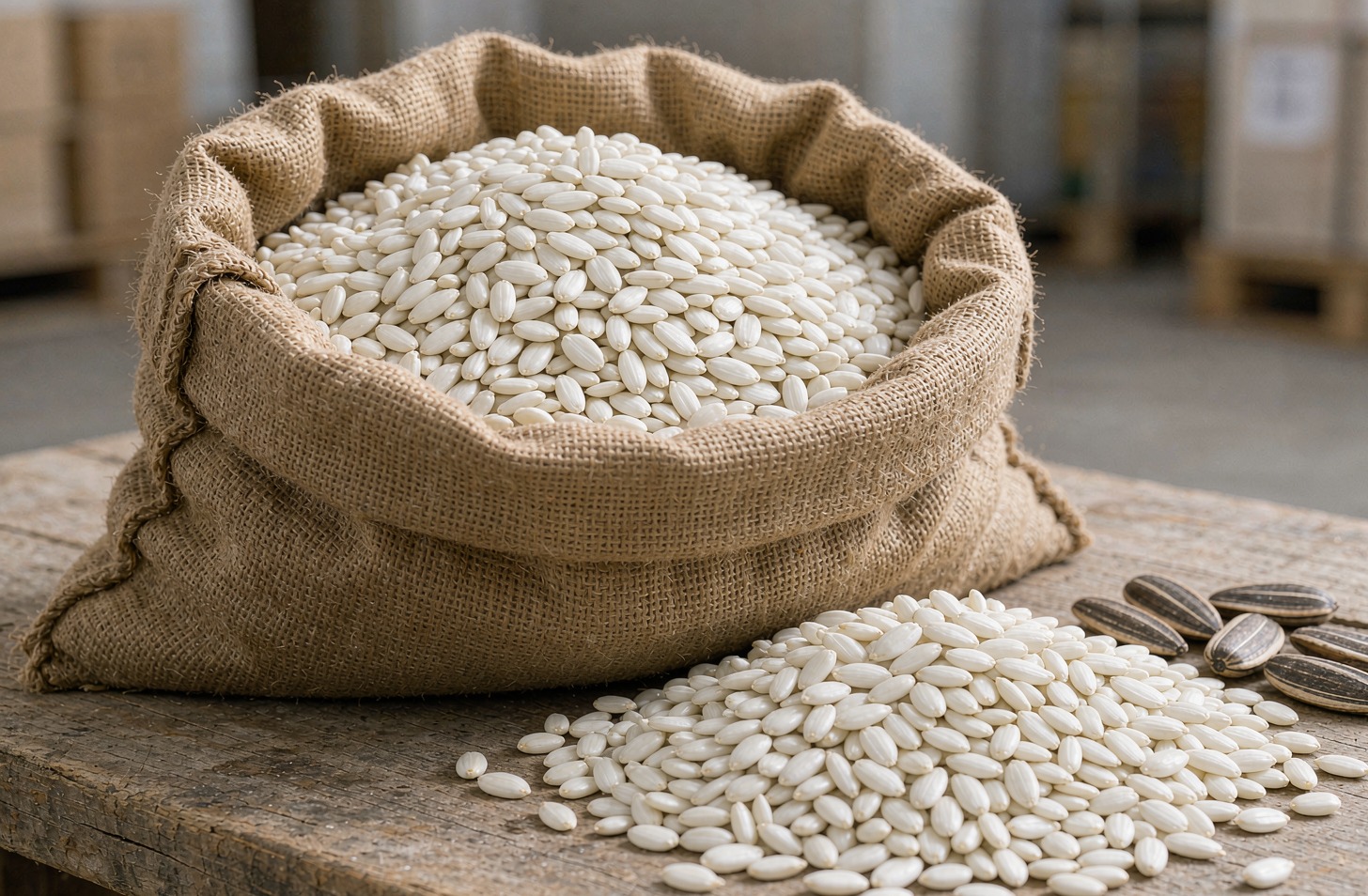
What Are White Sunflower Seeds?
White sunflower seeds — often called white bakery sunflower seeds or hulled-grade white seeds — are a confectionery-type sunflower seed with a light, silvery-white striped hull, larger kernel size, and lower oil content than black oil seeds. They are the preferred raw material for bakery decoration, chocolate coating, snack roasting, and kernel shelling. If you are looking for a dependable white sunflower seeds supplier, the key criteria are variety purity, size grading, moisture control, and certified export documentation. This guide explains what white sunflower seeds are, how they differ from black and striped varieties, which specs matter for your application, and how to qualify a supplier before placing a bulk order. As a processor based in Inner Mongolia — China’s largest sunflower belt — Ouji International has supplied white, black, and striped sunflower seeds to buyers in Europe, the Middle East, and North America since 2013.
Why White Sunflower Seeds Are a Different Product
Not all sunflower seeds are interchangeable. Buyers who treat “sunflower seeds” as one commodity often pay for the wrong grade. White sunflower seeds belong to the confectionery (non-oil) type, grown mainly for direct food use rather than oil crushing. Three characteristics define the type:
- Appearance: large hulls with dominant white-and-grey striping; the white hull is a premium visual signal in bakery and snack retail packaging.
- Kernel profile: bigger kernels, lower fat content (typically 40–50% vs 55%+ for oilseed types), and a milder, nuttier taste after roasting.
- Processing direction: white seeds are usually sold in-shell for snacking or shelled into kernels for bakery and chocolate industries, while black oil seeds go to crushing or bird feed.
According to the FAO statistics, China is among the world’s largest confectionery sunflower producers, and Inner Mongolia alone accounts for a major share of the white-type planting area — which is why most serious white sunflower seeds suppliers operate there.
White vs Black vs Striped Sunflower Seeds: Quick Comparison
Use this table to confirm that white sunflower seeds are the right variety for your market and application:
| Attribute | White (Confectionery) | Black Oil Type | Striped Snack Type |
|---|---|---|---|
| Main use | Bakery, chocolate, shelling to kernels, premium snacks | Oil crushing, bird feed | In-shell roasting, retail snacks |
| Hull colour | Silvery white with grey stripes | Solid black | Black-and-white wide stripes |
| Kernel size | Large, plump | Small | Medium to large |
| Oil content | 40–50% | 55%+ | 45–50% |
| Typical buyers | Bakeries, chocolate factories, kernel processors | Oil refiners | Snack brands |
| Price level | Premium | Commodity | Mid to premium |
If your application is bakery toppings or chocolate-coated kernels, white-type seeds — or their shelled kernels — are almost always the correct specification. For a full comparison across the black variety, see our black sunflower seeds sourcing guide.
Key Specifications to Demand From a White Sunflower Seeds Supplier
Professional importers evaluate white sunflower seeds against four spec groups. Ask every supplier for these figures in writing before sampling:
1. Physical Specs
| Parameter | Typical Export Standard | Why It Matters |
|---|---|---|
| Size grade | 24/64 inch (9.5 mm) and up, or 500–700 pcs/100 g | Larger seeds command bakery premiums |
| Purity | ≥ 99.5% (impurity ≤ 0.5%) | Reduces cleaning loss at your facility |
| Moisture | ≤ 9.0% (kernels ≤ 7.0%) | Prevents mould and aflatoxin risk in transit |
| Broken / damaged kernels | ≤ 2.0% | Affects visible quality in clear packs |
| Colour uniformity | ≥ 95% white-striped hulls | Mixed lots indicate poor variety control |
2. Food Safety & Certification
- ISO 22000 / HACCP certified processing lines — the baseline for EU and Gulf imports.
- Aflatoxin, pesticide residue, and heavy metal test reports per shipment (SGS or equivalent third party).
- For Middle East buyers: HALAL certificate; for specialty retail: Kosher available on request.
- Full traceability from farm lot to container — critical when your retail customer audits upstream.
3. Grading & Sorting Capability
White sunflower seeds are graded by size and colour after de-stoning, gravity separation, and colour sorting. A supplier running automated colour sorters and hand-picking lines can hold colour uniformity above 95%; a trader without processing capability cannot guarantee it across seasons. When you audit a supplier, ask specifically: how many sorting passes does the lot go through, and can they produce a pre-shipment sample from your actual order batch?
4. Packaging & Export Documentation
Standard export packaging is 25 kg PP woven bags or 50 kg jumbo bags, with vacuum or nitrogen-flush options for kernel orders. Documents should include commercial invoice, packing list, phytosanitary certificate, certificate of origin, and bill of lading — issued consistently, not “on request”.
How to Qualify a White Sunflower Seeds Supplier: 5 Steps
- Verify the factory, not the trade company. Ask for production-line videos, business licence scope, and export licence. Factories control grading; traders only resell it.
- Request spec sheets and third-party reports. Compare the written specs above with an independent SGS test on a drawn sample.
- Run a pre-shipment sample from your actual batch. Confirm size, colour uniformity, and moisture on the same lot that will ship — not a showroom sample.
- Check capacity and seasonality. New-crop supply (Oct–Dec) offers the best colour and price; confirm the supplier can hold stock for your program volume.
- Pilot one container, then scale. A 20–25 MT trial container exposes documentation quality and communication speed before you commit to annual contracts.
Red flags: prices far below the Inner Mongolia spot market, refusal to name the processing factory, no written aflatoxin policy, and quotes that mix black and white types as one grade.
M Evaluate MOQ, Pricing and Lead Time
| Item | Typical Range (Export) | Notes |
|---|---|---|
| MOQ | 1 × 20 ft container (approx. 17–19 MT in-shell) | Smaller trial lots possible via consolidated shipment |
| Price driver | Size grade, colour uniformity, crop year | New crop (Oct–Dec) is usually the value window |
| Packaging | 25 kg PP bags; 50 kg jumbo; vacuum packs for kernels | Private-label printing available from most factories |
| Lead time | 15–25 days after deposit and spec confirmation | Add 25–40 days ocean freight to EU/Gulf ports |
| Payment terms | 30% T/T deposit + balance against B/L copy; LC accepted | LC more common above 2 containers |
About Ouji International: White Sunflower Seeds From Inner Mongolia
Ouji International has processed and exported nuts and seeds from Hohhot, Inner Mongolia, since 2013. Two processing plants with six automatic grading and colour-sorting lines give us direct control over size, purity, and colour uniformity — the three specs that decide whether white sunflower seeds pass your bakery customer’s audit. We export confectionery sunflower seeds (white, black, and striped types), sunflower kernels, pumpkin seeds, and walnuts to Europe, the Middle East, Japan, Korea, and the Americas, with HALAL and Kosher certification and full per-shipment third-party testing. Send us your target spec and monthly volume, and we will return a quotation with a pre-shipment sample from actual stock within two working days.
Frequently Asked Questions
What is the difference between white and black sunflower seeds?
White sunflower seeds are a large-kernel confectionery type used for bakery, chocolate, and shelling; black sunflower seeds are an oilseed type with higher fat content used mainly for oil crushing and bird feed.
What size grades do white sunflower seeds come in?
Export grades are commonly quoted from 24/64 inch (about 9.5 mm) upward, or as 500–700 seeds per 100 g. Larger, more uniform lots carry a premium for bakery use.
Can I buy white sunflower kernels instead of in-shell seeds?
Yes. The same raw material can be shelled into white sunflower kernels, typically packed vacuum-sealed in 25 kg cartons with moisture below 7%.
What is the MOQ for export orders?
Most factories, including Ouji International, quote a 20-foot container (about 17–19 MT in-shell) as the standard MOQ; trial volumes can sometimes be arranged.
Which certifications should a white sunflower seeds supplier have?
At minimum ISO 22000 or HACCP for the processing facility, plus HALAL for Middle East markets and per-shipment aflatoxin and pesticide residue reports from an independent lab.
When is the best time to buy?
October to December, right after new-crop harvest, offers the best colour, moisture, and pricing. Orders placed in the off-season draw from storage, so insist on fresh pre-shipment samples.
Conclusion
White sunflower seeds are a premium confectionery product where variety purity, size grading, and colour uniformity decide the value — not just price per ton. Source from a factory in the Inner Mongolia growing belt that can document ISO 22000/HACCP processing, provide batch-specific third-party tests, and ship graded lots that match your bakery or shelling line’s spec. Ready to compare samples? Contact Ouji International for a quotation and pre-shipment sample from current stock.