

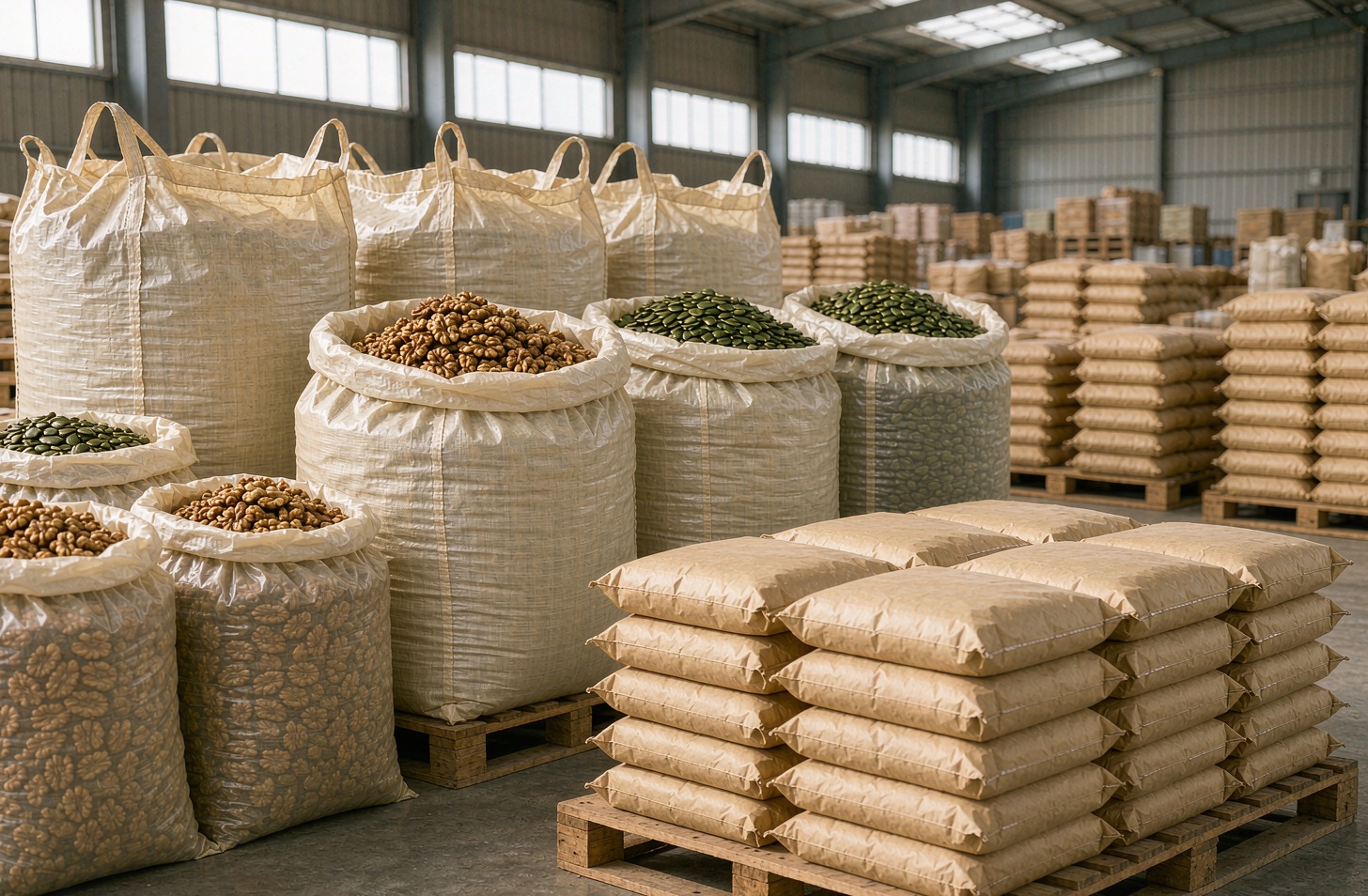
Bulk sunflower seeds packaging is the system of bags, liners, cartons, and pallets that protects in-shell seeds and kernels from moisture, pests, odor, and physical damage between the processing plant and your warehouse. For most B2B orders, packaging combines a food-grade inner liner (PP or PE) with an outer layer — typically 25 kg or 50 kg PP woven bags, kraft paper bags, cartons for retail-ready kernels, or 500–1,000 kg jumbo bags for industrial buyers. Choosing the right format protects germination and oil quality, keeps compliance documents aligned with your market’s labeling rules, and directly affects how many tonnes fit in a 20GP or 40HQ container.
At Ouji International, we have packed and exported sunflower seeds and kernels from Hohhot, Inner Mongolia since 2013, running two processing plants with six automatic packing and sorting lines serving buyers across Europe, the Middle East, North Africa, Japan, Korea, and South America. This guide shares the packaging specifications we recommend buyers lock into their contracts — and the mistakes that cause most claims.
Why Packaging Decides Whether Your Seeds Arrive Sellable
Sunflower seeds leave the factory at roughly 7–9% moisture (in-shell) or 6–8% (kernels). During a 30–45 day ocean freight to Europe, West Africa, or South America, containers routinely see internal humidity swings and temperatures above 50°C on deck routes. Poor packaging shows up in three predictable ways:
- Moisture gain and mold. Unlined or thin woven bags absorb container humidity; kernels can exceed safe moisture limits and develop free fatty acid (FFA) defects or visible mold before discharge.
- Pest and odor contamination. Seeds are hygroscopic and aromatic. Without a sealed liner, they absorb container odors and are exposed to storage-pest risk during transshipment.
- Physical damage and sifting. Under-filled or single-layer bags split under stacking pressure, and loose kernels sift out — losing weight and inviting foreign matter.
Food-safety frameworks such as ISO 22000 and general codex hygienic practice for low-moisture foods treat packaging as part of the hazard control system, not an afterthought. Your packaging spec should therefore be written into the sales contract with the same precision as purity and moisture limits.
Packaging Options for Bulk Sunflower Seeds
Different buyers need different formats. Industrial oil crushers buy by the tonne and want jumbo bags; snack roasters want retail-ready cartons; wholesalers want stackable 25 kg bags. The table below summarizes the standard options we quote for in-shell sunflower seeds and sunflower seed kernels:
| Format | Unit Weight | Best For | Key Features |
|---|---|---|---|
| PP woven bag + PE liner | 25 kg / 50 kg | Wholesalers, repackers | Strong, stackable, low cost; liner blocks moisture and odor |
| Kraft paper bag (multi-ply) | 25 kg | Food processors, EU buyers | Food-grade presentation, better print area, good moisture barrier with liner |
| Carton box + vacuum or gas-flushed inner bag | 10 kg / 12.5 kg / 20 kg | Kernels for roasters, snack brands | Maximum kernel protection, retail-ready, lowest breakage |
| Jumbo (FIBC) bag | 500 kg / 1,000 kg | Oil crushing, industrial buyers | Fast handling with forklifts, lowest per-tonne packing cost |
| Retail small packs inside master carton | 200 g – 1 kg × N | Private-label programs | Buyer’s artwork, barcodes, market-language labels |
In-Shell Seeds vs Kernels: Different Protection Needs
In-shell sunflower seeds carry their own natural armor — the hull — so they tolerate 25/50 kg woven bags well, provided a liner is used for long voyages. Sunflower seed kernels are exposed cotyledons: they oxidize faster, break easily, and absorb odors. For kernels we strongly recommend either vacuum-packed inner bags inside cartons or, at minimum, double-layer liners with nitrogen-flushed headspace for shipments longer than 30 days. Kernel buyers should also specify peroxide value and FFA limits at destination, since packaging is the first line of defense against rancidity.
Food-Grade Liners, Moisture and Pest Control
The liner does most of the protective work. A proper export liner specification looks like this:
| Liner Parameter | Recommended Spec | Why It Matters |
|---|---|---|
| Material | Food-grade PE or PP, virgin resin | No odor transfer; compliant with food-contact rules |
| Thickness | 0.06–0.10 mm (60–100 gauge) | Thin liners puncture during stuffing and stacking |
| Sealing | Heat-sealed or twist-tied + folded | Open-top liners defeat the purpose |
| Moisture barrier | Optional foil or EVOH barrier for long routes | Keeps kernels under 8% moisture to destination |
| Container desiccants | Container-dry bags, 6–12 units per 40HQ | Absorbs transit humidity inside the container |
| Palletization (optional) | ISPM-15 fumigated pallets, stretch-wrapped | Faster discharge, less bag damage, easier warehouse handling |
General guidance from the FAO food safety programme emphasizes keeping low-moisture commodities dry and protected from pests throughout storage and transport — exactly what a sealed liner plus container desiccants achieves in practice.
Labeling and Export Marking Requirements
Every export bag or carton should carry clear, durable marking so the shipment can be traced at every handover. Standard marking includes:
- Product name and type — e.g., “Sunflower Seed Kernels, Grades AA” or “In-shell Sunflower Seeds, Type 5009”
- Crop year and lot number — links each bag to the lab report and phytosanitary certificate
- Net weight — per bag and per pallet
- Origin — “Product of China”
- Buyer-specified details — consignee name, PO number, port of discharge, customer barcode or private-label artwork
If you are importing into the EU, Gulf states, or other regulated markets under your own brand, confirm label language, allergen, and nutrition-panel requirements with your import agent before production — relabeling at destination is far more expensive than printing correctly at the factory. Our team reviews label drafts with buyers at the proforma stage as part of the normal export workflow described in our bulk sunflower seeds supplier guide.
Container Loading: How Much Fits in 20GP and 40HQ
Packaging format determines freight economics. Typical loading figures for sunflower seeds from northern China ports (Tianjin/Qingdao) are:
| Packaging Format | 20GP (max) | 40HQ (max) | Notes |
|---|---|---|---|
| 50 kg PP woven bags, loose | ~18–19 t | ~26 t | Weight-limited; check road limits on your side |
| 25 kg bags on pallets | ~14–15 t | ~20–22 t | Pallet volume reduces net payload |
| Cartons 10–20 kg, palletized | ~12–14 t | ~18–20 t | Kernel programs; protect from crush |
| Jumbo bags 1,000 kg | ~16–18 t (16–18 bags) | ~24–26 t | Fast stuffing/discharge with forklift |
Ask your supplier to confirm payload vs volume limits for your specific route — sunflower seeds are a dense commodity, so most shipments are weight-limited rather than cube-limited.
How to Specify Packaging in Your Purchase Contract
A short packaging clause prevents most disputes. Make sure your contract or PO states:
- Format and unit weight — e.g., “25 kg PP woven bags with 0.08 mm PE food-grade liner, heat-sealed.”
- Inner protection for kernels — vacuum bag or nitrogen flush where applicable.
- Marking details — lot number, crop year, buyer marks, label language.
- Palletization and fumigation — ISPM-15 status if pallets are used.
- Desiccant policy — number of container-dry bags per container for monsoon-season shipments.
- Photo/inspection checkpoint — packaging photos at stuffing, plus SGS or buyer-agent inspection rights before container sealing.
Common Packaging Mistakes Importers Make
- Buying on price per bag only. Saving $0.10 on a cheap liner can cost a full container claim when kernels arrive above moisture limits.
- No liner for long routes. Unlined bags are acceptable for short regional shipments, not for 35-day voyages to West Africa or South America.
- Mixed pallets without dunnage. Bags shifting during transit split seams; simple airbags and strapping solve this.
- Ignoring label compliance. Artwork that misses destination-language or barcode requirements delays customs clearance.
- No stuffing supervision. Request pre-stuffing inspection or photo documentation; it is the cheapest insurance in the chain.
FAQ
What is the standard packaging for bulk sunflower seeds?
Most export orders use 25 kg or 50 kg PP woven bags with a food-grade PE inner liner. Kernels for food processors are usually packed in cartons with vacuum or gas-flushed inner bags for maximum protection.
How many tons of sunflower seeds fit in a 20-foot container?
A 20GP typically carries 18–19 tonnes of 50 kg bags, or around 14–15 tonnes when palletized. Sunflower seeds are dense, so shipments are usually weight-limited rather than volume-limited.
Do sunflower seed kernels need vacuum packing for export?
Vacuum or nitrogen-flushed packing is strongly recommended for kernels on long routes because exposed kernels oxidize and absorb odors. In-shell seeds tolerate lined woven bags well thanks to their natural hull.
What liner thickness should I require?
Specify a food-grade PE or PP liner of 0.06–0.10 mm, heat-sealed at the top. Thinner liners puncture during handling and lose their moisture barrier.
Can I use my own packaging design and labels?
Yes. Private-label bags, cartons, and retail packs are standard — supply artwork at the proforma stage so printing, barcodes, and destination-market label rules can be verified before production.
Conclusion
Packaging is not a line item to leave to the factory’s default. A precise spec — bag format, liner, sealing, marking, desiccants, and loading plan — is what turns a good seed specification into seed quality that actually survives the ocean. If you are sourcing sunflower seeds or kernels from China and want packaging matched to your route and market, contact Ouji International for a detailed packaging and export quotation.