

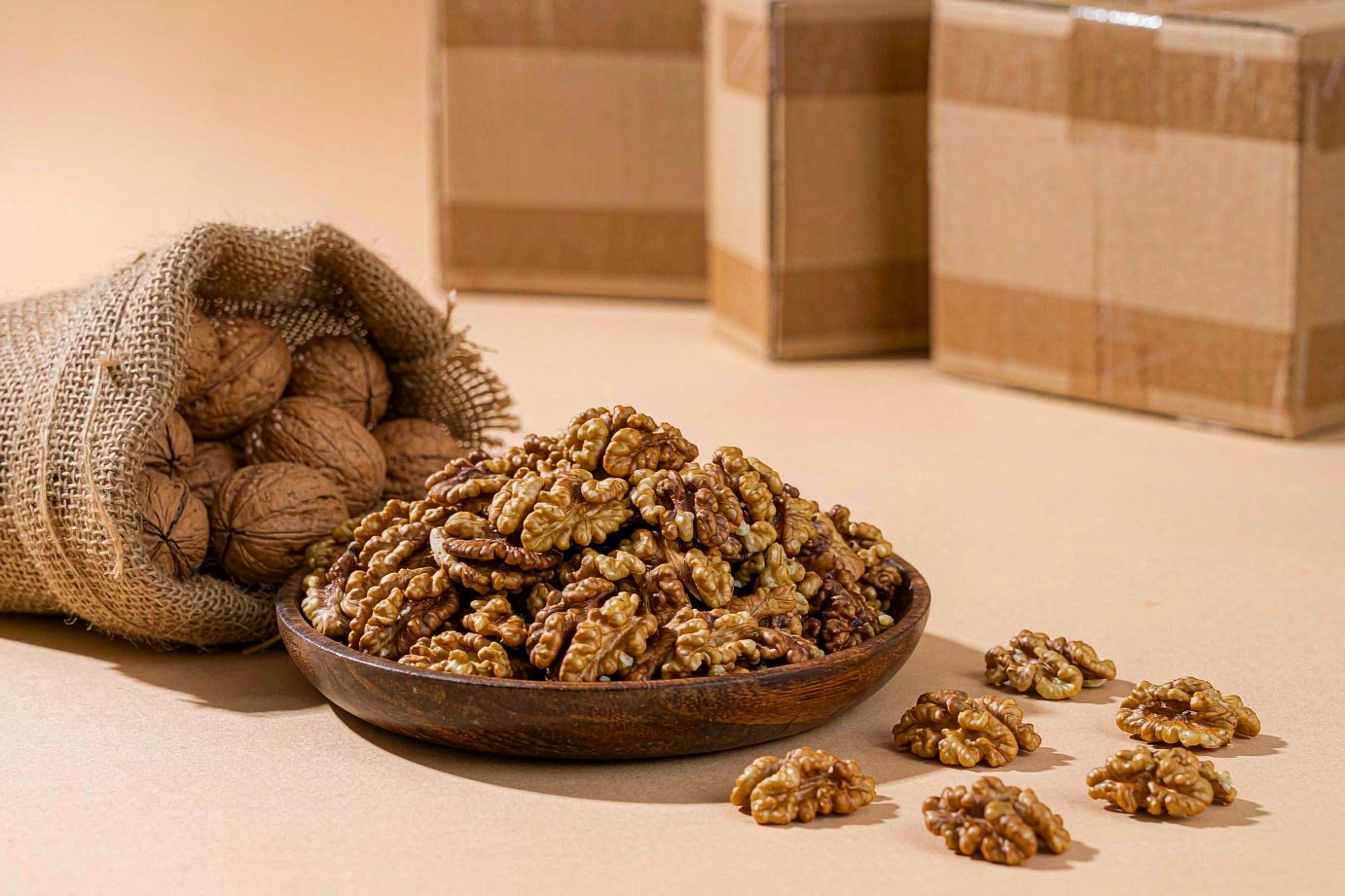
Walnut Supplier UAE: How to Source Bulk Walnuts for the Emirates
Choosing a walnut supplier for the UAE comes down to five verifiable points: food-safety certification (HACCP, ISO 22000), aflatoxin and moisture control, consistent grading, Arabic-compliant labelling, and dependable shipping into Jebel Ali or Khalifa Port. The UAE grows no commercial walnut crop, so every kilo is imported — and a large share is re-exported onward to the wider GCC, Africa and CIS markets. That makes supplier selection a supply-chain decision, not a price negotiation. This guide sets out exactly what UAE importers, traders, bakery groups and private-label brands should confirm before placing a bulk order.
Why the UAE Is a Strategic Market for Walnut Supply
Dubai is one of the world’s most efficient food re-export hubs: a container landed at Jebel Ali can reach Saudi Arabia, Kuwait, Oman, Qatar, Iraq and East Africa within days by road or feeder. A UAE buyer is therefore often buying for a whole region — larger volumes, tighter specs, more expensive paperwork errors.
Demand inside the Emirates is driven by three distinct channels:
- Retail and gifting — supermarket chains and traditional souq traders sell in-shell walnuts and premium halves, with sharp peaks around Ramadan, Eid and the winter gift season;
- Food manufacturing — bakeries, confectioners, ice-cream producers, halva and nut-paste makers buy walnut pieces and light amber halves in tonnage;
- Hotels, catering and airlines — the region’s hospitality sector consumes a steady flow of consistent, food-safe kernels for breakfast buffets, desserts and in-flight service.
The practical consequence: most UAE buyers need two supply profiles — a retail grade and an industrial grade — from a supplier able to hold both to spec across repeat shipments.
What UAE Buyers Actually Purchase
Walnut is not one product. Before comparing quotations, define the form you need, because prices differ by 30–50% between in-shell and light halves:
| Product Form | Typical Specification | Main UAE Buyers |
|---|---|---|
| In-shell walnuts | 28–30 mm, 30–32 mm, 32 mm+; thin shell; moisture ≤ 8% | Retail chains, gifting packs, souq wholesalers |
| Light halves (LH) | ≥ 80–90% halves, light colour, broken ≤ 5% | Premium retail, chocolate coating, gift assortments |
| Light amber halves | Halves intact, slightly darker tone | Bakery, ice cream, hotel kitchens |
| Light pieces | 2–8 mm granulation, uniform, light colour | Confectionery, biscuits, halva, nut pastes |
| Amber / mixed pieces | Blended to customer spec | Industrial processing, oil pressing, fillings |
| Organic kernels | EU/NOP certified, traceable lot | Health-food retail niche, premium private label |
Colour is the biggest price driver in kernels: light halves earn a premium because pale kernels signal fresher oil. For baking or paste, paying for retail-grade colour is usually wasted money.
UAE Import Requirements and Documentation
Food import into the UAE is regulated at both federal and emirate level: consignments are screened by the relevant municipality food-safety authority, and retail products must be registered. A competent supplier treats the following as routine, not as favours:
- Commercial invoice, packing list and bill of lading — with HS code, net/gross weight and lot identification;
- Certificate of origin — usually issued by the CCPIT or a chamber of commerce;
- Health certificate and phytosanitary certificate — issued by Chinese customs (CIQ) after inspection;
- HALAL certificate — nuts are inherently halal, but UAE retail and foodservice buyers commonly require a HALAL certificate covering the processing facility and storage;
- Aflatoxin and pesticide-residue test report — batch-specific, from a recognised third-party laboratory such as SGS, Bureau Veritas or Intertek;
- Arabic labelling — product name, net weight, production and expiry dates, storage conditions, origin and importer details, aligned with the applicable GSO labelling standard;
- Product registration — required for goods placed on the local retail market, handled through the emirate food-safety portal.
On the fiscal side, nuts typically attract the GCC Common Customs Tariff of around 5%, plus 5% VAT on import. Rates and registration procedures change, so confirm the current position with your customs broker or food-registration consultant before the first shipment — not after the container arrives.
Specifications to Lock in Writing
The Gulf climate is unforgiving. Ambient temperatures above 40°C and high humidity accelerate rancidity and mould, which is why moisture and aflatoxin control matter more in the UAE than in Northern European markets. Insist on a signed specification sheet covering:
| Parameter | Typical Export Standard | Why It Matters in the UAE |
|---|---|---|
| Moisture | ≤ 8% kernels; ≤ 8–10% in-shell | Prevents mould and rancidity during hot-weather storage |
| Foreign matter | ≤ 0.5% | Quarantine and retail-compliance risk |
| Broken kernels | ≤ 3–5% depending on grade | Direct grade and price integrity |
| Colour grade | Light / light amber / amber | Largest single price differentiator |
| Aflatoxin | Within GCC limits; stricter EU limits for re-export | Rejection at port or retail recall |
| Pesticide residue | Within destination MRL | Critical if goods are re-exported to the EU |
| Size (in-shell) | 28–30 / 30–32 / 32 mm+ | Retail grading and pack fill |
| Shelf life on arrival | ≥ 9 months remaining | Gulf heat shortens usable window |
| Packaging | 10 / 12.5 / 25 kg vacuum or nitrogen-flushed | Moisture barrier and pest protection |
Two contract clauses matter most: a crop-year declaration (never accept last season’s stock at new-crop prices) and a pre-shipment inspection right. Both are standard requests any serious exporter accepts.
How to Vet a Walnut Supplier Serving the UAE
1. Verify the Plant, Not the Trading Office
Many “suppliers” are intermediaries buying from mills. Ask for the production licence, the export registration number, and a live video walk-through showing cracking, shelling, colour sorting, hand-picking and packing in sequence. A trader will stall; a factory will schedule a call.
2. Confirm Certifications With the Issuing Body
Photographed certificates prove nothing. Check the certificate number, the certification body, the validity date and — most importantly — whether the scope covers the actual processing site. ISO 22000 and HACCP are the baseline; BRCGS or IFS are increasingly requested by European-linked buyers.
3. Demand a Signed Specification Sheet and a Real Sample
The sample must come from the lot you are quoting, not from a showroom jar. Test moisture, broken percentage and taste, and keep the retained sample sealed for comparison against the shipment.
4. Test Aflatoxin Independently
Walnuts are a known aflatoxin-risk commodity. Commission your own laboratory test on the pre-shipment sample. If a supplier resists this, that is your answer.
5. Start With Pallets, Then Scale
A one- to two-pallet trial — roughly 1–2 tonnes — exposes lead time, packing quality and paperwork accuracy at low risk. Scale to a 20 ft container (about 18–20 tonnes of in-shell walnuts bagged, less on pallets) only after the trial clears.
6. Check Their GCC Track Record
Ask for past bills of lading into Jebel Ali or Khalifa Port, or regional buyer references. Exporters already shipping to the Gulf understand the labelling, halal paperwork and Ramadan cycle without hand-holding.
Shipping Walnuts to the UAE: Transit Times and Terms
| Route | Mode | Typical Transit | Notes |
|---|---|---|---|
| Tianjin / Qingdao → Jebel Ali | FCL sea | 20–28 days | Most common routing for 20 ft and 40 ft |
| Shanghai / Ningbo → Jebel Ali | FCL sea | 22–30 days | Useful for mixed loads with other nuts |
| China → Khalifa Port (Abu Dhabi) | FCL sea | 22–30 days | Preferred for Abu Dhabi-bound distribution |
| China → Dubai (DXB) | Air freight | 3–6 days | Samples and urgent retail replenishment only |
FOB and CIF are the most common terms in China–UAE nut trade; CFR is popular with buyers who have their own freight forwarder. DDP is rare because import registration and duty liability sit with the UAE entity. Build a two-week buffer into your planning around Ramadan, when port and customs throughput tightens.
What Drives Your Landed Cost
| Cost Element | Typical Share of Landed Cost | Notes |
|---|---|---|
| FOB product cost | 70–80% | Grade and crop year dominate |
| Ocean freight and port charges | 8–15% | Volatile; book early in peak season |
| Marine insurance | 0.3–0.8% | Always cover aflatoxin-related rejection if possible |
| Customs duty | ~5% | GCC Common Customs Tariff |
| VAT | 5% | Recoverable for registered businesses |
| Clearance and handling | 1–3% | Includes lab sampling and registration fees |
| Inland delivery | 0.5–2% | Higher for onward GCC re-export |
The AED is pegged to the US dollar, so USD quotations carry no currency risk for UAE buyers — but dollar-denominated freight still swings. Fix the freight component, not just the product price.
Red Flags to Walk Away From
- A quotation significantly below the market range — usually last season’s crop or a lower grade relabelled;
- Certificates that cannot be verified, or whose scope excludes the plant being used;
- Reluctance to provide a batch-specific aflatoxin report or to accept third-party inspection;
- No clear answer on crop year, storage conditions or remaining shelf life;
- Vague labelling support — Arabic artwork and registration documents should be part of the service, not an afterthought;
- Pressure for 100% advance payment on a first order, with no inspection right.
Why Importers in the UAE Work With Ouji International
Ouji International is an agricultural food exporter based in Hohhot, Inner Mongolia, established in 2013. We operate 2 processing plants and 6 automatic production lines, supplying walnuts, walnut kernels, pecan, cashew, pumpkin seeds, pumpkin kernels, sunflower seeds and sunflower kernels to buyers in Europe, the Americas, Japan and South Korea, the Middle East, North Africa and South America.
For UAE and GCC buyers specifically, that means:
- Origin-side control — in-shell selection, cracking, colour sorting and hand-picking run under one roof, so grade consistency does not depend on third-party mills;
- Documentation prepared for Gulf clearance — health and phytosanitary certificates, HALAL certification, third-party aflatoxin reports and Arabic label artwork;
- Grade flexibility — light halves for gifting and retail, light pieces for confectionery and bakery, in-shell for souq and supermarket trade;
- Regional experience — a foreign-trade team that has shipped to Middle East markets for over a decade and understands Ramadan scheduling;
- Responsive sampling — courier samples and specification sheets within days, not weeks.
If you are benchmarking walnut grades, our walnut quality grade guide explains the defect and inspection standards behind each grade, and our guide to selecting a walnut kernel supplier in China covers the commercial side of the decision.
Frequently Asked Questions
How long does shipping take from China to the UAE?
Sea freight from Tianjin or Qingdao to Jebel Ali takes roughly 20–28 days port to port, plus 5–7 days for clearance and inland delivery. Air freight takes 3–6 days and is normally used for samples or urgent retail replenishment.
Do walnuts need HALAL certification to enter the UAE?
Walnuts are inherently halal, but many UAE retailers, hotels and food manufacturers require a HALAL certificate covering the processing facility and storage. Ask your supplier to confirm certification is current and issued by a recognised body.
What duty and VAT apply to walnut imports in the UAE?
Most nuts attract the GCC Common Customs Tariff of around 5%, plus 5% VAT on import. VAT is recoverable for VAT-registered businesses. Confirm the current rate and HS classification with your customs broker.
What aflatoxin limit applies to walnuts sold in the UAE?
GCC standards set maximum levels for total aflatoxins in nuts and nut products. If you re-export to the EU, stricter European limits apply, so ask for a batch-specific third-party report that satisfies your final destination — not just the UAE.
What is the minimum order quantity for bulk walnuts from China?
Most exporters accept trial orders of 1–5 tonnes, or a few pallets by LCL. A 20 ft container holds about 18–20 tonnes of bagged in-shell walnuts, or 14–16 tonnes on pallets; a 40 ft container holds roughly 24–26 tonnes.
Which walnut grade sells best in the UAE?
In-shell walnuts graded 30–32 mm dominate gifting and souq trade, light halves drive premium retail and chocolate, and light pieces supply bakeries and halva manufacturers. Most UAE importers carry at least two of these lines.
Conclusion
A dependable walnut supplier for the UAE is one you can verify three times over: on paper, in the sample, and in the container. Confirm certification scope and aflatoxin control, lock moisture and grade into a signed specification, test with pallets before committing to a container, and choose an origin-based exporter who already handles Gulf labelling and halal documentation.
If you are sourcing in-shell walnuts, light halves or walnut pieces for the UAE and wider GCC, contact Ouji International for current specifications, samples and export pricing — we will match the right grade to your channel and deliver it on schedule from Inner Mongolia to Jebel Ali.