

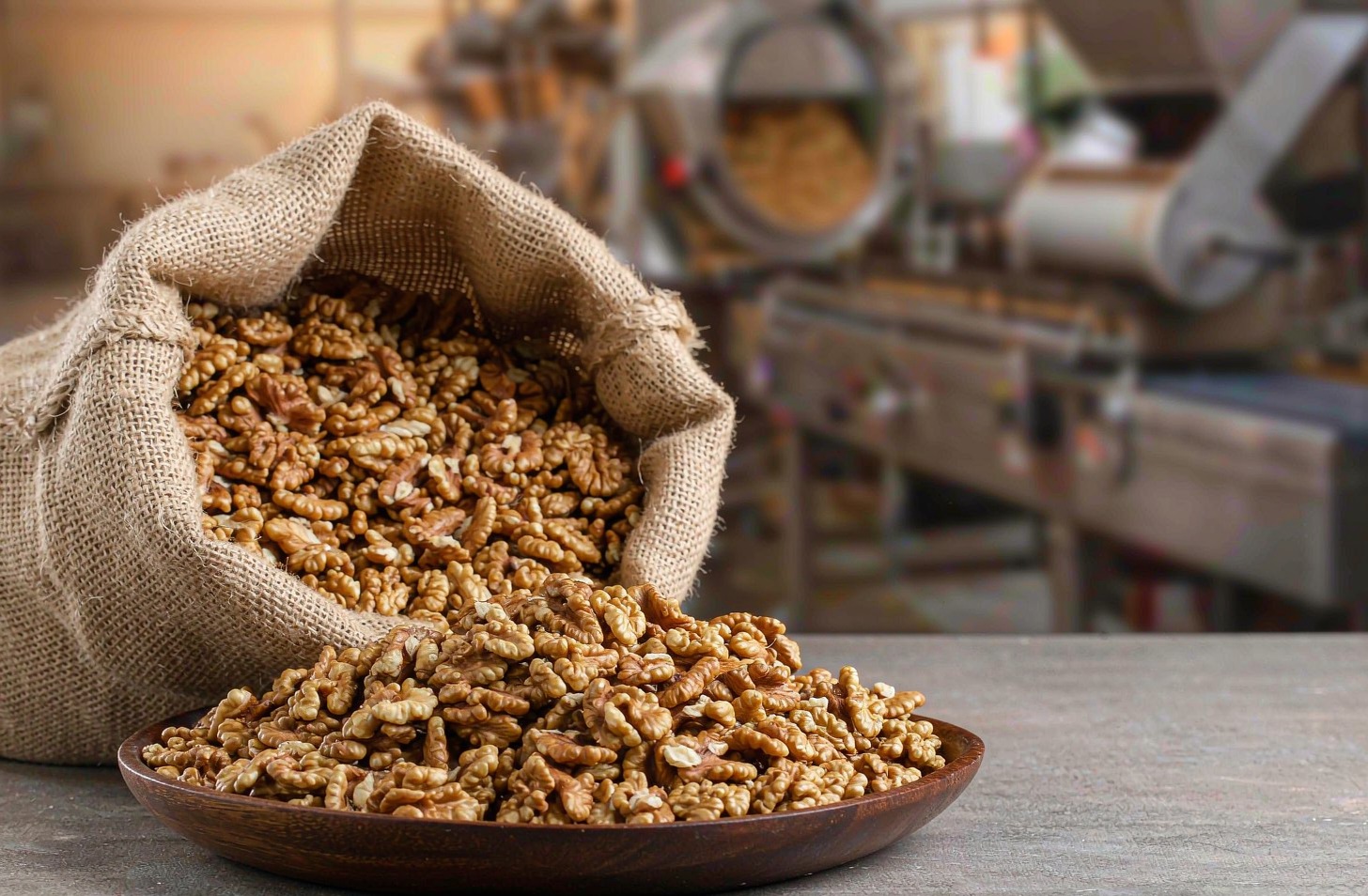
Walnut Kernel Price Per Ton China: 2026 Buyer’s Cost Guide
Walnut kernel prices per ton in China in 2026 sit in a wide band — roughly USD 4,800 to USD 11,000 per metric ton FOB — because “walnut kernel” is not one product. Light halves for retail packing quote near the top of that range, amber quarters and pieces near the bottom. The grade you buy, the outturn of the lot, the crop year and the packing spec move the number far more than the origin does. This guide breaks the per-ton price down by grade, shows what a ton actually costs once freight and testing are added, and explains how to benchmark any quote you receive.
What Drives the Price Per Ton of Chinese Walnut Kernels
A per-ton quote is the sum of five cost blocks: raw nut cost, outturn (how much saleable kernel one ton of in-shell nuts yields), processing, packing, and compliance. Understanding each one is the fastest way to tell a fair quote from a padded one.
1. Grade and Colour — The Largest Single Variable
Chinese walnut kernels are traded in five commercial forms: light halves (LH), light amber halves (LAH), amber halves, quarters (QTR) and pieces (PCS). Because halves command a premium in retail and bakery channels, the spread between LH and pieces can reach 80–100% on the same crop. Colour is assessed on a standard kernel colour card; “light” requires a pale, uniform tone with no dark veining.
2. Outturn and Kernel Yield
In-shell walnuts yield roughly 45–55% kernel by weight, depending on variety and crop condition. Two suppliers quoting the same in-shell price can therefore deliver very different kernel costs. A 3-point difference in yield moves landed kernel cost by about 6–7% — usually more than any negotiation on the raw nut price.
3. Crop Year and Harvest Pressure
New-crop Chinese walnuts arrive from late September through November. Prices typically peak in the first weeks of the harvest on speculative buying, ease through November–December as supply and quality become clear, and firm again from February as cold-storage inventory is drawn down. Buying a 2026-crop lot in October versus January can mean a 5–12% difference per ton.
4. Processing Depth
Raw, ungraded kernels are cheap; export-grade kernels are not. Hand-picking tables, CCD colour sorters, X-ray and metal detection, and moisture-controlled packing all add cost — but they are also what makes a lot acceptable to EU, Japanese or North American buyers. Kernel that has passed double hand-sorting plus colour sorting typically carries a USD 250–450 per ton premium over single-pass product.
5. Compliance and Documentation
Laboratory testing for aflatoxins, pesticide residues, microbiology and heavy metals, plus certification maintenance (HACCP, ISO 22000, BRCGS, HALAL, Kosher, organic), is priced into every serious quote. A quote that is 8% below the market usually reflects missing testing or a lower grade — not a better deal.
2026 Walnut Kernel Prices Per Ton by Grade
The table below shows indicative FOB ranges for Chinese walnut kernels in 10 kg vacuum cartons, 18 MT lots, Q4 2026. Treat these as benchmarking anchors, not fixed prices: every quote should be confirmed against a named spec, a crop year and a loading port.
| Grade | Typical specification | Indicative FOB (USD/MT) | USD per kg | Main channels |
|---|---|---|---|---|
| Light Halves (LH) | ≥90% halves intact, pale uniform colour, moisture ≤5%, defects ≤1% | 9,200 – 11,000 | 9.20 – 11.00 | Retail packs, premium bakery, gift packs |
| Light Amber Halves (LAH) | ≥85% halves, light amber tone, moisture ≤5% | 8,000 – 9,300 | 8.00 – 9.30 | Confectionery, cereal, food service |
| Amber Halves | ≥80% halves, amber colour accepted, moisture ≤5.5% | 7,000 – 8,100 | 7.00 – 8.10 | Bakery, ice cream, industrial use |
| Quarters (QTR) | Quarter pieces, colour mixed, foreign matter ≤0.1% | 6,200 – 7,100 | 6.20 – 7.10 | Bars, granola, fillings |
| Pieces (PCS) | 8–12 mm pieces, mixed colour | 4,800 – 5,900 | 4.80 – 5.90 | Pastes, butter, bakery inclusions |
| In-shell reference (30–32 mm) | Xinjiang 185 / 33 type, moisture ≤8% | 2,300 – 2,900 | 2.30 – 2.90 | Wholesale, roasting, retail in-shell |
For calibration, our own walnut kernel product range is quoted against the same grade definitions, so you can compare like with like across suppliers.
What One Ton Really Costs: From FOB to CIF
Most first-time buyers compare FOB numbers and are surprised by the invoice that arrives after freight is added. Here is how one ton of light halves builds up on a typical Middle East or European routing.
| Cost element | Basis | USD per MT | USD per 18 MT container |
|---|---|---|---|
| Kernel, FOB Tianjin/Qingdao | Light halves, 10 kg vacuum carton | 9,200 – 11,000 | 165,600 – 198,000 |
| Ocean freight | 20’FCL, 18 MT payload | 90 – 190 (Jebel Ali) 150 – 300 (Rotterdam) |
1,600 – 3,400 / 2,700 – 5,400 |
| Marine insurance | 0.3–0.5% of CIF value | 30 – 55 | 540 – 990 |
| Port handling, THC, documents | Origin + destination | 45 – 90 | 810 – 1,620 |
| Indicative CIF | Before duty and clearance | ~9,400 – 11,300 | ~169,000 – 204,000 |
Two practical points. First, a 20′ container of kernels rarely loads more than 18–19 MT because carton configuration and weight limits bind before cubic capacity does. Second, destination duty, VAT, port storage and inspection are excluded — in the EU, shelled walnuts under HS 0802.32 typically enter at low or zero MFN duty but still carry full import VAT and food-safety checks.
Converting In-Shell Prices to Kernel Cost
If your supplier offers both in-shell walnuts and kernels, the in-shell quote tells you a lot about whether the kernel quote is fair. The conversion is:
Kernel cost basis = (in-shell price − shell credit) ÷ kernel yield
The shell credit matters: walnut shells sell as an industrial abrasive, blasting media or fuel at roughly USD 60–120 per ton, so they offset part of the raw material cost.
| In-shell price (USD/MT) | Kernel yield | Shell credit | Kernel cost basis (USD/MT) |
|---|---|---|---|
| 2,600 | 45% | 55 | ≈ 5,656 |
| 2,800 | 47% | 53 | ≈ 5,845 |
| 2,900 | 48% | 52 | ≈ 5,933 |
| 3,000 | 50% | 50 | ≈ 5,900 |
Add processing (USD 350–450/MT), packing (USD 150–250/MT) and testing (USD 40–80/MT) to reach a realistic ex-works kernel cost. Notice that yield moves the result more than the in-shell price: raising yield from 45% to 50% can save more than a USD 100/MT cut in raw nut cost. That is why professional buyers audit outturn testing before they negotiate.
Why Two Quotes for the “Same” Kernels Differ by 20%
When three suppliers quote light halves and the numbers range from USD 8,900 to USD 10,800, the gap is almost always in the specification, not the market.
| Specification variable | Cheaper quote often means | Premium quote usually means |
|---|---|---|
| Halves integrity | 70–75% halves, balance quarters | ≥90% halves, verified at packing |
| Colour | Mixed light/amber, no colour card reference | Colour-card matched batch |
| Moisture | 6%+ (higher weight, shorter shelf life) | ≤5%, moisture-controlled packing |
| Defects & foreign matter | 2–3% defects, untested | ≤1% defects, ≤0.1% FM, metal-detected |
| Microbiology | No CoA, salmonella status unknown | Batch CoA: salmonella negative, APC/yeast/mould in spec |
| Aflatoxin | “Within limits” without a report | Tested to EU 2023/915 limits (total 10 µg/kg, B1 6 µg/kg for walnuts) |
| Packing | 25 kg PP bags, no vacuum | 10 kg vacuum cartons, nitrogen flushing available |
| Payment terms | 100% T/T before shipment | 30/70 against documents, or L/C at sight |
A 20% price gap therefore usually equals a 20% difference in what is inside the carton — and a much bigger difference in rejection risk at destination.
Inside the Factory Cost Structure
Knowing how a processor’s cost per ton is built helps you see where a discount can realistically come from.
| Cost block | Share of ex-works kernel price | Notes |
|---|---|---|
| Raw in-shell nuts | 78 – 84% | Set by farm-gate price and yield |
| Cracking, shelling, grading | 5 – 8% | Energy, labour, screen and sorter wear |
| Hand sorting & QC | 3 – 5% | Labour-intensive; higher for LH grade |
| Packing materials | 2.5 – 4% | Vacuum film, cartons, pallets, liners |
| Lab testing & certification | 1 – 2% | Per-batch aflatoxin, micro, residue panels |
| Inland transport to port | 1 – 2% | Inner Mongolia / Xinjiang to Tianjin or Qingdao |
| Processor margin | 4 – 8% | Thin in commodity years, wider in short crops |
Because raw material is roughly four-fifths of the cost, no factory can cut 15% from a quote without changing grade, yield assumption or testing scope. Buyers who understand this stop chasing the lowest number and start negotiating on specification, volume and payment terms instead.
How to Benchmark a Per-Ton Quote in 5 Steps
- Normalise the basis. Convert every quote to the same unit — USD per metric ton, FOB the same port, same packing. A CIF quote in USD/lb cannot be compared to an FOB quote in USD/kg without conversion.
- Fix the specification in writing. Halves percentage, colour reference, moisture, defects, foreign matter, aflatoxin and micro limits. No spec, no comparison.
- Ask for the outturn report. Request the yield test for the lot: in-shell input weight, kernel output, halves/quarters/pieces split. Cross-check the arithmetic yourself.
- Request a batch Certificate of Analysis. It should match the lot number and the shipment date, not a generic sample from last season.
- Compare landed cost, not headline price. Add freight, insurance, port charges, duty and expected rejection risk. A cheaper FOB with a 5% rejection probability is usually the more expensive ton.
2026 Price Risks to Watch
- Spring frost and summer heat in Xinjiang and Yunnan affect nut size and yield; a short crop lifts kernel prices within weeks.
- Freight volatility on Asia–Europe and Asia–Middle East lanes can swing CIF by USD 100–200 per ton with no change in the kernel market.
- EU border controls on aflatoxins and pesticide residues: a rejected container costs far more than any price saving.
- Currency: RMB movement against the dollar changes factory quotes even when farm prices are flat.
- Cold-storage release: old-crop stock sold off before the new season can temporarily depress prices — and quality.
For reference data on global walnut production and trade flows, see the FAO FAOSTAT database; for the EU contaminant limits that shape testing costs, see Regulation (EU) 2023/915; and for the food-safety management standard most Chinese processors are certified against, see ISO 22000.
FAQ: Walnut Kernel Prices Per Ton from China
How much does one ton of walnut kernels cost in China in 2026?
Indicative FOB ranges in Q4 2026 are USD 9,200–11,000 per MT for light halves, USD 7,000–9,300 for amber and light amber halves, USD 6,200–7,100 for quarters and USD 4,800–5,900 for pieces. Your final price depends on grade, crop year, packing and volume.
Is it cheaper to buy in-shell walnuts or kernels?
Kernels cost more per ton but less per usable kilogram. In-shell walnuts are cheaper only if you have the cracking capacity and can sell or dispose of shells; at 45–50% yield plus processing and labour, most importers find buying graded kernels more predictable.
Why is there such a large gap between light halves and pieces?
Halves sell at a retail and bakery premium, while pieces go into paste, butter and inclusion channels. The spread on the same crop is typically 70–100%, and it widens when retail demand is strong.
What is the minimum order for a per-ton price?
Most Chinese factories quote per-ton prices from 1 MT for trial orders, but the best per-ton economics usually start at a 20’FCL — about 18 MT of kernels. Below that, packing and inland freight are charged at a higher unit rate.
Do quoted prices include shipping and insurance?
Only if the quote says CIF or CFR. FOB prices exclude ocean freight, insurance and destination charges. Always confirm the Incoterm, the loading port and the freight validity period, which is often only 7–14 days.
How can I verify that a per-ton quote is fair?
Benchmark three things: the grade specification in writing, the outturn or yield report, and a batch Certificate of Analysis. Then compare landed cost rather than FOB. A quote within 5% of the market with full documentation is normally a better buy than the cheapest number in the inbox.
When is the best time to buy Chinese walnut kernels?
Generally November to January, once new-crop quality is confirmed and harvest speculation has eased. Buying before quality data is available in October carries grade risk; buying after March usually means paying a cold-storage premium.
Get a Verified Per-Ton Quote from Ouji International
Ouji International has processed and exported walnuts, walnut kernels, pumpkin seeds, sunflower seeds, cashews and pecans since 2013, operating two processing plants and six automatic production lines from Hohhot, Inner Mongolia. Every kernel lot ships with a grade specification, an outturn record and a batch Certificate of Analysis, so the ton you price is the ton you receive. Send us your target grade, volume and destination port — we will return a per-ton quote with the full cost breakdown, FOB or CIF, within one working day.