

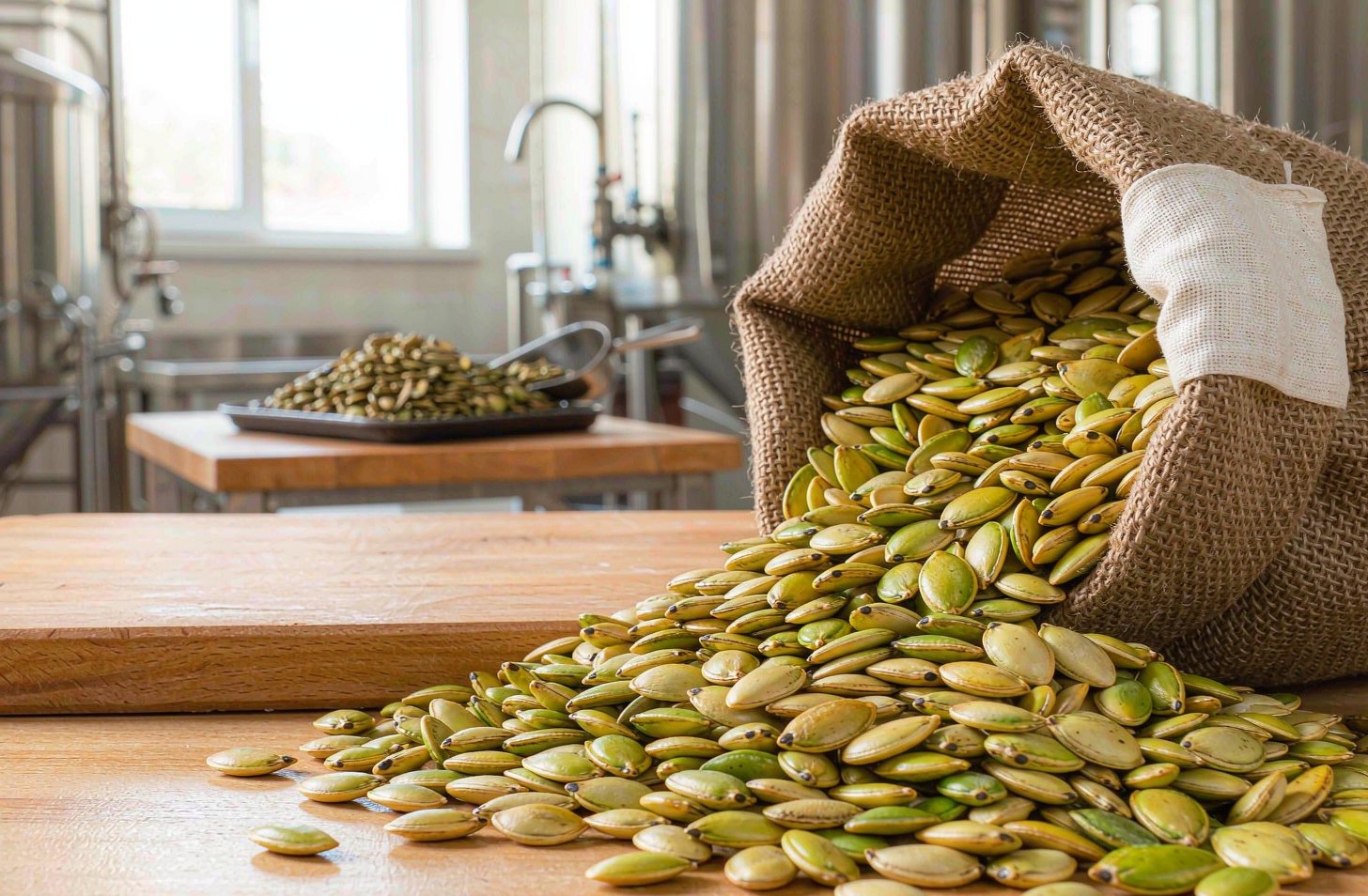
How to Choose a Reliable Pumpkin Seed Supplier from China
Finding a reliable pumpkin seed supplier from China comes down to verifying five things before you sign anything: food-safety certification, processing and grading capability, consistent quality specifications, transparent communication, and export documentation. China is one of the world’s largest origins for high-quality pumpkin seeds, especially from Inner Mongolia, where the dry climate and long sunshine hours produce plump, uniform kernels. But a good origin country does not automatically mean a good supplier. This guide walks importers through a practical, step-by-step vetting process so you can buy bulk pumpkin seeds with confidence.
If you are a wholesale buyer, food manufacturer, or trading company sourcing Shine Skin, GWS, Snow White, or hulled pumpkin seed kernels for Europe, the Middle East, North America, or Asia, the criteria below apply to every order — whether it is your first 1-ton trial or your hundredth container.
Why Source Pumpkin Seeds from China
China’s pumpkin seed industry is concentrated in Inner Mongolia, Xinjiang, and Gansu, where pumpkin seeds are a major cash crop. Chinese suppliers offer:
- Competitive pricing — large-scale cultivation keeps farm-gate costs lower than most competing origins;
- Wide variety selection — Shine Skin (光板), GWS (白板), Snow White, and kernel types are produced in the same growing region, which simplifies mixed-container sourcing;
- Processing maturity — modern plants with automatic cleaning, grading, color-sorting, and metal-detection lines;
- Proven export track record — China is a leading exporter of pumpkin seeds and kernels to Europe, the Middle East, and Asia.
The main risk for overseas buyers is not origin quality — it is supplier inconsistency: changing quality between batches, substituting grades, or failing to deliver paperwork on time. That is exactly what a proper vetting process prevents.
5 Key Criteria for Vetting a Pumpkin Seed Supplier
1. Food-Safety Certifications and Audit Readiness
For edible nuts and seeds, certification is the first filter. A reliable supplier should be able to show, at minimum:
- HACCP / ISO 22000 — food-safety management systems;
- ISO 9001 — quality management;
- HALAL and/or Kosher certificates — if you supply Middle East, Southeast Asia, or Jewish-market customers;
- BRC or IFS — increasingly expected by European retailers and large food manufacturers.
Certificates alone are not proof — ask for the certifying body and validity date, and confirm the scope covers the actual plant. A supplier that is genuinely certified will volunteer this documentation without hesitation.
2. Processing and Grading Capability
Bulk buyers should understand exactly how the supplier processes and grades seeds:
- Automatic grading lines — sieve grading by size (e.g., 200–240, 240–260, 260–280 seeds per 100 g) produces consistent lots;
- Color sorting — removes discolored, moldy, or damaged seeds that human sorting can miss;
- Metal detection — a non-negotiable step for food export;
- Moisture control — moisture below 8–9% prevents mold and rancidity during shipping;
- Hand-picking stations — for premium grades and final visual inspection.
Ask whether sorting happens at the supplier’s own facility or is outsourced. Integrated processing plants (factories that clean, grade, and pack under one roof) give you far more control over consistency than trading companies that buy and resell from multiple mills.
3. Quality Specifications That Match Your Market
Different markets buy different specs. Make your requirement explicit in writing before sampling:
- Variety — Shine Skin (high-gloss light green), GWS (snow-white shell), Snow White, or kernels;
- Grade — AA / AAA for retail snack packs, lower grades for further processing;
- Purity — e.g., 99%, 99.5%, or 99.9% kernel purity;
- Moisture and admixture limits — the two numbers every contract should state;
- Packing — 25 kg pp bags, 50 kg pp bags, or vacuum/retail packs with custom branding.
A professional supplier will send you a specification sheet with a physical sample and will confirm that the delivered lot matches the pre-shipment inspection report — not just the quote.
4. Communication and Export Experience
Sourcing is a relationship, not a transaction. Evaluate the supplier’s export maturity:
- Do they respond within 24 hours with clear, specific answers?
- Can they quote FOB, CIF, or DDP correctly for your port?
- Do they prepare complete export paperwork — commercial invoice, packing list, certificate of origin, phytosanitary certificate, and insurance?
- Do they arrange third-party inspection (SGS, Bureau Veritas, Intertek) before shipment?
- Do they already serve buyers in your region and understand local documentation rules?
5. Samples, Small Orders, and Reference Checks
Never place a container order on the strength of photos. The minimum responsible test sequence is:
- Request pre-shipment samples and check aroma, taste, color, and uniformity yourself;
- Place a trial order (1–5 tons) and inspect the actual shipped lot;
- Ask for two or three existing buyer references in markets similar to yours;
- If volume justifies it, arrange a factory audit — on-site or via video tour — and compare what you see against the certifications.
Typical Pumpkin Seed Specifications at a Glance
| Parameter | Common Export Standard |
|---|---|
| Moisture | ≤ 8–9% |
| Admixture | ≤ 0.5–1% |
| Purity (kernels) | 99% – 99.9% |
| Size (Shine Skin / GWS) | 200–240, 240–260, 260–280 seeds / 100 g |
| Packing | 25 kg / 50 kg PP bags, or custom retail packing |
| Shelf life | 12 months under dry, cool storage |
Red Flags to Walk Away From
- A supplier who cannot name their processing plant location or show it on a map;
- Certificates that are expired, photoshopped, or issued by unknown bodies;
- Quotes far below the market range — quality is usually the first thing cut;
- Refusal to send samples, sign a specification sheet, or accept third-party inspection;
- Pressure to pay 100% in advance with no letter of credit or escrow option for first orders.
Why Ouji International Is a Reliable Pumpkin Seed Supplier
Hohhot Ouji International Co., Ltd. (Ouji International) is an agricultural food exporter based in Hohhot, Inner Mongolia — right at the center of China’s pumpkin seed production belt. Established in 2013, the company works with 2 production processing plants and 6 automatic production lines, supplying pumpkin seeds, pumpkin seed kernels, sunflower seeds, walnuts, and other nuts to Europe, the Americas, Japan and South Korea, the Middle East, North Africa, and South America.
What importers typically notice when working with Ouji:
- Origin advantage — Inner Mongolia sourcing means fresher, plumper seeds with shorter farm-to-port lead times;
- Stable quality control — automatic cleaning, grading, and inspection at integrated plants;
- Export paperwork handled — full documentation for customs clearance, plus third-party inspection support;
- Market experience — a team with 10+ years of foreign trade serving both end users and trading companies;
- 24/7 service — fast quotes, samples, and after-sales support across time zones.
Frequently Asked Questions
Which Chinese city is best for pumpkin seed sourcing?
Inner Mongolia — especially Hohhot and Bayannur — is the leading production area. Suppliers based here (like Ouji International) sit closest to the farms, giving them fresher stock and better control over grading and price.
What is the minimum order quantity for bulk pumpkin seeds?
Most exporters accept trial orders of 1–5 tons or even a few sample cartons first. Container orders typically start at 12–13 tons (20 ft) or 24–26 tons (40 ft) depending on packing and variety.
Do I need HALAL or Kosher certification for the Middle East?
Yes. Most Middle Eastern and some Southeast Asian markets require HALAL certificates for edible seeds; Kosher is commonly requested by buyers supplying Jewish-market retailers. Ask your supplier to confirm both are current.
How can I verify a Chinese pumpkin seed supplier is real?
Combine checks: confirm business registration, ask for a live video tour of the plant, request samples, place a small trial order, and use third-party inspection before the first full shipment. A reliable exporter will support all of these steps.
What documents do I need to import pumpkin seeds from China?
Typically: commercial invoice, packing list, bill of lading, certificate of origin, phytosanitary certificate, and any market-specific certificates (HALAL, Kosher, or heavy-metal test reports). Your supplier’s export team should prepare these routinely.
Conclusion
A reliable pumpkin seed supplier from China is one you can verify — on paper, in the sample, and in the container. Check certifications and processing capability first, lock quality specifications into writing, test with samples and a trial order, and choose an origin-based exporter with real plants and real export experience.
If you are sourcing Shine Skin, GWS, Snow White, or pumpkin seed kernels in bulk, contact Ouji International for samples, current specifications, and export pricing — we will help you match the right grade to your market and deliver it on time, anywhere in the world.