

Bulk Pumpkin Kernels Packaging Guide: Bags, Cartons & Shipping
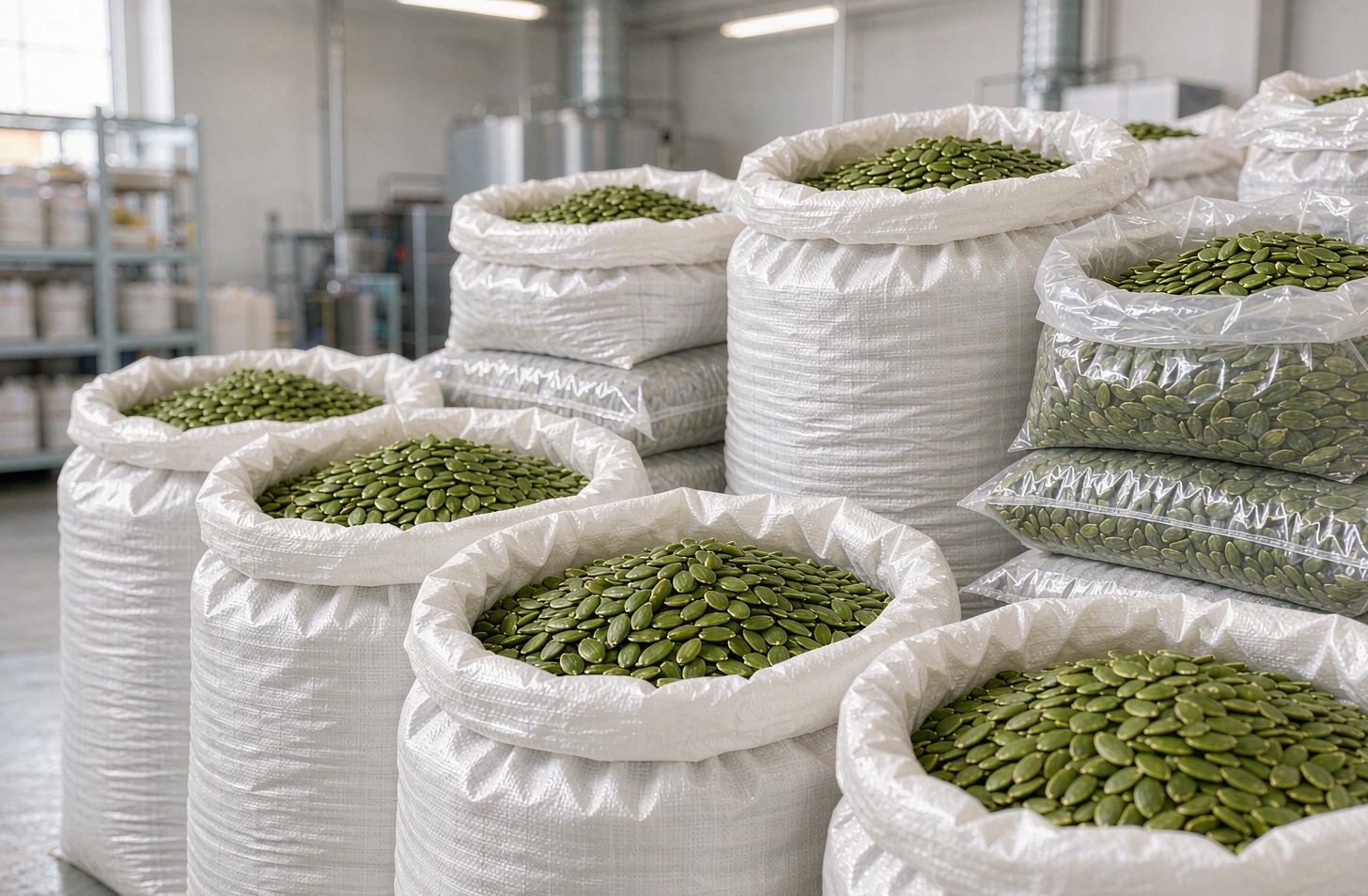
Choosing the right packaging for bulk pumpkin kernels is one of the most underrated decisions in the entire import process. The kernel that leaves the factory at 99.9% purity can still arrive rejected at your warehouse if it was packed in the wrong bag, loaded into the wrong container, or sealed without a moisture barrier. In short: standard export lots of pumpkin seed kernels are packed in food-grade inner liners inside 25 kg or 50 kg PP woven bags, palletized or loose-loaded into 20-foot or 40-foot containers, with moisture kept below 8% throughout transit. This guide explains every packaging option available from Chinese suppliers, how each option affects shelf life and landed cost, and how to specify packaging in your contract so nothing is left to interpretation.
Whether you are a food manufacturer buying full containers, a packer filling retail bags, or a distributor consolidating mixed nuts, understanding bulk pumpkin kernel packaging will protect your quality claims, reduce claims and disputes, and often save real money per ton. The recommendations below reflect how experienced exporters in Inner Mongolia — the world’s leading pumpkin seed origin — actually pack and ship kernels to Europe, the Middle East, North America, and Asia.
Why Packaging Decides Whether Your Kernels Arrive Sellable
Pumpkin seed kernels are a high-oil, shelf-stable product — but only under the right conditions. Three enemies destroy kernel quality in transit:
- Moisture — kernels packed above 8% moisture, or exposed to humidity in a non-breathable bag, will develop mold and free fatty acids. This is the number-one cause of rejected lots.
- Oxidation — exposure to air turns the delicate green color dull and produces rancid off-flavors. Vacuum packing or oxygen-barrier liners dramatically extend shelf life.
- Pest and contamination risk — torn woven bags or reused cartons invite infestation and cross-contamination during sea freight, which can take 25–45 days from North China ports to Europe or the Americas.
Good packaging is cheap insurance. A food-grade liner and proper woven bag typically add only a few dollars per ton, while a rejected container can cost tens of thousands of dollars plus a season of delayed production. According to FAO market data, global demand for edible seeds and tree nuts continues to grow, and buyers increasingly audit not just product quality but also packaging and traceability standards.
Standard Export Packaging Options for Bulk Pumpkin Kernels
Chinese pumpkin kernel exporters offer a small number of proven configurations. The table below summarizes the most common ones and their typical use cases:
| Packaging Option | Specification | Best For | Shelf-Life Protection |
|---|---|---|---|
| PP woven bag + PE inner liner | 25 kg or 50 kg net | Industrial processing, oil crushing, re-packing | Standard (6–12 months) |
| PP woven bag + vacuum-sealed foil liner | 25 kg net | Premium kernels, long transit, humid destinations | High (12+ months) |
| Carton + vacuum bag | 10 kg / 12.5 kg / 20 kg | Retail packers, bakery chains, high-value grades | High (12+ months) |
| Retail-ready pouches in cartons | 250 g – 1 kg, private label | Supermarket and e-commerce brands | Highest (with nitrogen flush) |
| Big bag (FIBC) | 500 kg – 1000 kg | Oil mills and large-scale processors | Standard, needs dry storage |
25 kg vs 50 kg Bags: Which Should You Order?
The classic bulk format is a 25 kg PP woven bag with an inner food-grade PE liner. Most buyers — especially in Europe and the Middle East — prefer 25 kg because it is easier for warehouse staff to handle safely and generates less product breakage at the bottom of the stack. 50 kg bags reduce packaging cost slightly but increase manual-handling risk and compaction damage. If your line feeds directly into roasting or sorting equipment, ask your supplier whether the liner should be heat-sealed or tied; heat-sealed liners give the best moisture barrier but require cutting equipment at your end.
Vacuum Packing: When It Is Worth the Extra Cost
Vacuum-sealed foil liners inside the woven bag cost roughly 10–20% more per ton in packaging, but they pay for themselves in three situations:
- Long sea transit — shipments from China to South America or West Africa can spend 40+ days in humid holds;
- Summer shipments — kernels crossing the Red Sea or Persian Gulf in July face extreme container temperatures;
- Premium AAA grades — where a dull color or off-aroma immediately downgrades the value of the lot.
For standard AA-grade industrial shipments into nearby markets, a well-tied PE liner is usually sufficient. Discuss the route and season with your supplier — an experienced exporter will recommend vacuum packing proactively when the route demands it.
How Packaging Choices Affect Container Loading and Freight Cost
Packaging format directly determines how many kilograms you can fit in a container — and therefore your freight cost per ton. Typical loading figures for pumpkin seed kernels from North China ports (Tianjin, Qingdao) are:
| Container | 25 kg PP Bags | Approx. Load |
|---|---|---|
| 20 GP (without pallets) | ~680–720 bags | 17–18 MT |
| 20 GP (palletized) | ~600–640 bags | 15–16 MT |
| 40 GP (without pallets) | ~1,100–1,160 bags | 27–29 MT |
| 40 HQ (without pallets) | ~1,280–1,340 bags | 32–33 MT |
Three practical notes for buyers:
- Palletized loading costs space but saves time and damage — if your warehouse is forklift-friendly, ask for fumigated ISPM-15 pallets and stretch wrap. Many European buyers require pallets by default.
- Loose loading maximizes weight but requires floor labor at destination and slightly increases bag slippage damage.
- Desiccant strips and container drying bags are a low-cost addition for humid destination ports; request them for Middle East and Southeast Asia shipments, especially in summer.
Private Label and Retail Packaging for Pumpkin Kernels
If you sell under your own brand, most Chinese pumpkin kernel suppliers — including integrated processors with their own packing lines — offer OEM retail packaging: stand-up pouches, zipper bags, vacuum bricks, or PET/PE laminated films printed with your artwork, filled at weights from 250 g to 1 kg. When requesting retail packing, specify in writing:
- Film structure and barrier properties (e.g., PET/AL/PE with oxygen transmission limits);
- Nitrogen flush or vacuum level;
- Printing process (gravure for large runs, digital labels for short runs);
- Language, nutrition panel, and compliance with your market’s labeling law (EU 1169/2011, FDA, GCC standards);
- Minimum order quantity — retail packing usually requires 5–10 tons per SKU to be economical.
Retail-packed cartons should also be drop-tested and stacked to a defined pallet height. A supplier who proactively discusses these details is demonstrating the processing maturity you want behind your brand.
What to Write in Your Contract: The Packaging Clause
Vague packaging terms are a leading source of disputes. A professional packaging clause should state all of the following, in one sentence if possible:
“Packing: pumpkin seed kernels packed in food-grade PE inner liner, heat-sealed, inside new 25 kg PP woven bags; bags loaded on ISPM-15 fumigated pallets, stretch-wrapped; container fitted with desiccant bags; packing specification per confirmed pre-shipment sample.”
Key elements to never leave unstated:
- Bag weight and tolerance (e.g., 25 kg net, ±0.2 kg);
- Liner type and sealing method (PE vs foil, tied vs heat-sealed, vacuum or not);
- New bags only — always; reconditioned bags are a food-safety red flag;
- Marking and labeling — product name, grade, lot number, net weight, origin, harvest year, and your consignee details printed or labeled on each bag;
- Reference to the approved sample — packaging is judged against the sample you signed off, not against a verbal description.
How Ouji International Packs Bulk Pumpkin Kernels
Hohhot Ouji International Co., Ltd. (Ouji International) is an agricultural exporter based in Hohhot, Inner Mongolia, established in 2013, operating 2 processing plants and 6 automatic production lines serving buyers across Europe, the Americas, Japan and South Korea, the Middle East, North Africa, and South America. Standard packing for its Shine Skin, GWS, and hulled pumpkin seed kernels is 25 kg PP woven bags with food-grade inner liners, with vacuum-packed and private-label retail options available on request.
Because the company’s plants sit inside the Inner Mongolia growing belt, kernels move from farm to packed bag with minimal handling, and packaging can be matched to the exact route and season of your shipment. Buyers can review the full product range — including walnut kernels, sunflower seeds, cashews, and pecans — on the Ouji International website and request a packaging specification sheet together with the grade specification before ordering.
Frequently Asked Questions
What packaging is best for bulk pumpkin seed kernels?
For most industrial buyers, 25 kg PP woven bags with a heat-sealed food-grade PE liner is the standard and most cost-effective choice. Use vacuum foil liners for premium grades, long routes, or humid destinations.
How many tons of pumpkin kernels fit in a 20-foot container?
Approximately 17–18 MT loose-loaded in 25 kg bags, or 15–16 MT palletized. A 40 HQ container holds roughly 32–33 MT.
Do pumpkin kernels need vacuum packing for sea freight?
Not always. A sealed PE liner is sufficient for short, cool routes. Vacuum packing is recommended for shipments longer than 30 days, summer departures, and AAA retail grades.
What is the shelf life of properly packed pumpkin kernels?
Typically 12 months in standard liner bags and 18–24 months in vacuum-sealed packaging, stored below 20 °C and away from direct sunlight.
Can suppliers print my brand on retail pumpkin kernel packs?
Yes. Most established exporters offer OEM retail pouches from 250 g to 1 kg with private-label printing, usually from 5–10 tons per SKU.
Should bags be palletized for export?
Palletizing on ISPM-15 fumigated pallets is recommended for European and large industrial buyers: it speeds unloading, reduces damage, and is often a customer requirement.
Conclusion: Specify Packaging Before You Sign
Packaging is not a footnote to your pumpkin kernel order — it is the system that carries your quality claims across 30 days of ocean freight and into your customer’s hands. Decide the bag weight, liner type, sealing method, palletization, and container treatment before signing the contract, reference the approved sample, and your bulk pumpkin kernels will arrive exactly as they left the plant: plump, green, and premium. Ready to review packaging options for your next shipment? Contact Ouji International for a specification sheet and a packaging quotation tailored to your route and market.