

China Nuts Supply Chain Explained: Farm to Port in 6 Steps
The China nuts supply chain usually runs through four layers before a container leaves the port: farms and cooperatives, primary processing plants, trading companies, and exporters or consolidators. Each layer adds cost and distance between you and the crop. Buying at the factory layer instead of the trader layer typically removes one to two intermediaries, improves traceability, and shortens the sample-to-shipment cycle. This guide maps each step, explains where quality and cost are actually created, and shows how importers verify the chain instead of trusting it.
It is written for importers, roasters, snack manufacturers and private-label brands sourcing walnuts, pumpkin seeds, sunflower seeds, pecans or cashews from China.
What Does China’s Nut Supply Chain Look Like?
China’s nut trade is origin-clustered: growing regions sit far inland, ports sit on the coast, and a chain of specialised businesses in between handles cleaning, drying, grading, storage, finance and paperwork. Knowing who does what tells you where your money goes and where your risk sits.
| Layer | What they do | Typical value added | Main risk for the buyer |
|---|---|---|---|
| 1. Farms & cooperatives | Grow, harvest, sun-dry, deliver to collection points | Raw material, basic moisture control | Uneven moisture, admixture, inconsistent lots |
| 2. Primary processors | De-hulling, shelling, washing, drying, gravity separation, colour sorting, metal detection, packing | Food safety, grading, shelf life | Grade substitution, weak QC records |
| 3. Trading companies | Aggregate lots from several plants, hold stock, arrange domestic logistics | Volume flexibility, working capital | Loss of lot traceability, blended origins |
| 4. Exporters / consolidators | Export documentation, inspection, booking, container loading, mixed-SKU consolidation | Compliance, shipping reliability | Paperwork errors, port delays |
| 5. Port & inspection | Customs declaration, CIQ inspection, phytosanitary certification, terminal handling | Legal clearance | Detention, re-inspection, demurrage |
Two practical notes. First, the layers overlap: good exporters own processing lines, and strong processors hold export licences — that overlap is what “factory-direct” means. Second, always confirm whether your contact owns the plant or merely books capacity in it.
Step 1 to 6: How Nuts Actually Move from Farm to Port
Step 1 — Harvest and on-farm drying
Quality is largely decided before the crop reaches a plant. Moisture at harvest and drying speed determine kernel colour, rancidity risk and mould exposure. Walnuts are usually harvested from late August to October in China, pumpkin seeds from August to October, and sunflower seeds from September to October, depending on latitude and variety. Buyers should ask which harvest window a lot comes from: late-harvest material dried in cool, wet weather behaves very differently in a container.
Step 2 — Collection and first-stage cleaning
Farm-gate material moves to village collection points and then to a primary plant for de-stoning, aspiration and pre-cleaning. This is the first point where admixture is measured and where a real lot code should be created. If a supplier cannot say which plant a lot came from, the chain effectively starts here — not at the farm.
Step 3 — Processing, grading and food-safety controls
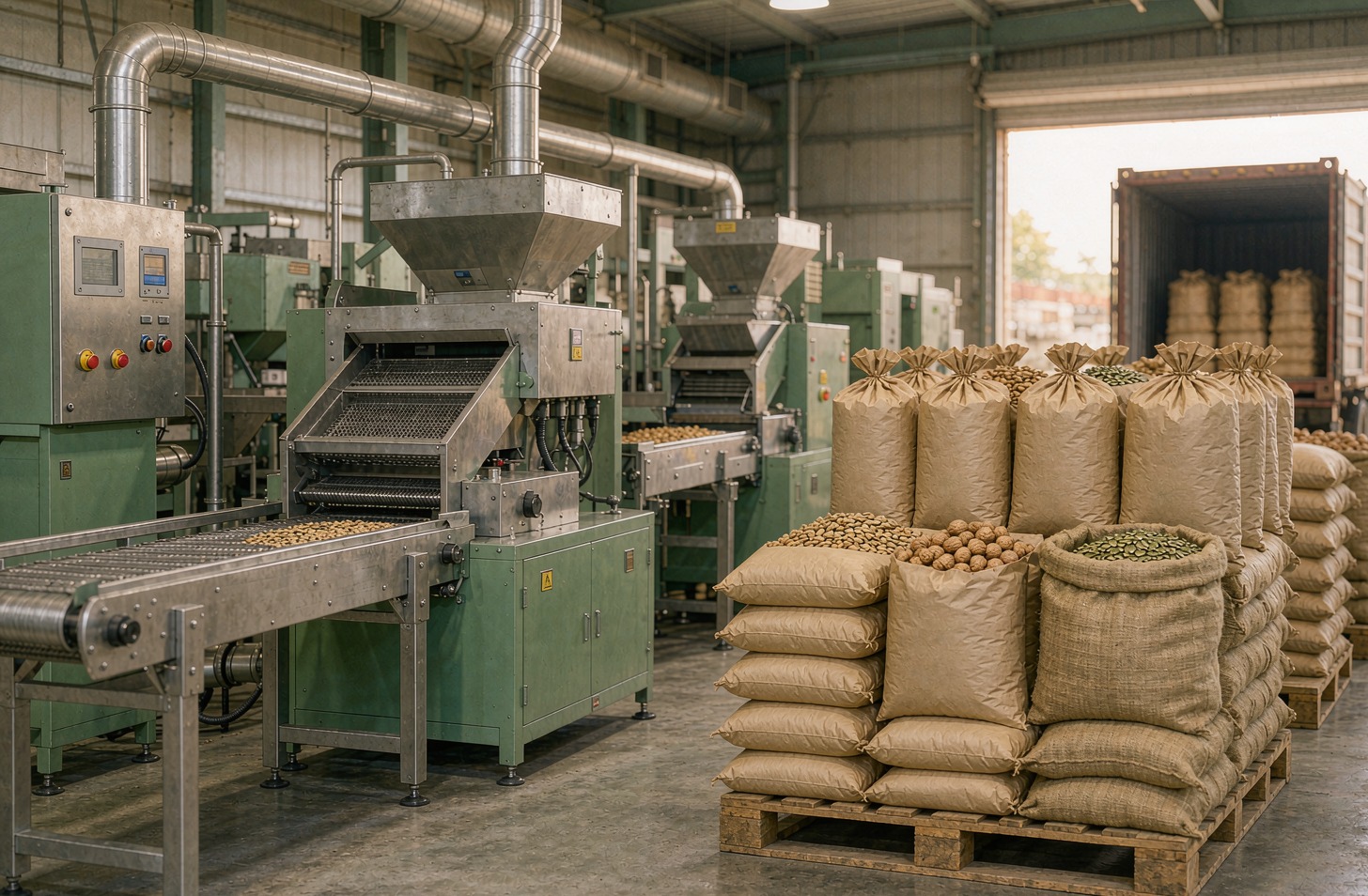
This is where your specification is manufactured: shelling or cracking, density and size grading, colour sorting, hand-picking of defects, metal detection and, for some products, roasting or pasteurisation. A modern line combines gravity separation, optical sorting and metal detection. A plant with HACCP-based controls and ISO 22000 should show monitoring records per lot — not just a certificate on the wall.
Step 4 — Storage and stock rotation
Seeds and kernels are hygroscopic. Storage temperature, humidity and stacking decide whether a good lot arrives as good cargo three months later. Ask about cold storage for kernels, fumigation policy, and whether your order comes from fresh production or older stock. Stock rotation is the least-asked and most expensive question in this chain.
Step 5 — Export documentation and inspection
Once a lot is allocated, the exporter assembles the compliance pack: commercial invoice, packing list, bill of lading, certificate of origin, phytosanitary certificate (aligned with the IPPC framework), health certificate where required, fumigation record, laboratory COA (aflatoxin, heavy metals, pesticide residues) and allergen/GMO statements. Wooden packaging must carry ISPM 15 marking. For the United States, importers also carry duties under the FDA Foreign Supplier Verification Program — your supplier’s records become your records.
Step 6 — Port, loading and sailing
Finally the cargo moves by rail or truck to a port such as Tianjin, Qingdao or Shanghai, clears customs and is stuffed — often at a designated CFS. Container condition, desiccant use and loading pattern belong to this step, and they cause more claims than the seed itself.
China’s Nut Supply Chain by Product
China is not a single “nut origin” — it is several different supply chains that happen to share ports. This matters when you build a mixed container or an annual contract.
| Product | Main growing regions | Harvest | China’s position |
|---|---|---|---|
| Walnuts & kernels | Xinjiang, Yunnan, Shaanxi, Shanxi, Sichuan | Late Aug – Oct | World’s largest producer; strong export supply of light halves and pieces |
| Pumpkin seeds (Shine Skin, GWS, Snow White) | Inner Mongolia, Xinjiang, Gansu | Aug – Oct | Dominant global supplier of seed and kernel |
| Sunflower seeds & kernels | Inner Mongolia, Xinjiang, Gansu, Heilongjiang | Sep – Oct | Major producer and exporter, especially confectionery and bakery grades |
| Pecans | Yunnan, Zhejiang, Anhui (limited) | Sep – Oct | Small domestic crop; most export volume is imported raw and re-processed |
| Cashews | Not grown commercially in China | — | Processing and repacking hub for raw cashew nuts from Vietnam, Cambodia and West Africa |
That last row is worth stating plainly: if a supplier claims “Chinese cashews”, what they mean is cashews processed in China. Reliable exporters say so. Origin honesty is a fast, cheap test of how the rest of the chain is managed — and it is consistent with the way origin and trade flows are recorded in FAOSTAT and UN Comtrade.
Why the Number of Intermediaries Affects Your Landed Cost
Every layer between farm and port is paid for by someone, and in practice that someone is the buyer. The build-up below is illustrative — not a quotation — but the proportions are typical for bulk kernels and seeds.
| Cost layer | Added to FOB (indicative) | What you get for it |
|---|---|---|
| Farm-gate / collection | Base | Raw material, first drying |
| Primary processing & grading | +6% to +12% | Specification, food safety, packing |
| Trading layer | +4% to +8% | Volume aggregation, stock, credit |
| Export & logistics layer | +3% to +6% | Documents, inspection, loading, risk cover |
Two conclusions follow. Removing a trading layer can save roughly 4–8% of FOB — real money on a 40′ container of kernels. But removing a competent export layer to save 3–6% usually costs more in document delays or moisture claims. The right target is not the fewest companies; it is the shortest chain that still owns its processing and its compliance.
Where Quality Risk Actually Enters the Chain
Moisture and storage history
Most aflatoxin and rancidity problems are storage problems, not farming problems. Ask for the moisture at packing and the packing date, then compare with the moisture on arrival. A jump of more than about one percentage point tells you the container or the warehouse is the issue.
Grading consistency between lots
Two lots can both meet “AA grade” on paper and look different in a fryer. Lock the specification numerically — count per ounce, size range in millimetres, defect and admixture tolerance, moisture, colour — and keep a retained sample per lot. Grading language without numbers is where substitution happens.
Allergen and cross-contamination control
A plant running peanut, sesame or gluten lines needs documented allergen changeover and cleaning validation — for EU and North American retail customers this is a specification item.
Documentation gaps
The certificate is the cheapest part of the chain and the most common cause of a held container. A supplier whose documents arrive correct and early is almost always one whose production is also under control. Codex Alimentarius principles are the reference most national authorities build on.
How to Buy at the Factory Layer: 6 Checks
- Confirm the legal entity owns the plant. Cross-check the business licence address against the plant address and the export registration.
- Ask for a live video walk-through of receiving, grading, metal detection and packing — not a photo gallery.
- Request lot-level records: incoming weight, moisture, grading result, metal-detection log, packing date.
- Order a retained sample plus a third-party lab test (aflatoxin, heavy metals, pesticide residues, microbiology as relevant).
- Run a trial shipment with pre-shipment inspection, then compare arrival quality against the retained sample.
- Write the specification and the document list into the contract, including tolerance for defects and the remedy if a lot fails.
Ouji International works at this layer: founded in 2013, based in Hohhot, Inner Mongolia, operating two processing plants with six automatic production lines for walnuts, walnut kernels, pumpkin seeds, sunflower seeds, pecans and cashews, exporting to Europe, North America, Japan and Korea, the Middle East, North Africa and South America. You can review the product range on our products page and the processing setup on our factory page — both are the parts of a supply chain a buyer can actually audit.
Traceability: What a Real Chain Partner Can Show You
Traceability is not a certificate — it is the ability to answer four questions about any bag in your warehouse: which plant, which lot, which date, which test. In practice, ask for:
- Lot codes printed on bags and repeated on the packing list;
- Processing date and line for each lot;
- Metal-detection and colour-sorter logs for the production run;
- Container loading photos showing pallet count, desiccant and door seal number;
- Retained samples held for at least the shelf-life period.
A supplier who can produce these within a day is running a chain. One who promises to “check with the plant” and returns a generic certificate is running a trading desk.
FAQ
How many intermediaries are typical in China’s nut supply chain?
Usually two to four between farm and port: a collection point or cooperative, a primary processing plant, often a trading company, and an exporter. Factory-direct buying cuts this to one or two layers.
Is it cheaper to buy nuts directly from a Chinese factory?
Generally yes — typically 4–8% lower than buying through a trading layer, because aggregation margin is removed. The saving only holds if the factory also handles export compliance properly.
Why is Inner Mongolia important in China’s nut supply chain?
Its dry climate and long sunshine hours suit pumpkin and sunflower seed production, and it sits near the Tianjin port corridor. Inner Mongolia with neighbouring Xinjiang and Gansu supplies most of China’s exported pumpkin seeds.
Are cashews grown in China?
No, not commercially. China is a processing hub: raw cashew nuts are imported from Vietnam, Cambodia and West Africa, then shelled, graded and packed for export.
How long does it take from farm to a shipped container?
For seeds and kernels, typically 3–8 weeks after harvest, depending on drying time, grading queue and shipping schedule. Peak-season congestion at inland plants is the usual delay factor.
What documents prove supply chain traceability?
A lot code on bag and packing list, processing and packing dates, lab COA per lot, phytosanitary certificate, certificate of origin and loading records. Lot-level records prove traceability — certificates alone do not.
How do I verify a Chinese nut exporter is a real factory?
Match the business licence address to the plant, request a live video tour, ask for processing records for one specific lot, and place a trial order with third-party inspection before a container programme.
Conclusion
The China nuts supply chain is short in geography and long in paperwork. Farms in Inner Mongolia, Xinjiang and Yunnan feed processing clusters, which feed trading desks, which feed ports. Every layer you keep adds cost; every layer you remove removes some control. The workable middle is a supplier that owns processing, owns export compliance and can prove lot-level traceability.
If you are building a sourcing programme for walnuts, walnut kernels, pumpkin seeds, sunflower seeds, pecans or cashews, contact Ouji International for current specifications, samples and export pricing — we will map the chain for your product, your market and your documentation requirements before the first container is booked.