

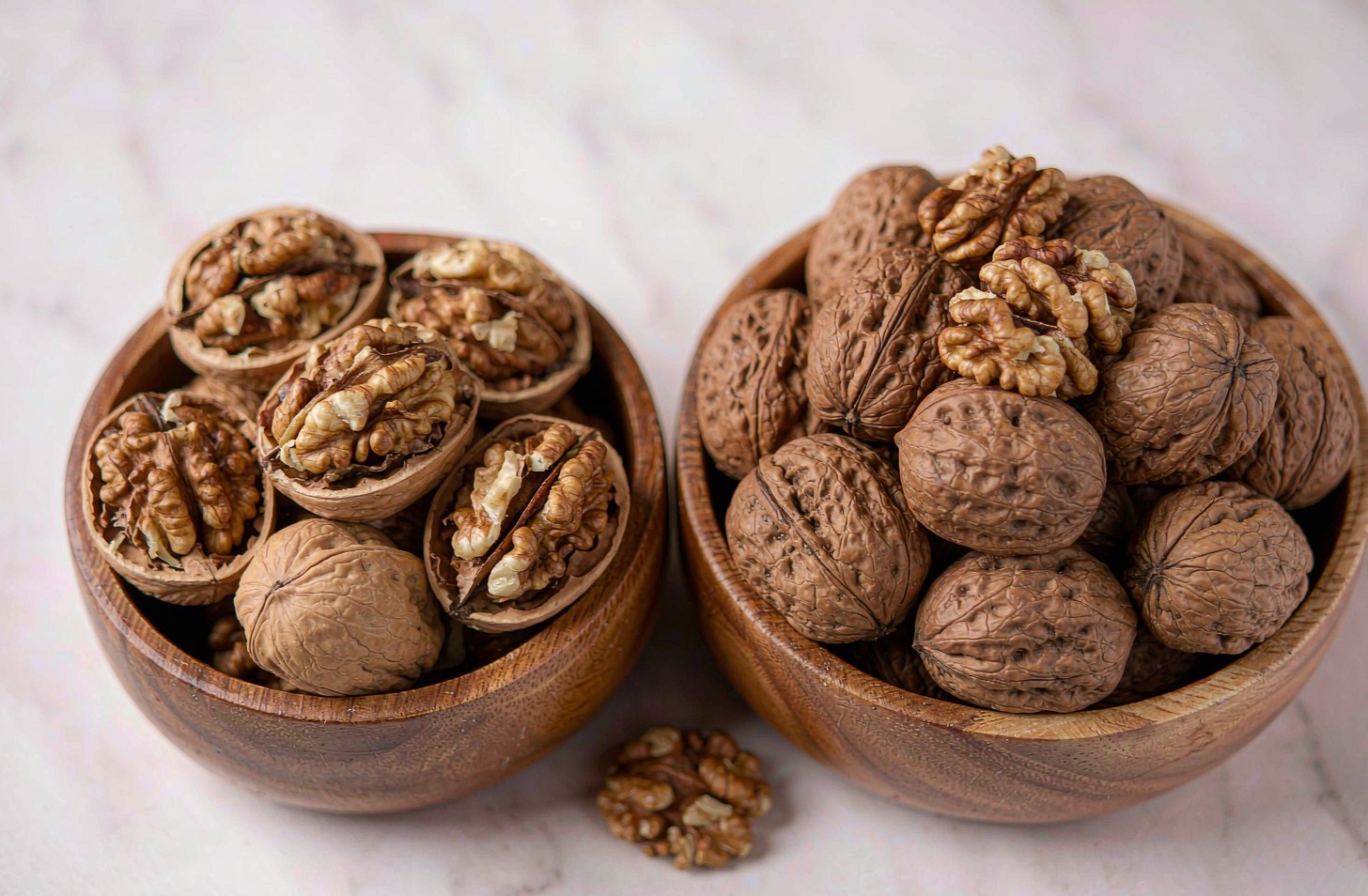
China Walnut vs USA Walnut: Which Is Better for Importers?
China walnut vs USA walnut is a question every bulk nut importer eventually faces. The short answer: China walnuts (especially from Inner Mongolia and Xinjiang) offer thinner shells, higher kernel yields, and competitive pricing, while USA (California) walnuts — primarily the Chandler variety — are known for large kernel size, light color, and consistent supply volume. For B2B buyers in the Middle East, Africa, South America, and Southeast Asia, China walnuts often deliver better value per ton; for buyers needing Chandler-grade large halves for retail or baking, USA walnuts may be preferred. The best choice depends on your market’s spec requirements, price sensitivity, and end-use application.
This guide breaks down the key differences across varieties, shell thickness, kernel yield, color grade, processing capability, certifications, price, and logistics — so you can make an informed sourcing decision for your next container.
Major Walnut Origins: China vs USA
China — Inner Mongolia, Xinjiang, and Beyond
China is one of the world’s largest walnut producers, with major growing regions in Inner Mongolia, Xinjiang, Yunnan, and Shaanxi. Northern Chinese walnuts — particularly from Inner Mongolia — are prized for:
- Thin shells and high kernel yield — many local varieties yield 50–55% kernel by weight, compared to 42–48% for thick-shell types;
- Rich flavor and high oil content — preferred in Middle Eastern and North African markets for confectionery and direct snacking;
- Organoleptic diversity — from light, mild kernels to darker, more intense profiles;
- Cost advantage — lower farm-gate and processing costs translate to competitive FOB pricing.
Companies like Ouji International, based in Hohhot, Inner Mongolia, operate processing plants with automatic cracking, grading, and color-sorting lines — giving buyers access to both in-shell and kernel products from a single origin.
USA — California’s Central Valley
The United States walnut industry is concentrated in California’s Central Valley, with the Chandler variety dominating exports. Key characteristics include:
- Large, plump kernels — Chandler halves are among the largest in the world, ideal for retail packs and baking;
- Consistent light color — California’s grading system (Extra Light, Light, Light Amber) is well-established;
- Industrial-scale supply — California produces over 700,000 tons annually, ensuring large-volume availability;
- Premium pricing — USA walnuts typically command a 20–40% premium over Chinese walnuts of comparable grade.
Side-by-Side Comparison Table
| Parameter | China Walnut (Inner Mongolia) | USA Walnut (California Chandler) |
|---|---|---|
| Main varieties | Thin-shell, Wen 185, Xiangling, Liaoning | Chandler, Hartley, Howard |
| Shell thickness | Thin (0.8–1.2 mm) | Medium-thick (1.3–1.8 mm) |
| Kernel yield | 50–55% | 42–48% |
| Kernel color (typical) | Light to light amber | Extra light to light |
| Kernel size (halves) | Medium to large | Large to extra large |
| Oil content | High (62–68%) | Moderate (58–62%) |
| Flavor profile | Rich, nutty, full-bodied | Mild, clean, slightly sweet |
| FOB price (approx.) | USD 4.50–6.50/kg (kernels) | USD 7.00–10.00/kg (kernels) |
| Certifications | HACCP, ISO 22000, HALAL, Kosher | HACCP, FDA, Kosher, Organic |
| Min order (kernels) | 1–5 tons trial, 12–26 tons/container | Typically 20 ft / 40 ft container |
Quality and Processing Comparison
Shell Thickness and Kernel Yield
This is where China walnuts have a structural advantage. Many Chinese varieties — especially thin-shell types grown in Inner Mongolia and Xinjiang — produce shells under 1.2 mm thick. This means:
- Higher kernel-to-shell ratio — more edible nut per ton of in-shell input;
- Easier cracking — less mechanical force required, reducing kernel breakage during processing;
- Lower processing cost per kg of kernels — a direct savings passed to bulk buyers.
California Chandler walnuts have thicker shells (1.3–1.8 mm), which means a lower kernel yield but also a larger average half size — critical for retail-grade “halves and pieces” packaging where visual appeal matters most.
Color Grading
Both origins use similar color grades, but the ranges differ:
- USA: Extra Light (EL), Light (L), Light Amber (LA), Amber (A) — per USDA standards;
- China: Extra Light, Light, Light Amber, Amber — per exporter specifications, often aligned with USDA equivalents.
California consistently produces Extra Light and Light grades due to controlled harvesting and rapid processing. Chinese processors have invested heavily in optical color sorters to match, and premium-grade Chinese kernels now regularly achieve Light and Extra Light color — closing the gap for most commercial applications.
Processing Capability
Modern Chinese walnut exporters like Ouji International operate automatic cracking lines, gravity separators, color sorters, metal detectors, and hand-picking stations — comparable to California’s processing standards. The key difference is scale: California handlers process enormous volumes through highly centralized facilities, while Chinese plants may be smaller but offer more flexibility for custom specs, packing, and mixed-container orders.
Price and Value Comparison
For most B2B importers, price per kg of usable kernel is the decisive metric. Consider this illustrative calculation:
| Metric | China (In-Shell) | USA (In-Shell) |
|---|---|---|
| FOB price (in-shell) | USD 2.20–3.00/kg | USD 3.50–5.00/kg |
| Kernel yield | 52% | 45% |
| Effective kernel cost/kg | ~USD 4.23–5.77 | ~USD 7.78–11.11 |
| Savings vs USA | — | 30–48% more expensive |
Note: Prices are indicative and fluctuate with harvest season, global demand, and exchange rates. Always request current quotes.
This 30–48% cost advantage is why many Middle Eastern, African, and South American buyers prefer Chinese walnuts — the flavor and quality are excellent for confectionery, direct consumption, and food processing, and the savings per container are substantial.
Certification and Food Safety
Both China and USA walnut exporters can provide internationally recognized food-safety certifications:
- China: HACCP, ISO 22000, ISO 9001, HALAL, Kosher, BRC (selected exporters). Phytosanitary certificates are standard for all export shipments. Refer to ISO 22000 and FAO food safety for framework details.
- USA: FDA registration, HACCP, Kosher, Organic (USDA NOP), and PrimusGFS / GlobalG.A.P. for selected handlers.
For buyers serving Middle Eastern markets, HALAL certification is often mandatory — Chinese exporters like Ouji International routinely provide HALAL and Kosher certificates, while USA handlers may need to arrange these separately.
Logistics and Lead Time
| Factor | China | USA |
|---|---|---|
| Main export ports | Tianjin, Qingdao, Shanghai | Oakland, Long Beach |
| Typical transit to Middle East | 20–30 days | 35–45 days |
| Transit to Europe | 30–40 days | 20–30 days (via Panama) |
| Document processing | Full export docs (CI, PL, COO, phytosanitary) | Full export docs + FDA certificate |
For Middle East, North Africa, and South Asia buyers, China is geographically closer — meaning shorter transit, lower freight costs, and faster replenishment cycles. For European buyers, the difference is less pronounced, and USA walnuts may arrive via shorter Atlantic routes.
Which Walnut Should You Choose?
Choose China Walnuts If You:
- Serve Middle Eastern, African, or South American markets where price competitiveness is critical;
- Need high oil content walnuts for confectionery, baking, or oil extraction;
- Prefer thin-shell varieties for higher kernel yield and lower effective cost;
- Want flexible MOQs, custom packing, and mixed-container sourcing (walnuts + pumpkin seeds + sunflower seeds);
- Require HALAL and Kosher certification at competitive cost.
Choose USA Walnuts If You:
- Need extra-large Chandler halves for premium retail packaging;
- Supply large-scale baking or cereal manufacturers requiring consistent Extra Light color;
- Are willing to pay a premium for USDA-grade standardization;
- Serve North American or European markets with shorter USA-based supply chains.
Why Ouji International Is Your China Walnut Partner
Ouji International (Hohhot Ouji International Co., Ltd.) is an agricultural food exporter based in Hohhot, Inner Mongolia — at the heart of China’s thin-shell walnut belt. Established in 2013, the company operates 2 processing plants with 6 automatic production lines, supplying:
- In-shell walnuts — thin-shell varieties, size-graded;
- Walnut kernels — halves, pieces, and crumb, color-sorted to Light / Extra Light;
- Pumpkin seeds, sunflower seeds, pecans, and cashews — mixed-container sourcing from one supplier;
- Export to Europe, the Americas, Japan, South Korea, the Middle East, North Africa, and South America.
Ouji’s advantages for walnut importers:
- Origin-based sourcing — direct from Inner Mongolia farms, fresher stock, shorter lead time;
- Integrated processing — cracking, grading, color sorting, metal detection, and packing under one roof;
- Full export documentation — commercial invoice, packing list, certificate of origin, phytosanitary certificate, HALAL & Kosher;
- Third-party inspection support — SGS, Bureau Veritas, Intertek before shipment;
- Flexible MOQ — trial orders from 1–5 tons, full containers up to 26 tons.
Frequently Asked Questions
Are Chinese walnuts lower quality than American walnuts?
No. Modern Chinese processing plants use the same color-sorting, metal-detection, and grading technology as California handlers. The main differences are shell thickness (Chinese varieties are thinner, yielding more kernel per ton) and price (Chinese walnuts are typically 30–48% cheaper per kg of usable kernel).
Which walnut has a higher kernel yield?
Chinese thin-shell walnuts typically yield 50–55% kernel by weight, while California Chandler yields 42–48%. This means you get more edible nut per ton of in-shell input from China.
Can I get HALAL-certified walnuts from China?
Yes. Chinese exporters like Ouji International routinely provide HALAL and Kosher certificates for walnut shipments — often more readily available and at lower cost than from USA handlers.
What is the price difference between China and USA walnuts?
As an indicative range, Chinese walnut kernels FOB at USD 4.50–6.50/kg, while California Chandler kernels FOB at USD 7.00–10.00/kg. The gap varies with harvest season, grade, and global demand — always request a current quote.
Which origin is better for the Middle East market?
China is generally preferred for Middle East and North Africa: shorter shipping distance (20–30 days vs 35–45 days from USA), lower freight cost, HALAL certification readily available, and the rich, high-oil flavor profile that Middle Eastern buyers prefer for confectionery and direct consumption.
Can I mix walnuts with other nuts in one container from China?
Yes. Suppliers like Ouji International offer mixed-container sourcing — walnuts, pumpkin seeds, sunflower seeds, pecans, and cashews in a single shipment — which reduces logistics cost and simplifies procurement.
Conclusion
The China walnut vs USA walnut comparison is not about “better” in absolute terms — it is about fit for purpose. California Chandler walnuts excel in large halves, light color, and volume standardization for premium retail. Chinese thin-shell walnuts from Inner Mongolia and Xinjiang offer higher kernel yield, richer flavor, HALAL/Kosher certification, and 30–48% cost savings — making them the smart choice for price-competitive B2B importers serving the Middle East, Africa, South America, and Asia.
If you are sourcing walnut kernels, in-shell walnuts, or mixed nut containers, contact Ouji International for current specifications, samples, and FOB pricing — we will help you match the right grade to your market and deliver on time, anywhere in the world.