

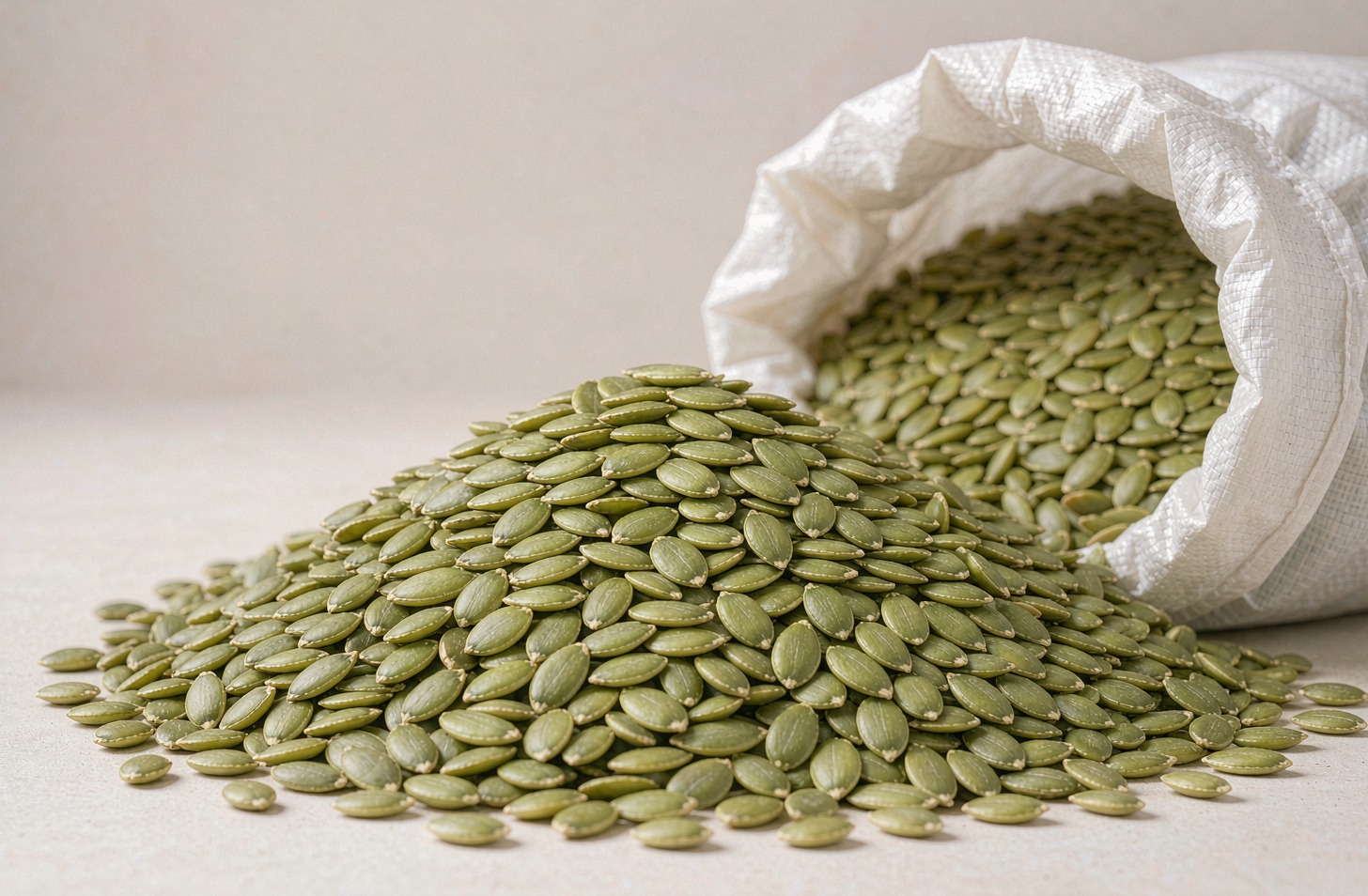
Chinese Pumpkin Seeds Exporter Guide: Specs, MOQ & Export Process
Working with a Chinese pumpkin seeds exporter is the most direct route to consistent bulk supply, but importing successfully depends on getting four things right before the first container ships: confirmed specifications, a realistic MOQ, the correct Incoterm, and complete export documentation. China grows and processes some of the world’s largest volumes of Shine Skin, GWS, and Snow White pumpkin seeds, and Inner Mongolia — the core production belt — supplies plump, uniform kernels favored by snack roasters, bakeries, and food manufacturers worldwide. This guide explains how a professional pumpkin seeds exporter actually operates: what specifications you can expect, what minimum order quantities look like, which documents accompany every shipment, and how to move from first inquiry to goods on your dock without surprises.
If you are a wholesale distributor, private-label packer, or food factory sourcing pumpkin seeds for the Middle East, Europe, North America, or Asia, the process below reflects how experienced exporters handle orders day to day — and what you should demand from any exporter you work with.
What Does a Pumpkin Seeds Exporter Actually Do?
An exporter is more than a seller. A professional pumpkin seeds exporter controls the full chain from farm procurement to loading bay:
- Raw material procurement — buying directly from growers in Inner Mongolia at harvest, then storing in controlled warehouses to protect freshness;
- Processing — cleaning, size grading, color sorting, metal detection, and (for kernels) shelling and hand-picking lines;
- Quality control — moisture testing, purity checks, and third-party inspection (SGS, Bureau Veritas, Intertek) before shipment;
- Export documentation — commercial invoice, packing list, certificate of origin, phytosanitary certificate, and insurance paperwork;
- Logistics coordination — inland trucking to port, container booking, and customs declaration.
This matters because it separates true exporters from trading intermediaries: an exporter that owns or controls its processing lines can guarantee the same grade every shipment, while a reseller passing orders between mills often cannot. Per the FAO, China remains among the largest global producers of pumpkins and gourds, which is why its seed-processing capacity scales so reliably for export demand.
Pumpkin Seed Varieties and Export Specifications
Main Export Varieties
- Shine Skin (光板) — light green, high-gloss kernels; the most demanded grade for European and North American snack markets;
- GWS (白板) — snow-white hulled seeds, popular in Middle Eastern and Asian markets;
- Snow White — white-shelled variety with a distinctive appearance for roasting-in-shell applications;
- Pumpkin seed kernels — fully hulled, graded by purity for bakery, confectionery, and health-food use.
Standard Export Specification Sheet
Every serious inquiry should be answered with a written specification sheet. Typical export standards look like this:
| Parameter | Common Export Standard |
|---|---|
| Moisture | ≤ 8–9% |
| Admixture | ≤ 0.5–1% |
| Purity (kernels) | 99% – 99.9% |
| Size grading | 200–240 / 240–260 / 260–280 seeds per 100 g |
| Broken kernels | ≤ 3–5% (grade dependent) |
| Packing | 25 kg / 50 kg PP woven bags; vacuum or retail packs on request |
| Shelf life | 12 months in dry, cool storage |
| Certifications | HACCP / ISO 22000 food-safety system; HALAL & Kosher available |
State your required variety, size, purity, and packing in writing before sampling. The pre-shipment lot should match the approved sample, and a reliable exporter confirms this with a third-party inspection report rather than an internal claim. Food-safety systems should follow recognized frameworks such as ISO 22000 — ask for the certificate number, issuing body, and validity date.
MOQ, Pricing and Container Loading
Understanding minimum order quantities and container economics helps you plan budget and cash flow realistically:
| Item | Typical Range |
|---|---|
| Sample orders | 1–5 kg (often free, freight collected) |
| Trial orders | 1–5 tons |
| MOQ for production orders | 1 × 20 ft container (approx. 12–14 tons in PP bags) |
| 1 × 40 ft container | approx. 24–26 tons in PP bags |
| Mixed containers | 2–4 SKUs (e.g., Shine Skin + GWS + sunflower seeds) loadable together |
| Payment terms | 30% T/T deposit + balance against B/L copy; L/C for established buyers |
Pricing is quoted per ton and moves with the harvest cycle and international demand — a good exporter will explain whether your quote is valid for 7, 15, or 30 days and what triggers a re-quote. Do not chase the lowest number on the market: quotes far below the prevailing range usually mean downgraded purity or old-crop material.
Incoterms: FOB, CIF and DDP Explained for Seed Buyers
- FOB (Free On Board) — exporter delivers goods cleared onto the vessel at a Chinese port (Tianjin is the standard port for Inner Mongolia origin); you arrange freight and insurance. Best for buyers with established freight forwarders.
- CIF (Cost, Insurance and Freight) — exporter covers ocean freight and insurance to your named port. The most common choice for first-time importers.
- DDP (Delivered Duty Paid) — exporter handles transport and import duties to your warehouse. Convenient but rare for food commodities due to import-license complexity; confirm feasibility market by market.
Whichever term you choose, confirm it in the proforma invoice together with packing, tolerance, and inspection clauses — that document becomes the reference for the letter of credit and any later dispute resolution.
Export Documentation Checklist
A complete shipment file should include:
- Commercial invoice and packing list;
- Certificate of origin (CCPIT-issued, or Form/RCEP where applicable);
- Phytosanitary certificate issued by China Customs;
- Bill of lading (or air waybill);
- Insurance certificate (for CIF/CIP terms);
- Health/sanitary certificate where your importing country requires it;
- Optional: SGS/BV/Intertek pre-shipment inspection report, HALAL or Kosher certificates, fumigation certificate.
Ask your exporter for a document draft before the original set is couriered — typos in consignee names or HS codes are the single most common cause of customs delays, and they are far easier to fix on a draft.
From Inquiry to Delivery: A Realistic Timeline
| Stage | Typical Duration |
|---|---|
| Inquiry, quotation, spec confirmation | 2–5 days |
| Samples dispatched and approved | 5–10 days (courier transit included) |
| Proforma invoice, deposit, production booking | 3–7 days |
| Processing, grading and packing | 10–20 days depending on season |
| Third-party inspection and customs clearance | 3–5 days |
| Ocean transit (Tianjin → Jebel Ali / Rotterdam / LA) | 25–40 days |
Total lead time from confirmed order to arrival is typically 45–70 days. Plan seasonal demand (Ramadan, Christmas, Chinese New Year freight congestion) at least 90 days ahead.
Why Ouji International Is a Trusted Pumpkin Seeds Exporter
Hohhot Ouji International Co., Ltd. is an agricultural food exporter based in Hohhot, Inner Mongolia — the center of China’s pumpkin seed belt. Established in 2013, Ouji operates 2 production processing plants with 6 automatic production lines, covering cleaning, size grading, color sorting, shelling, and hand-picking for final visual inspection. The company exports pumpkin seeds, pumpkin seed kernels, sunflower seeds, walnuts, and other nuts to Europe, the Americas, Japan and South Korea, the Middle East, North Africa, and South America.
What importers gain from working with Ouji:
- Origin advantage — sourcing at the farm gate in Inner Mongolia means fresher crop and shorter farm-to-port lead times;
- Integrated processing — one roof from cleaning to packing, so grade consistency is controllable rather than promised;
- HALAL and Kosher certified — ready for Middle East, Southeast Asian, and specialty retail requirements;
- Export experience since 2013 — complete documentation practice and third-party inspection welcome;
- Flexible packing — 25/50 kg PP bags, vacuum packs, or custom private-label retail packaging.
How to Start Your First Order: 5 Steps
- Send your target specification (variety, size, purity, packing, destination port) by email or the Ouji International website contact form;
- Receive a written quotation with validity period and request free samples;
- Approve samples and sign the proforma invoice; pay the 30% deposit;
- Production, grading, and optional third-party inspection are arranged;
- Balance payment against B/L copy, documents couriered, goods shipped to your port.
FAQ: Importing Pumpkin Seeds from China
What is the MOQ for pumpkin seeds from a Chinese exporter?
Production orders usually start at one 20 ft container (about 12–14 tons in PP bags). Trial orders of 1–5 tons are possible for new buyers, and sample quantities ship by courier.
Which port do Inner Mongolia pumpkin seeds ship from?
Mostly Tianjin Port, about 600 km from Hohhot, with regular sailings to the Middle East, Europe, North America, and Southeast Asia.
Can I mix pumpkin seeds with other nuts in one container?
Yes. Shine Skin, GWS, snow white, sunflower seeds, and walnuts can typically be loaded together in a mixed container of 2–4 SKUs.
What certifications should a pumpkin seeds exporter have?
At minimum HACCP or ISO 22000 food-safety management; HALAL and Kosher certificates are standard for Middle East and specialty markets, and third-party inspection reports (SGS/BV/Intertek) should be available per shipment.
How long does shipping take from China?
Ocean transit is 25–40 days depending on destination, and total lead time from order confirmation to arrival is typically 45–70 days.
What payment terms do Chinese nut exporters accept?
The common standard is 30% T/T deposit with the balance paid against a copy of the bill of lading; confirmed L/C at sight is available for established buyers.
Conclusion: Get a Specification-First Quotation
The difference between a smooth import and a costly one is almost always set before the container is stuffed: a written specification sheet, an approved sample, the right Incoterm, and a documentation checklist. Choose an exporter that owns its processing, welcomes third-party inspection, and answers spec questions with data instead of adjectives. That is the standard Ouji International has applied to pumpkin seed exports since 2013 — request a specification-first quotation and samples for your market today.