

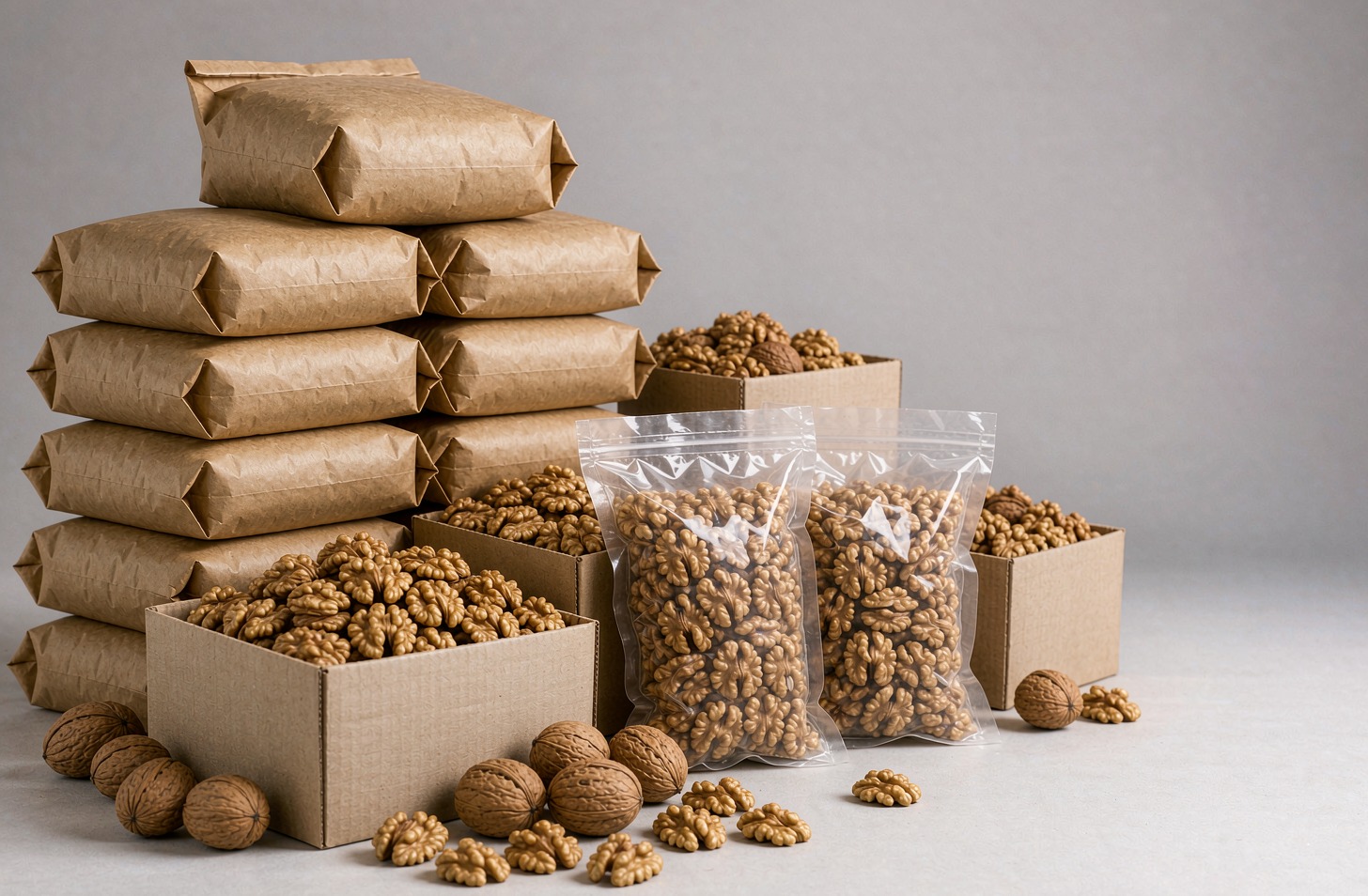
Export Walnut Packaging Guide: Bags, Cartons & Containers
An export walnut packaging guide answers one practical question: how do you pack in-shell walnuts, walnut halves, and walnut pieces so they arrive at the destination port with the same moisture, color, and aroma they had at the factory gate? The short answer: match the pack format to the product form, use a food-grade moisture barrier on every long route, keep kernel moisture at 5–7% before sealing, and specify the loading pattern and pallet treatment in the sales contract. This guide covers the bag and carton specifications, container payloads, compliance markings, and inspection checkpoints that B2B walnut importers should write into a purchase order.
Ouji International ships in-shell walnuts, light halves, quarters, and pieces from Inner Mongolia to Europe, the Middle East, North Africa, Japan, Korea, and South America. The specifications below are the ones we build into commercial invoices every week — they are written for buyers who need packaging that survives 25–40 days of ocean transit and then passes destination inspection.
Why Walnut Packaging Is Not the Same as Seed Packaging
Walnuts behave differently from pumpkin seeds or sunflower kernels, and packaging decisions follow from that:
- Kernels oxidize fast. Walnut kernels carry 60–65% oil, much of it polyunsaturated. Exposed to oxygen and light, they go rancid within weeks. Oxygen barrier and light barrier are not optional on long routes.
- The hull is a partial shield — the kernel is not. In-shell walnuts tolerate woven bags well because the shell limits moisture exchange and protects the kernel mechanically. Kernels have no such protection.
- Moisture moves both ways. Kernels above roughly 7% moisture invite mould and aflatoxin risk; kernels that dry out below about 4% become brittle and shatter into pieces, destroying the grade you paid for.
- Colour is the grade. Light halves command a premium over amber halves and pieces. Light exposure and heat darken kernel colour, so packaging and storage temperature directly protect the price.
- Insect and phytosanitary exposure. In-shell product shipped in woven bags is inspected for live insects at destination; packaging, fumigation records, and wood packaging treatment all become part of the file.
If you are still selecting grades and defect tolerances, read our walnut quality grade guide first — packaging protects a specification, it does not create one.
Match the Pack Format to the Product Form
The single most common packaging error in walnut export is applying an in-shell pack spec to kernels, or a kernel pack spec to in-shell product. Use this as the starting matrix:
| Product form | Recommended primary pack | Barrier requirement | Typical net weight | Main risk if under-specified |
|---|---|---|---|---|
| In-shell walnuts | PP woven bag with PE liner; or 10 kg carton for retail | PE liner 0.05–0.08 mm, heat-sealed | 10 / 12.5 / 25 kg | Moisture pickup, shell staining, live insects |
| Walnut halves (light amber / light) | Carton with vacuum or N₂-flushed inner bag | High-barrier film, O₂ transmission minimised | 10 / 12.5 / 20 kg | Rancidity, colour darkening, breakage |
| Quarters / pieces | Carton with food-grade PE or vacuum bag | PE 0.06 mm minimum; vacuum preferred | 10 / 12.5 / 20 kg | Rancidity, caking, fines migration |
| Retail-ready packs | Printed stand-up pouch or gusset bag in master carton | Metallised or high-barrier film, N₂ flush | 100–500 g retail | Label non-compliance, punctures, short shelf life |
| Industrial / ingredient | 25 kg multiwall paper or PP bag with liner | PE liner, food-grade declaration | 25 kg | Contamination, moisture, pest access |
Standard Export Bag and Carton Specifications
These are the formats that clear customs and pass buyer inspection most reliably in walnut trade. Confirm the exact construction with your supplier in writing — “standard export packing” alone is not a specification.
| Pack type | Construction detail | Best used for | Notes |
|---|---|---|---|
| 25 kg PP woven bag + PE liner | 90–100 g/m² woven PP, 0.05–0.08 mm food-grade PE liner, heat-sealed or tied | In-shell walnuts, bulk shipments | Cheapest robust option; liner is what protects the product |
| 12.5 kg carton, vacuum inner | 5-ply corrugated, food-grade vacuum bag, vacuum ≥ 90% | Halves for retail packing and food processors | Best protection against breakage and oxidation |
| 10 kg carton, N₂ flushed | 5-ply corrugated with high-barrier bag, nitrogen flush | Halves and quarters, premium programmes | Alternative when vacuum compression is undesirable |
| 20 kg carton, PE liner | 5-ply corrugated, 0.06 mm PE liner folded and sealed | Pieces, industrial use | Lower cost than vacuum; shorter shelf life |
| Big bag (FIBC) | 500–1000 kg, food-grade liner, discharge spout | Domestic or short-sea industrial supply | Rarely accepted for containerised export of premium grades |
Every pack should carry, at minimum: product name and form, grade, crop year, lot number, net and gross weight, production date, best-before date, storage conditions, allergen statement where required, and the exporter’s and importer’s details. Where the destination requires it, add the plant registration number and the language of the destination market.
Container Loading: Payloads and Patterns
Walnuts are unusual because in-shell product is volume-limited and kernels are weight-limited. Planning container quantity from tonnage alone is how buyers end up short-loaded.
| Container | In-shell, 25 kg bags (floor loaded) | Kernels, 12.5–20 kg cartons | Palletised (in-shell, 25 kg) |
|---|---|---|---|
| 20GP (~33 m³) | ≈ 10–12 t | ≈ 18–20 t | ≈ 9–10 t (10–11 pallets) |
| 40GP (~67 m³) | ≈ 20–23 t | Payload-limited, ≈ 24–26 t | ≈ 18–20 t |
| 40HQ (~76 m³) | ≈ 22–25 t | Payload-limited, ≈ 24–26 t | ≈ 20–22 t |
Treat these as planning figures, not guarantees — actual payload depends on bag density, pallet height, and carrier weight limits on the specific trade lane. Ask your supplier for a loading plan with pallet counts and stack heights before the container is booked.
Floor loaded versus palletised
Floor loading maximises utilisation and is normal for in-shell bulk. Palletising costs roughly 8–12% of payload but cuts handling damage and speeds up unloading — worth it for cartons of halves, and for buyers whose warehouse cannot handle loose bags. If you palletise, require ISPM 15 heat-treated or fumigated wood and the corresponding IPPC stamp; untreated wood packaging is a routine cause of port rejection. The applicable standard is published by the IPPC (ISPM 15).
Protecting Moisture, Oil and Shelf Life
Moisture targets before sealing
Specify moisture at dispatch, not on arrival. For in-shell walnuts, 6–8% is the working range; for kernels, 5–7% with water activity below about 0.65. Add a moisture test result per lot to the shipping documents. Kernels that leave at 8% will arrive with mould risk; kernels that leave at 4% will arrive as pieces.
Barrier and gas options
- PE liner (0.05–0.08 mm): the minimum for any ocean shipment. Cheap, effective against moisture, weak against oxygen.
- Vacuum packing: the strongest protection for halves; removes oxygen and compacts the product, which also reduces breakage in transit.
- Nitrogen flushing: good compromise where vacuum compression would crush a fragile grade.
- High-barrier film: required for retail pouches where 9–12 months of shelf life is promised.
Desiccants and container condition
For long routes or monsoon-season loading, add container desiccant bags sized to the voyage length, and require a dry, odour-free, food-grade container. Never load walnuts in a container that previously carried chemicals, fish meal, or spices — nut kernels absorb odours permanently. Where pallets are used, dunnage bags and strapping prevent shifting that splits bag seams.
Export Compliance and Labelling
- Food-safety management: the packing line should operate under HACCP and, ideally, ISO 22000. Buyers increasingly ask for BRCGS or IFS where retail customers are involved.
- Phytosanitary certificate: normally required for in-shell walnuts; confirm the destination’s requirement at order stage, not at the port.
- Fumigation record: where destination rules require it, the certificate must match container numbers and lot codes.
- Contaminant limits: verify current maximum levels for aflatoxins and ochratoxin A in the destination market — for the EU these sit in Regulation (EU) 2023/915, aligned with Codex Alimentarius guidance. Rancidity (peroxide and free fatty acid values) is a private-specification issue, not a regulatory one, so write limits into the contract yourself.
- Label language and nutrition: retail packs must meet destination labelling law; artwork approval belongs in the pre-production stage, not after printing.
Private Label and Retail-Ready Walnuts
Private label is standard for walnut programmes supplying supermarkets and snack brands. The workable sequence is: approve artwork and barcode data → confirm film structure and fill weight → produce a pre-production sample → approve the sample in writing → run the batch. Skipping the sample approval step is the most expensive shortcut in private-label packaging, because film and print defects are only visible after the run. Ouji International produces retail packs from 100 g to 500 g with master cartons configured for your pallet and shelf plan.
Inspection Checkpoints Before the Container Is Sealed
- Moisture and water activity — test per lot, record the result on the packing list.
- Seal integrity — vacuum level or nitrogen flush verified on a sample of bags per pallet.
- Weight control — net weight within declared tolerance; check a minimum of 10 units per lot.
- Metal detection and foreign matter — pass/fail record from the line, retained for traceability.
- Label and marking check — lot, dates, weights, destination language, plant code.
- Container inspection — cleanliness, dryness, absence of odour and previous cargo residue, photographed.
- Loading photographs — stowage pattern, dunnage, desiccants, and door-end blocking, sent to the buyer before sealing.
- Seal number — recorded on the shipping documents and matched to the bill of lading.
These eight checks are also the fastest way to resolve a claim: if arrival quality is disputed, the records decide the conversation. Our own process, including purity and grading control, is described alongside our walnut kernel sourcing process.
Common Packaging Mistakes in Walnut Export
- Quoting on bag price instead of total protection cost. A liner that costs a few cents per bag prevents a five-figure claim.
- Using one pack spec for every grade. Halves and pieces need different barrier and compression decisions than in-shell.
- No moisture specification at dispatch. Without a number in the contract, “within standard” is unenforceable.
- Untreated pallets. ISPM 15 non-compliance can stop the container at the port.
- Ignoring transit time. A 12-day regional shipment and a 38-day South American voyage do not need the same barrier.
- No loading photographs. Without them, damage in transit cannot be separated from damage at loading.
FAQ
What is the standard packaging for exporting walnuts?
In-shell walnuts are normally packed in 25 kg PP woven bags with a food-grade PE liner, or 10–12.5 kg cartons for retail supply. Walnut kernels are packed in 10–20 kg cartons with a vacuum or nitrogen-flushed inner bag. The liner or barrier film matters more than the outer bag.
How many tons of walnuts fit in a 20-foot container?
Roughly 10–12 tonnes of in-shell walnuts in 25 kg bags, because in-shell product is volume-limited. Walnut kernels in cartons typically load 18–20 tonnes in the same container, since kernels are weight-limited. Palletising reduces payload by about 8–12%.
Do walnut kernels need vacuum packing for export?
Not always, but it is strongly recommended for halves on routes longer than about 20 days. Vacuum packing removes oxygen, slows rancidity, protects colour, and reduces breakage. Nitrogen flushing is an acceptable alternative for fragile grades.
What moisture content should walnuts have before packing?
In-shell walnuts are usually shipped at 6–8% moisture; kernels at 5–7% with water activity below approximately 0.65. Always specify moisture at dispatch and require a per-lot test result in the shipping documents.
Are wooden pallets allowed in walnut export?
Yes, if they comply with ISPM 15 — heat-treated or fumigated and stamped with the IPPC mark. Untreated solid wood packaging is rejected by most markets.
Can I use my own branded bags and cartons?
Yes. Private label is routine in walnut trade. Supply artwork, barcode data, and destination labelling requirements at the proforma stage, and approve a pre-production sample before the full run.
How long do walnuts keep in export packaging?
In-shell walnuts in lined bags typically hold quality for 9–12 months at 0–5 °C and low humidity; vacuum-packed kernels for 12 months under the same conditions. At ambient temperatures, expect a materially shorter window, especially for kernels.
Conclusion
Walnut export packaging is a set of decisions you can specify precisely: pack format per product form, liner or barrier structure, moisture at dispatch, container loading pattern, pallet treatment, labelling, and inspection records. Get those six right and the product that leaves Inner Mongolia is the product that arrives.
Ouji International has operated since 2013 with two processing plants and six automatic production lines, shipping walnuts, walnut kernels, cashews, pecans, pumpkin seeds, and sunflower seeds to buyers in Europe, the Middle East, North Africa, Japan, Korea, and South America. For a packaging specification matched to your grade mix, route, and destination labelling rules, contact our export team for a quotation with a written packing specification.