

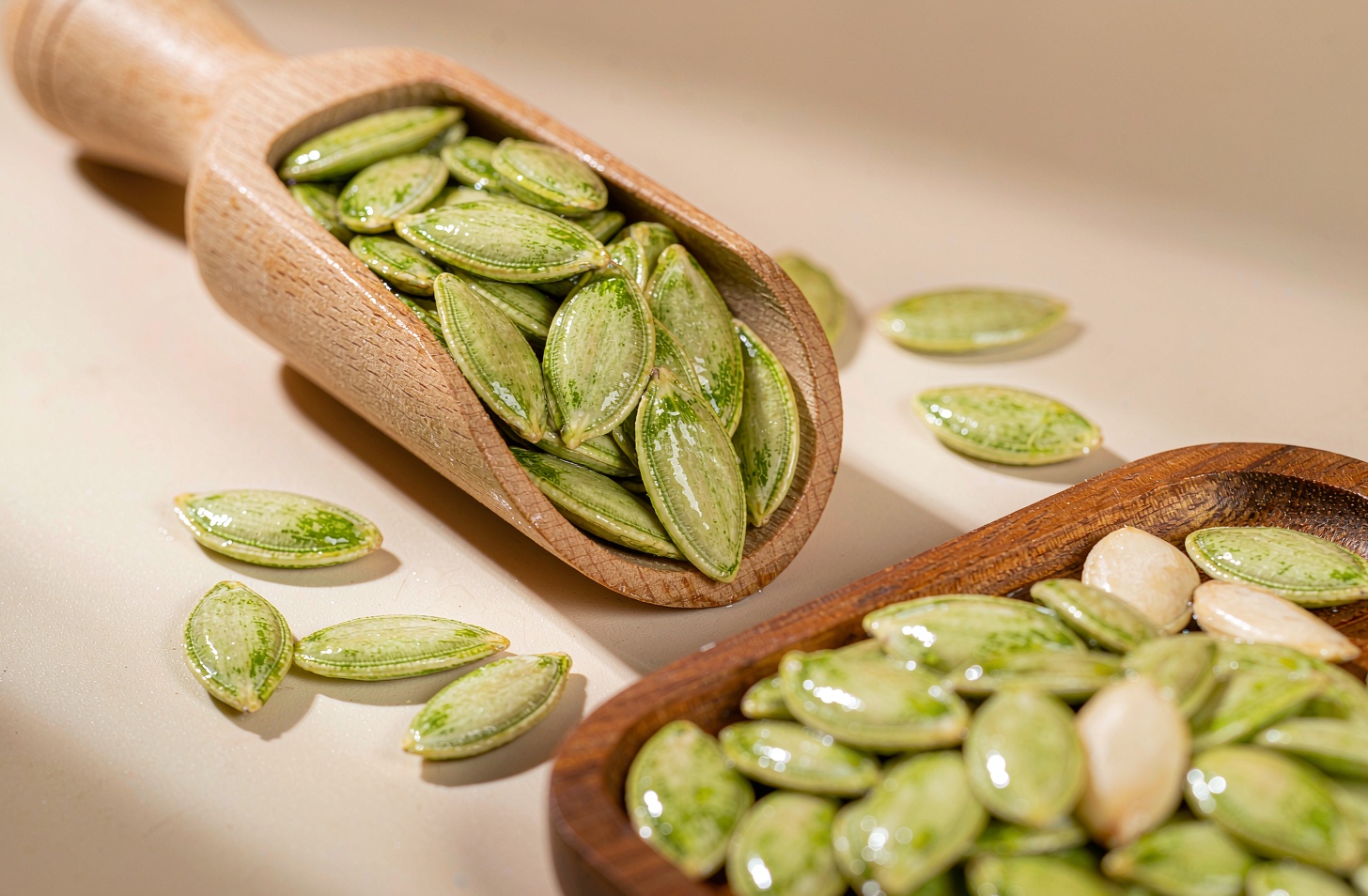
Green Pumpkin Seeds Supplier: How to Source Premium Shine Skin & GWS Seeds from China
A reliable green pumpkin seeds supplier gives you more than a low price — they deliver consistent kernel color, clean shell finish, food-grade certification, and export-ready documentation. “Green pumpkin seeds” usually refers to the light-green varieties popular in global snack and baking markets, especially Shine Skin (light shell with green kernel) and GWS (grow-without-shell, snow-white to pale-green kernel) types. China, led by Inner Mongolia, is the world’s largest origin for these seeds. This guide explains what green pumpkin seeds are, why buyers source them from China, and how to choose a supplier that can reliably ship to Europe, the Middle East, North America, and Asia.
If you are a wholesale buyer, snack manufacturer, or trading company looking for a green pumpkin seeds supplier for bulk import, the checklist below will help you evaluate origin, quality grades, processing capability, and export experience before placing your first order.
What Are Green Pumpkin Seeds
In the export trade, “green pumpkin seeds” generally describes pumpkin seeds whose kernel or shell has a fresh green appearance. The two main commercial types are:
- Shine Skin pumpkin seeds — also called “green pumpkin seeds” because of their glossy light-green shell and plump green kernel. Eaten roasted or salted as a snack; the shell is thin and edible.
- GWS pumpkin seed kernels — grow-without-shell kernels that are ivory to pale green, hulled, and widely used in bakery, cereal, and health-food products.
Both are prized for their mild flavor, high protein content, and visual appeal. Demand is strong in Europe, the Middle East, North Africa, and East Asia, where they appear in retail snack packs, trail mixes, confectionery, and nut butters.
Why Source Green Pumpkin Seeds from China
China accounts for a major share of global pumpkin seed production, with Inner Mongolia, Xinjiang, and Gansu as the primary growing regions. The continental climate — cold winters, dry air, long sunshine hours, and big day-night temperature swings — produces seeds with:
- Bright, uniform kernel color — the dry climate reduces mold and discoloration;
- Higher kernel fill — plumper kernels per shell, better yield for snack processors;
- Stable crop size — large planted area supports year-round export supply;
- Competitive farm-gate pricing — scale and integrated processing keep costs under control.
Suppliers based in Hohhot, the capital of Inner Mongolia, sit closest to the main growing belt. This shortens farm-to-factory time and gives exporters fresher stock and stronger control over grading.
Key Quality Specifications for Green Pumpkin Seeds
When you contact a green pumpkin seeds supplier, ask for a written specification sheet that matches the table below. Specifications vary by market, but these are the baseline numbers most importers expect.
| Parameter | Shine Skin Seeds | GWS Kernels |
|---|---|---|
| Variety | Shine Skin (light green shell) | GWS (hulled kernel) |
| Purity | ≥ 99% | ≥ 99.5% – 99.95% |
| Moisture | ≤ 8–9% | ≤ 7–8% |
| Admixture | ≤ 0.5–1% | ≤ 0.05–0.1% |
| Size | 200–240 / 240–260 / 260–280 seeds per 100 g | Grade AA / A / B by kernel size |
| Color | Uniform light green, glossy shell | Pale green to ivory, no dark spots |
| Packaging | 25 kg / 50 kg PP bags | 12.5 kg / 25 kg vacuum cartons |
| Shelf life | 12 months in dry, cool storage | 12 months in dry, cool storage |
Always request a pre-shipment sample that matches the specification sheet. Appearance, aroma, and moisture are the first things buyers check when the container arrives.
How to Vet a Green Pumpkin Seeds Supplier
1. Verify Certifications and Audit Readiness
Food safety is non-negotiable for edible seeds. A trustworthy supplier should provide:
- HACCP or ISO 22000 — food-safety management system;
- ISO 9001 — quality management system;
- HALAL and Kosher — required for Middle East, Southeast Asia, and Jewish-market supply chains;
- BRC / IFS — increasingly requested by European retailers and large manufacturers.
Ask for the certificate number, certifying body, and validity date. Confirm the scope covers the actual processing plant, not just a trading office.
2. Inspect Processing and Sorting Capability
Bulk buyers need to know how the supplier turns raw seeds into export-grade product. Look for:
- Automatic cleaning lines — removes stones, dust, and foreign matter;
- Grading sieves — separates sizes for consistent lots;
- Color sorters — removes discolored, damaged, or moldy seeds;
- Metal detectors and X-ray — final food-safety checkpoint;
- Moisture-controlled storage — protects quality during hot seasons.
Integrated plants that clean, grade, and pack under one roof offer better consistency than brokers who resell from multiple small mills.
3. Confirm Export Experience to Your Region
A good green pumpkin seeds supplier understands your import requirements. Ask whether they have shipped to your country before, what documents they prepare, and whether they can quote FOB, CIF, or DDP for your port. Experienced exporters usually arrange third-party inspection (SGS, Bureau Veritas, Intertek) and provide phytosanitary certificates, certificates of origin, and market-specific test reports.
4. Test With Samples and a Trial Order
Never commit to a full container without physical verification. The responsible sequence is:
- Request samples and check color, smell, taste, and moisture;
- Place a 1–5 ton trial order to evaluate real shipment quality;
- Ask for buyer references in markets similar to yours;
- If volume is large, arrange a factory audit or live video tour.
Common Market Applications for Green Pumpkin Seeds
Understanding end uses helps you choose the right grade and packing:
- Roasted snack packs — Shine Skin AAA grade, retail-ready 25 g–500 g packs;
- Bakery and confectionery — GWS kernels, halves, or pieces;
- Breakfast cereals and granola — GWS kernels, often organic or conventional;
- Health foods and supplements — cold-pressed kernel oil or protein-rich kernels;
- Food manufacturing — bulk kernels for bars, nut butters, and plant-based products.
Red Flags to Avoid
- Supplier cannot name the processing plant location or refuses a video tour;
- Certificates are expired, blurry, or issued by unknown bodies;
- Price is far below market range — quality is usually cut first;
- Refusal to send samples or sign a written specification sheet;
- No third-party inspection option for first shipments;
- Inconsistent kernel color or high broken-shell rate in the sample.
Why Ouji International Is a Reliable Green Pumpkin Seeds Supplier
Hohhot Ouji International Co., Ltd. (Ouji International) is an agricultural food exporter headquartered in Hohhot, Inner Mongolia, the heart of China’s pumpkin seed region. Established in 2013, the company operates 2 production processing plants and 6 automatic production lines, supplying green pumpkin seeds, pumpkin seed kernels, sunflower seeds, walnuts, cashews, pecans, and other nuts to buyers in Europe, the Americas, Japan and South Korea, the Middle East, North Africa, and South America.
What importers value when working with Ouji:
- Origin advantage — direct sourcing from Inner Mongolia farms means fresher stock and shorter lead times;
- Integrated processing — cleaning, grading, color sorting, metal detection, and packing under controlled conditions;
- Stable green color and purity — strict lot-by-lot sorting for Shine Skin and GWS grades;
- Export documentation support — phytosanitary certificates, certificates of origin, HALAL/Kosher, and third-party inspection coordination;
- Flexible packing — 25 kg / 50 kg industrial bags, vacuum cartons, and custom retail packs;
- 10+ years of foreign-trade experience — fast quotes, samples, and after-sales service across time zones.
Frequently Asked Questions
What is the difference between Shine Skin and GWS green pumpkin seeds?
Shine Skin pumpkin seeds have a thin, light-green edible shell and a green kernel. GWS kernels are grown without a shell and are hulled, ivory to pale green, and mainly used in bakery, cereal, and health-food manufacturing.
Which Chinese region produces the best green pumpkin seeds?
Inner Mongolia, especially the Hohhot and Bayannur areas, is China’s leading production region. The dry climate and long sunshine hours produce bright, plump seeds with good kernel fill and color stability.
What purity should I request for bulk green pumpkin seeds?
For Shine Skin seeds, 99% purity is standard; premium lots reach 99.5% or higher. For GWS kernels, 99.5% to 99.95% purity is typical. Always state your target purity in the purchase contract.
Do I need HALAL or Kosher certification?
Yes, if you supply Middle Eastern, Southeast Asian, or Jewish-market customers. Most professional exporters in Inner Mongolia can provide current HALAL and Kosher certificates on request.
What is the minimum order quantity?
Trial orders often start at 1–5 tons or a few sample cartons. Full container loads are typically 12–13 tons (20 ft) or 24–26 tons (40 ft), depending on packing and variety.
How do I verify a green pumpkin seeds supplier is real?
Combine business-registration checks, a live video factory tour, physical samples, a small trial order, and third-party pre-shipment inspection. A reliable supplier will welcome all of these steps.
Conclusion
Finding the right green pumpkin seeds supplier means balancing price with verifiable quality, processing capability, and export experience. Start by confirming certifications and specifications, test with samples and a trial order, and choose a supplier with real plants in a major growing region like Inner Mongolia.
If you are sourcing Shine Skin pumpkin seeds or GWS pumpkin seed kernels in bulk, contact Ouji International for current specifications, samples, and export pricing. We help buyers match the right grade and packing to their market and ship reliably worldwide.