

HACCP Nuts Supplier China: Certification Verification Guide
A HACCP nuts supplier in China is a processor that actually runs a documented Hazard Analysis and Critical Control Point system — not simply one that owns a framed certificate. For importers, HACCP is the minimum food-safety baseline expected by EU, US, Gulf and Japanese buyers, and it is the system that controls the hazards most likely to hit a nut shipment: aflatoxin, Salmonella, foreign matter and allergen cross-contact. This guide explains what HACCP requires inside a nut plant, how it differs from ISO 22000 and FSSC 22000, and how to verify a Chinese supplier’s certificate in six checks before you wire a deposit.
The verification steps below are the same ones our customers use on us at Ouji International — and the same ones we apply to our own raw material suppliers.
What HACCP Actually Requires in a Nut Processing Plant
HACCP is a preventive system built on seven principles defined by the Codex Alimentarius Commission: conduct a hazard analysis, determine critical control points (CCPs), set critical limits, monitor them, define corrective actions, verify the system works, and keep records. In a nut plant, those principles translate into a handful of concrete control points.
The seven principles in plain language
- Hazard analysis — identify biological, chemical and physical hazards at every step, from farm intake to container loading.
- Determine CCPs — the steps where a hazard can be prevented, eliminated or reduced.
- Set critical limits — measurable values such as aflatoxin ppb, moisture, detector sensitivity or roast temperature.
- Monitor — assign who checks what, how often, and record it in real time.
- Corrective actions — define what happens when a limit is breached (hold, re-sort, reject).
- Verification — calibration, challenge tests, internal audits and lab testing.
- Record keeping — documentation a buyer or auditor can inspect months later.
Typical CCPs for walnuts, pumpkin seeds and sunflower seeds
| Process step | Main hazard | Control measure | Typical critical limit | Record kept |
|---|---|---|---|---|
| Raw material receiving | Aflatoxin, high moisture, mould | Supplier approval + inbound rapid test | Aflatoxin within destination-market limit; moisture ≤ 8–9% | Inbound inspection report |
| Storage | Mould growth, insect activity | Temperature and humidity control, pest programme | ≤ 25 °C, RH ≤ 60%, no live insects | Temp/RH log, pest log |
| Shelling / hulling | Stones, glass, metal | Destoner, magnets, sieves | No detectable foreign matter above agreed size | Equipment check sheet |
| Colour sorting & hand picking | Discoloured or mouldy kernels (aflatoxin risk) | Optical sorter plus manual picking stations | Defect rate within contract grade (e.g. ≤ 1–2%) | Sorting and picking record |
| Roasting (if applicable) | Salmonella, E. coli | Validated time/temperature profile | Core temperature and dwell time per validated study | Roast curve chart |
| Metal detection & packing | Ferrous, non-ferrous, stainless fragments | Inline metal detector, sealed liner | Fe 1.5 mm / Non-Fe 2.0 mm / SS 2.5 mm (typical) | Detector log + hourly challenge test |
If a supplier cannot name its own CCPs and critical limits from memory, it holds a certificate but does not operate a HACCP system — the single most useful filter in Chinese nut sourcing.
Why HACCP Status Decides Whether Your Container Clears Customs
Food-safety certification is no longer a marketing extra; it is an entry condition in most mature markets.
- European Union — EU food hygiene rules require exporters to apply HACCP principles; aflatoxin is checked at the border and non-compliant lots are published in the EU RASFF alert system.
- United States — the FDA’s Foreign Supplier Verification Program (FSVP) makes the US importer legally responsible for verifying equivalent hazard controls. A working HACCP plan is the standard evidence.
- Gulf states — GSO standards and SFDA registration increasingly require HACCP or ISO 22000 evidence alongside HALAL certification.
- Japan and Korea — import monitoring and residue checks; buyers expect plant-level HACCP documentation.
A rejected container costs far more than a few cents per kilogram: detention, re-testing, destruction or re-export can erase the entire margin on a shipment.
HACCP vs ISO 22000 vs FSSC 22000 vs BRCGS
Buyers often ask for “HACCP” while actually needing a GFSI-recognised scheme. The table below clarifies what each certificate proves.
| Standard | Owner | What it covers | What it tells a buyer |
|---|---|---|---|
| HACCP (Codex) | Codex Alimentarius / national regulators | Hazard analysis and CCP control at plant level | Baseline food-safety system; the legal expectation in most markets |
| ISO 22000:2018 | ISO | Full food-safety management system built on HACCP principles, whole chain | More mature system, documented processes, management review |
| FSSC 22000 | FSSC Foundation | ISO 22000 + sector PRPs + additional scheme requirements | GFSI-recognised; commonly requested by EU and global retailers |
| BRCGS Food Safety | BRCGS | GFSI-recognised, retail and private-label oriented | Strong evidence for supermarket and own-brand programmes |
| ISO 9001 | ISO | Quality management system — not food safety | Supports consistency and traceability, but does not control aflatoxin or pathogens |
A supplier holding ISO 22000 or FSSC 22000 has necessarily implemented HACCP; one holding only ISO 9001 has not. The two are not interchangeable — see the ISO 22000:2018 standard.
How to Verify a Chinese Supplier’s HACCP Certificate in 6 Steps
1. Read the certificate, not the brochure
Request a full, uncropped scan. Check four fields: certificate number, certified scope (product and process), site address and validity dates. The address must match the plant that will actually produce your order.
2. Identify the certification body and its accreditation
Chinese certification bodies are approved by CNCA and accredited by CNAS; internationally recognised certificates carry an IAF MLA mark. A certificate from an unknown body with no accreditation logo is worth very little.
3. Confirm the certificate is live — directly with the issuer
Find the certification body’s own website and use the contact published there — never the details printed only on the PDF. Ask one question: “Is certificate No. X currently valid for this company and scope?” This catches most forged or expired certificates.
4. Match the scope to your exact product
Scope language matters. “Processing and packing of roasted pumpkin seed kernels” does not automatically cover raw in-shell sunflower seeds, walnut kernels, or a different production site. If your order falls outside the scope, ask for the certificate that does cover it.
5. Ask for the HACCP plan summary and the last audit report
A confident supplier shares a one-page CCP summary plus the non-conformities and corrective actions from the last surveillance audit. Refusal here is more informative than any certificate.
6. Cross-check paper with the physical shipment
Align the system with what actually arrives: a certificate of analysis from an accredited lab (SGS, BV, Intertek or CNAS), phytosanitary certificate, and metal-detector records for your batch. For first orders, a pre-shipment inspection closes the loop.
Eight Red Flags in Chinese Nut Supplier Certification
- Certificate scans only — no number, no issuing body, no accreditation mark.
- Scope mismatch — certificate covers a different address, a sister company, or only trading activity.
- Expired or “renewal in progress” for more than 90 days with no audit evidence.
- Cannot name their CCPs — vague answers about “strict quality control” instead of limits and records.
- No metal detector, or a detector not challenge-tested with test pieces each shift.
- Aflatoxin testing only after arrival — risk transferred to you, not controlled at origin.
- Plan written, records empty — a consultant prepared the manual but no monitoring logs exist.
- One certificate, many factories — a trading company showing a mill’s certificate for product made elsewhere.
Buyer’s HACCP Audit Checklist for Nut Suppliers
| # | Check | What good looks like |
|---|---|---|
| 1 | Certificate validity and scope | Live certificate from an accredited body, scope naming your product and the producing site |
| 2 | Hazard analysis | Documented biological, chemical and physical hazards with justification for each CCP |
| 3 | Raw material control | Approved supplier list, inbound aflatoxin and moisture testing, rejection records |
| 4 | Traceability | Batch code links raw material lot → processing date → finished pallet → container |
| 5 | Foreign matter control | Magnets, destoner, sieves and metal detector all in use and calibrated |
| 6 | Allergen and cross-contact | Separate lines or validated cleaning between tree nuts and seeds |
| 7 | Water, ice and hygiene | Potable water test reports, hand-wash stations, controlled personnel flow |
| 8 | Pest control | Licensed pest contractor, bait maps, no rodent activity in storage |
| 9 | Laboratory testing | Accredited third-party lab, aflatoxin, pesticide MRLs, microbiology, heavy metals |
| 10 | Recall and complaint handling | Written recall procedure with a mock recall completed in the last 12 months |
How Ouji International Manages HACCP Compliance
Ouji International has been exporting nuts and seeds since 2013, operating from Hohhot, Inner Mongolia — China’s premium growing region for pumpkin seeds and sunflower seeds. Our setup is built to make verification easy for buyers:
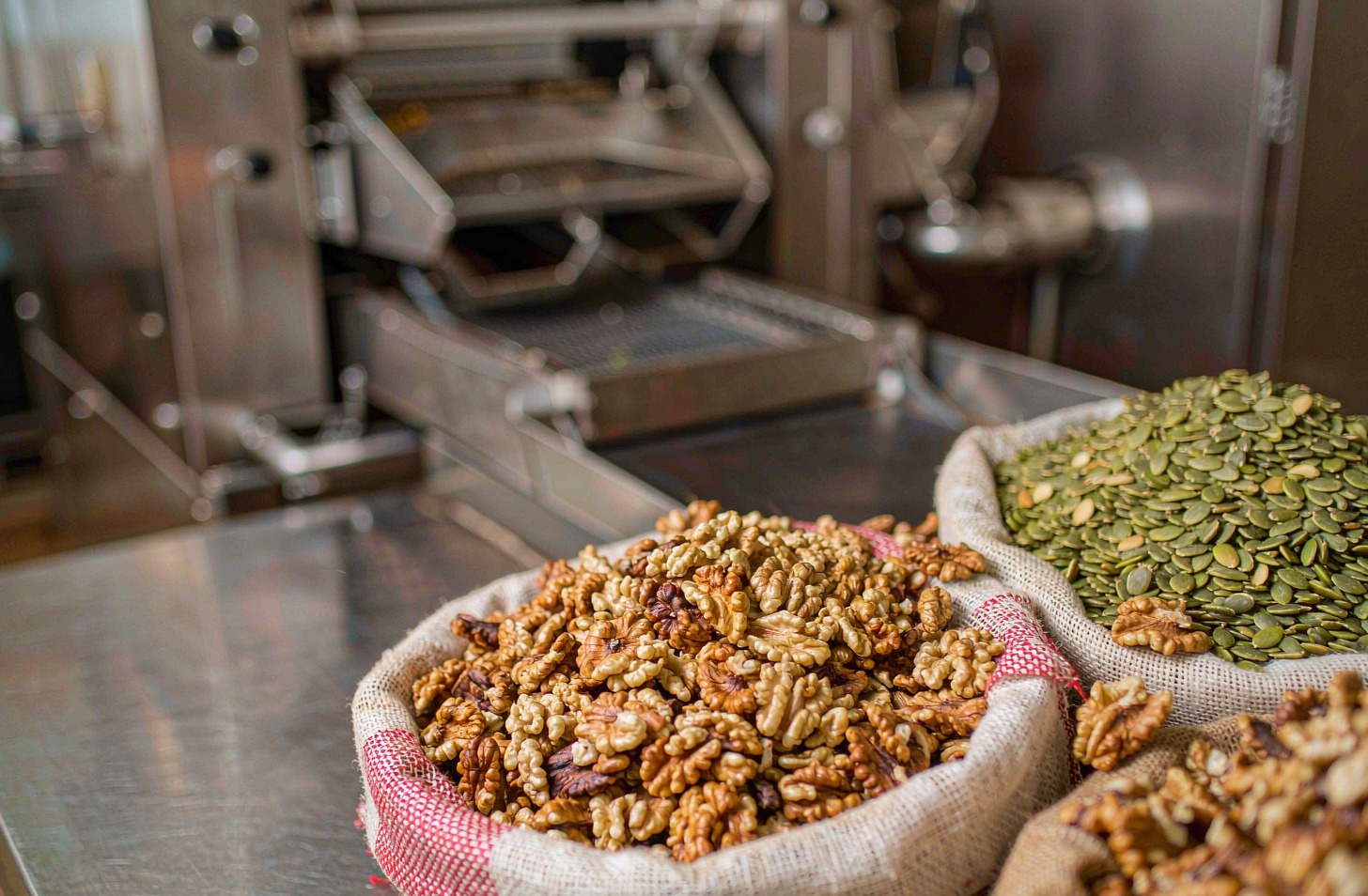
- Two processing plants, six automatic production lines — cleaning, destoning, gravity separation, colour sorting, hand-picking and metal detection under one roof.
- Documented HACCP-based food safety management, supported by ISO 22000 and ISO 9001, plus HALAL and Kosher certification for Middle East, Southeast Asian and Jewish-market buyers.
- Batch-level traceability — every pallet carries a lot code mapping back to the intake record and that day’s monitoring logs.
- Pre-shipment testing — aflatoxin, moisture, defect rate and microbiology through accredited labs, against your contract specification.
- Product range — walnuts, walnut kernels and halves, pecans, cashews, Shine Skin / GWS / Snow White pumpkin seeds and kernels, sunflower seeds.
You can review our plant capability on the factory page or browse current specifications on the product range page. For buyers who want a second opinion, we welcome third-party audits and pre-shipment inspection by SGS, BV or Intertek.
Frequently Asked Questions
Does a Chinese nut supplier need HACCP to export to the EU?
Yes in practice. EU food hygiene rules require food business operators to apply HACCP principles, and EU importers are legally obliged to verify this. Border controls on aflatoxin in nuts make documented hazard control essential, not optional.
Is HACCP the same as ISO 22000?
No. HACCP is the hazard-control methodology; ISO 22000 is a full management-system standard built on HACCP principles. A company certified to ISO 22000 has implemented HACCP, but a HACCP certificate alone does not mean ISO 22000 compliance.
How long is a HACCP certificate valid?
Typically three years, subject to annual surveillance audits and a recertification audit before expiry. Always check the issue date as well as the expiry date — a certificate can be valid but suspended after a failed surveillance audit.
Can I verify a Chinese HACCP certificate online?
Usually yes. Ask for the certificate number and the issuing body, then check that body’s official website or a national accreditation database. The most reliable method is still a direct email or call to the certification body’s published contact address.
What is the difference between a HACCP certificate and a health certificate?
A HACCP certificate proves the plant operates a food-safety management system. A health or sanitary certificate is a per-shipment document issued by the competent authority confirming the specific consignment is fit for human consumption. You need both.
What aflatoxin limit applies to nuts imported from China?
Limits vary by market and product. The EU sets total aflatoxin limits in the range of 4–10 µg/kg for nuts intended for direct human consumption, with tighter limits for processed products. Always confirm the limit for your exact product and destination before contracting.
Conclusion: Verify the System, Then Buy the Nuts
Choosing a HACCP nuts supplier in China is a documentation exercise before it is a price negotiation. Read the certificate, confirm the issuer’s accreditation, match the scope to your product and site, ask for the CCP summary and audit history, then cross-check it against the shipment’s certificate of analysis. Suppliers who run a real system answer all six checks within a day; suppliers who only own a certificate stall at the first one.
If you are sourcing walnuts, walnut kernels, pumpkin seeds, sunflower seeds, pecans or cashews in bulk and need a supplier whose food-safety documentation stands up to your own customer audits, contact Ouji International for current specifications, certificates and export pricing. Samples and full documentation are available before you commit to a container.