

How Importers Buy Sunflower Seeds: The Real Buying Process
Importers buy sunflower seeds through a fixed sequence: they define a written specification, send a request for quotation to several exporters, evaluate samples and pre-shipment inspections, then lock price, payment terms and Incoterms into a sales contract before the container is booked. The whole cycle usually takes three to six weeks for a repeat order and six to ten weeks for a first purchase. This guide explains each step in the order it actually happens, the documents and terms involved, and the points where first-time buyers in Europe, the Middle East and North America most often lose money.
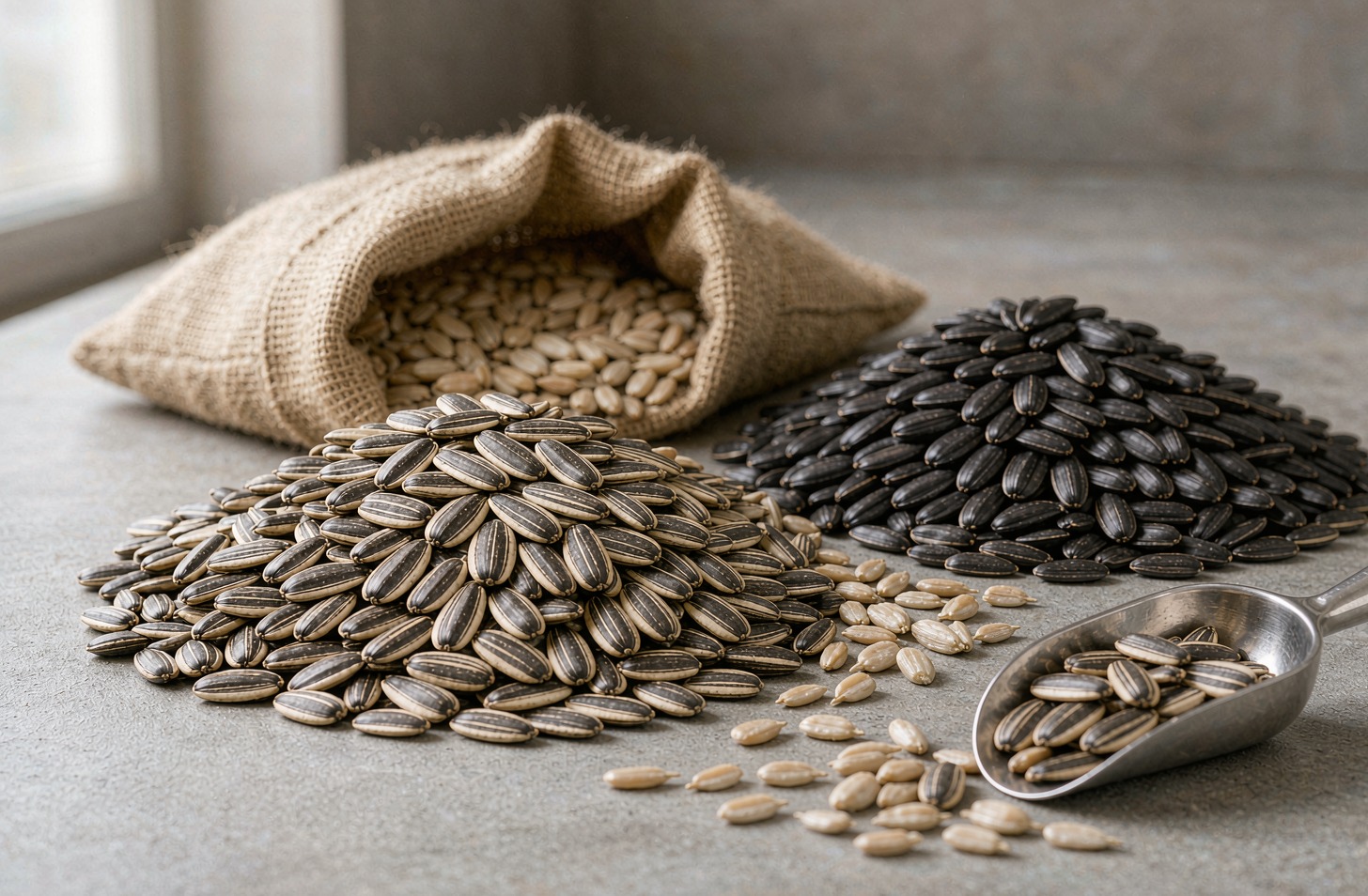
The buying pattern differs by end use. Roasters and snack packers buy striped confectionery seeds by size grade and uniformity; oil mills buy black oil sunflower seeds by oil content and price per tonne; bakeries and ingredient traders buy sunflower kernels by purity, moisture and broken rate. Ouji International supplies all three formats from Inner Mongolia to buyers across Europe, the Americas, Japan and South Korea, the Middle East, North Africa and South America.
Who Is Buying, and What They Actually Need
Understanding your own buying category prevents the most expensive mistake in the category: ordering a seed that is technically correct but commercially wrong for your line.
- Roasters and snack manufacturers — need uniform seed size so that roast time and colour are consistent. A 2 mm size spread in the raw material produces scorched and pale seeds in the same batch.
- Oil crushers — buy on oil content and foreign matter. Kernel weight matters less than extraction yield per tonne landed.
- Bakery and confectionery plants — buy hulled kernels with high purity, low broken percentage and low moisture so that toppings adhere and shelf life is predictable.
- Distributors and trading companies — buy repeatable grades under their own brand, so batch-to-batch consistency and packaging presentation matter most.
The 7 Steps of a Sunflower Seed Purchase
1. Write the specification before you ask for a price
A price without a specification is meaningless. Two quotations for “sunflower seeds” can differ by USD 200 per tonne simply because one is 99% purity confectionery grade and the other is oil-grade with 2% admixture. Build a one-page specification sheet covering variety, size grade, moisture, admixture, imperfect grains, oil content (for oil types), packing and destination. Send that same sheet to every supplier so that the quotes you receive are comparable.
2. Send a structured RFQ to three to five exporters
An effective request for quotation states: product and grade, quantity per shipment and per year, destination port, required Incoterm, packing, certification requirements, target shipment window and payment method. Ask each supplier to quote FOB and CIF separately, and to confirm the harvest or crop year of the stock they are offering. Suppliers who answer in detail within one working day are showing you how they will behave after the deposit is paid.
3. Evaluate samples and verify the numbers
Ask for a 1–2 kg sample drawn from the actual lot, not a showroom sample. Evaluate it against your own sheet: measure moisture, sieve the size distribution, count broken and discoloured seeds, and roast a small batch if you are a snack producer. Where the order value justifies it, commission a third-party inspection (SGS, Bureau Veritas, Intertek) at the loading warehouse. A pre-shipment inspection costing a few hundred dollars routinely prevents a five-figure claim.
4. Negotiate price against crop year and freight
Sunflower seed pricing is driven by three moving parts: the domestic crop in the origin country, competing demand from the oil-crushing industry, and ocean freight. Because sunflower is one of the four major oilseed crops globally and is crushed for oil and meal, seed prices track vegetable oil markets as well as edible-nut demand. Confirm whether the quote is based on new-crop or old-crop stock, and whether freight is fixed or subject to bunker adjustment. Fixed-price contracts are normal for shipments within 60 days; longer programmes are often priced with a renegotiation clause.
5. Agree payment terms and Incoterms in writing
Payment and delivery terms carry more risk than price. Standard practice in the Chinese export trade is a deposit by T/T with the balance against a copy of the bill of lading, or a documentary letter of credit at sight for larger or first-time orders. Never accept “balance before shipment” without an inspection report, and never accept a term that leaves you without recourse if the container does not sail.
6. Book inspection, shipping and documentation
Once production is confirmed, the exporter books the container, arranges loading under supervision, and issues the document set: commercial invoice, packing list, bill of lading, certificate of origin, phytosanitary certificate, and market-specific certificates such as HALAL or Kosher. Fumigation and a non-wood-packing declaration are standard for shipments to the EU and the US. Check that the certificate of origin matches the origin stated on the invoice — a mismatch is one of the most common causes of customs delay.
7. Clear customs and set up the repeat order
After the first container clears, compare the arrived quality with the pre-shipment sample and record the deviations. Importers who document this become better buyers: by the third order they can specify tolerance bands, agree a quality-claim procedure, and negotiate annual volume pricing instead of one-off spot deals.
Reference Specification Sheet for Sunflower Seeds
The table below shows the parameters that most export contracts for Chinese sunflower seeds define. Values vary by variety and by buyer requirement, so treat these as a starting point for negotiation rather than a fixed standard.
| Parameter | Typical Export Standard | Why Buyers Specify It |
|---|---|---|
| Product type | Black oil seed / striped confectionery seed / kernel | Determines end use, roasting behaviour and price band |
| Size grade | 361, 5009, 601, 363 or seeds per 100 g / ounce | Controls roast uniformity and retail presentation |
| Moisture | ≤ 8–9% | Prevents mould, rancidity and weight loss in transit |
| Admixture | ≤ 0.5–1% | Reduces cleaning cost and rejects at destination |
| Imperfect / broken | ≤ 2–3% (seeds), ≤ 1–2% (kernels) | Affects yield and visual grade |
| Oil content | 38–48% (oil types) | Directly sets crushing margin per tonne |
| Purity (kernels) | 99% – 99.9% | Required for bakery and ingredient use |
| Packing | 25 kg / 50 kg PP or paper bags, big bags, cartons | Handling cost, retail readiness, fumigation rules |
| Container load | Approx. 18–20 t per 20 ft, 25–26 t per 40 ft | Freight cost per tonne and port weight limits |
| Shelf life | 12 months, cool and dry storage | Stock rotation and retail dating |
Payment Terms and Incoterms Compared
Most disputes in seed trading are not about quality — they are about who carries risk at which point. The comparison below reflects how buyers and exporters normally allocate that risk.
| Term | Risk Position for the Buyer | Typical Use |
|---|---|---|
| T/T 30% deposit, 70% against B/L copy | Medium — you pay the balance before inspecting the container | Repeat orders with a trusted supplier |
| Letter of credit at sight | Low — payment against compliant documents | First orders, orders above USD 100,000 |
| D/P (documents against payment) | Medium — goods ship before payment is secured | Established relationships, smaller volumes |
| FOB | You control freight and insurance | Buyers with their own forwarder contracts |
| CFR / CIF | Seller books freight; you carry risk once loaded | Buyers without freight leverage |
| DAP | Seller carries risk to your door; highest price | Small volumes, inland destinations |
Costs Importers Often Forget
The FOB price is roughly 70–80% of what a container actually costs you. Budget for the rest before you compare suppliers, otherwise the cheapest quote can become the most expensive shipment:
- Ocean freight and bunker surcharges — highly volatile on Middle East and North Africa routes;
- Cargo insurance — typically a small percentage of CIF value, but uninsured losses are total losses;
- Inspection and certification — third-party inspection, HALAL or Kosher certification, lab tests;
- Import duty and VAT — duty rates on HS 1206.00 vary widely by market;
- Port charges, demurrage and inland transport — demurrage alone can exceed the value of a small order;
- Rejection risk — the cost of a failed consignment includes freight both ways and lost sales.
Common Buying Mistakes
Four mistakes account for most of the problems we see from new importers:
- Comparing prices across different specifications. Always normalise to the same grade, packing and Incoterm.
- Skipping the pre-shipment inspection. A sample approved in your office does not guarantee the container matches it.
- Ignoring the crop year. Old-crop seed at a discount may lose viability, oil quality or roast performance.
- Ordering a full container on the first deal. Start with 1–5 tonnes or a mixed trial load, then scale.
How Ouji International Supports Importers
Ouji International has been exporting agricultural products since 2013 from Hohhot, Inner Mongolia. We operate 2 processing plants and 6 automatic production lines covering cleaning, grading, colour sorting, metal detection and packing, and we ship sunflower seeds, sunflower kernels, pumpkin seeds, walnuts, cashews and pecan nuts to buyers in Europe, the Americas, Japan and South Korea, the Middle East, North Africa and South America.
For buyers, that translates into practical support at each step of the process: specifications written to your market’s requirements, samples drawn from production lots, third-party inspection coordination, HALAL and Kosher documentation where required, and full export paperwork. You can review our product range and current specifications or read more about our processing plants and quality control lines before you send an enquiry.
Food-safety management follows recognised international frameworks — ISO 22000 and HACCP principles — while the Codex Alimentarius standards published by FAO/WHO remain the reference point for contaminants, hygiene and labelling in most destination markets. Buyers sourcing under EU or US rules should confirm maximum residue limits and aflatoxin controls against those standards, not against a supplier’s own brochure.
Frequently Asked Questions
What is the minimum order quantity for sunflower seeds?
Most Chinese exporters accept trial orders from 1–5 tonnes, or a few cartons for sampling. Full container loads usually run 18–20 tonnes for a 20 ft container and 25–26 tonnes for a 40 ft container, depending on packing and destination weight limits.
How long does it take to buy sunflower seeds from China?
Allow three to six weeks for a repeat order: one week for quotation and contract, one to two weeks for production and inspection, and two to three weeks for ocean transit. First orders with new specifications typically take six to ten weeks including sampling and documentation.
Which sunflower seed grade should a snack producer buy?
Striped confectionery seeds in a narrow size grade — commonly 361, 5009, 601 or 363 — with moisture at or below 8–9% and admixture under 1%. Uniform size is more important than absolute size, because it determines whether the batch roasts evenly.
What payment terms are normal for sunflower seed imports?
A 30% T/T deposit with the balance against a copy of the bill of lading is the most common arrangement. Letters of credit at sight are standard for first orders or values above roughly USD 100,000, and give the buyer document-based protection.
Do sunflower seeds need a phytosanitary certificate?
Yes, for virtually all markets. The exporter’s plant-health authority issues it, and it must match the declared origin and treatment. The EU and the US additionally require a non-wood-packing declaration or ISPM 15 treated pallets.
How do I check quality before the container ships?
Request a sample from the production lot, then book a third-party pre-shipment inspection at the loading warehouse. The inspector verifies moisture, admixture, size distribution and packing against your contract specification, and issues a report before the balance payment is released.
Conclusion
Buying sunflower seeds in bulk is a documentation exercise as much as a sourcing one. Define the specification first, compare quotes on identical terms, verify the lot with a sample and an inspection, and agree payment and delivery terms that keep risk visible. Importers who run this process once properly find that every subsequent order becomes faster and cheaper.
If you are planning a sunflower seed, sunflower kernel or mixed nut container, contact Ouji International for a specification-matched quotation, current crop information and samples — we will quote FOB and CIF so you can compare on the same basis.