

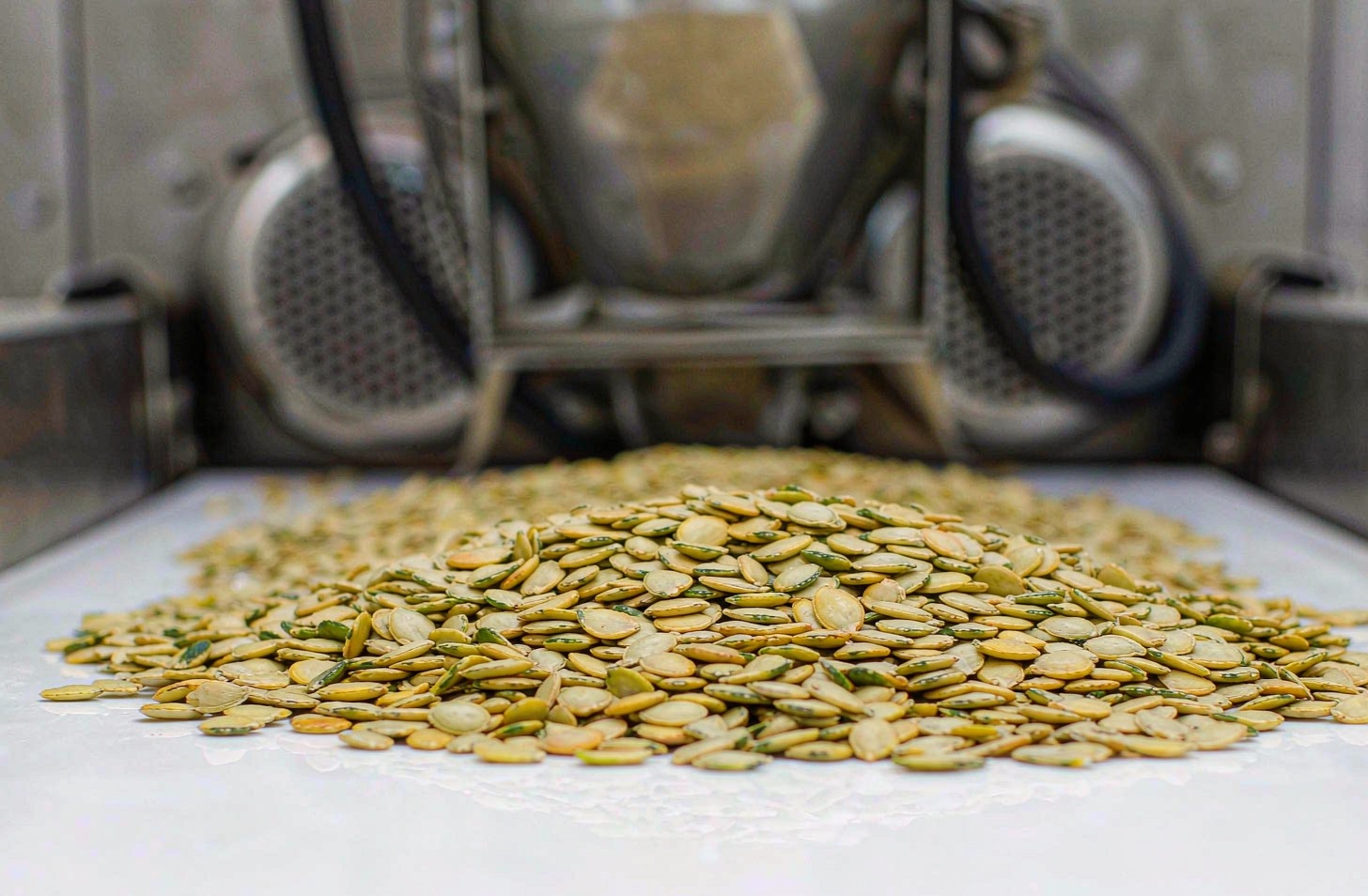
Pumpkin Kernel Factory China: A Buyer’s Guide to Sourcing
A pumpkin kernel factory in China processes raw pumpkin seeds into cleaned, hulled, graded, and packed kernels ready for food manufacturers, snack brands, and wholesale importers. China’s largest concentration of these factories sits in Inner Mongolia, where the dry climate and long growing season produce plump, uniform pumpkin seeds. For B2B buyers, choosing the right factory means verifying origin access, processing equipment, food-safety certifications, and export experience before placing bulk orders.
This guide explains what a Chinese pumpkin kernel factory does, how to evaluate one, and what specifications, certifications, and logistics to expect when sourcing Shine Skin, GWS, Snow White, and hulled pumpkin seed kernels for Europe, the Middle East, North America, or Asia.
What Does a Pumpkin Kernel Factory in China Do?
A pumpkin kernel factory transforms field-run seeds into export-ready edible kernels through a series of controlled mechanical and manual steps. The typical workflow includes:
- Raw seed reception and storage — seeds are received from farms or cooperatives, dried to safe moisture levels, and stored in clean warehouses or steel silos;
- Cleaning and dehulling — air separators, gravity tables, and dehulling machines remove shells, debris, and empty seeds;
- Grading by size — sieve machines sort kernels into standard size bands such as 9mm, 10mm, 11mm, or counts per 100g;
- Color sorting — optical sorters remove discolored, moldy, or damaged kernels that manual inspection can miss;
- Metal detection and final inspection — food-grade metal detectors and hand-picking stations remove remaining defects;
- Vacuum packing and export loading — kernels are packed in food-safe bags, vacuum-sealed or nitrogen-flushed when required, and loaded into containers.
Integrated factories handle all of these steps under one roof, which gives buyers more consistent quality and shorter lead times than traders who resell from multiple small mills.
Why Source Pumpkin Kernels from a Chinese Factory?
China is one of the world’s leading producers and exporters of pumpkin seeds and kernels. A factory-based pumpkin kernel supplier in China offers several advantages:
- Origin proximity — factories in Inner Mongolia and surrounding regions buy directly from growers, reducing middlemen and improving freshness;
- Scale and capacity — established factories run multiple automatic production lines and can process hundreds of tons per season;
- Variety coverage — Chinese factories produce Shine Skin, GWS, Snow White, and hulled kernels from the same sourcing region;
- Competitive pricing — integrated processing and large raw-material volumes keep factory-gate prices competitive;
- Export readiness — experienced factories prepare certificates of origin, phytosanitary documents, HALAL/Kosher certificates, and third-party inspection reports.
The main risk is not origin quality but factory inconsistency: equipment age, hygiene discipline, and grading standards vary widely between suppliers. Proper vetting prevents surprises.
How to Evaluate a Pumpkin Kernel Factory in China
1. Factory Location and Raw Material Access
Ask where the factory is located and how close it is to the growing region. Inner Mongolia — especially Hohhot and Bayannur — is China’s primary pumpkin seed belt. Factories located here typically have:
- Fresher raw material with shorter farm-to-factory transit;
- Stronger relationships with local growers and cooperatives;
- Better control over variety selection and harvest timing;
- Lower inland logistics costs before export.
A factory that cannot clearly state its plant address or show it on a map is a red flag.
2. Processing Equipment and Capacity
Bulk buyers should understand the factory’s real production capability. Useful questions include:
- How many automatic production lines do you operate?
- What is your daily or monthly processing capacity?
- Do you own the dehulling, grading, color-sorting, and metal-detection equipment?
- Is processing done in-house or subcontracted?
Factories with integrated lines and documented capacity are better positioned to fulfill container orders on time and maintain batch-to-batch consistency.
3. Certifications and Food Safety
Food-safety certification is the first filter when choosing a pumpkin kernel factory in China. Request current copies of:
- HACCP / ISO 22000 — food-safety management systems;
- ISO 9001 — quality management;
- HALAL and Kosher certificates — essential for Middle East, Southeast Asia, and Jewish-market buyers;
- BRC, IFS, or organic certification — often required by European retailers and premium private-label brands.
Check the certifying body, validity date, and scope. The certificate should cover the actual plant address and the products you plan to buy.
4. Quality Control and Inspection
A reliable pumpkin kernel factory should have clear quality-control checkpoints and welcome third-party inspection. Ask about:
- Incoming raw-seed inspection criteria;
- Processing-line sampling frequency;
- Final lot inspection and retention samples;
- Support for SGS, Bureau Veritas, or Intertek pre-shipment inspection.
Factories that refuse third-party inspection or cannot explain their QC process should be avoided.
Typical Pumpkin Kernel Specifications from Chinese Factories
| Parameter | Common Export Standard |
|---|---|
| Varieties | Shine Skin, GWS, Snow White, hulled kernels |
| Kernel size | 9mm, 10mm, 11mm+ or 240–320 seeds / 100 g |
| Moisture | ≤ 7–8% |
| Admixture | ≤ 0.1–0.5% |
| Broken kernels | ≤ 1–3% |
| Purity | 99% – 99.95% |
| Packaging | 25 kg / 50 kg PP bags, vacuum packs, or retail cartons |
| Shelf life | 12 months under cool, dry storage |
Always request a written specification sheet and a pre-shipment sample before confirming an order. Specification sheets prevent disputes over size, purity, moisture, and admixture limits.
Packaging and Export Logistics
Chinese pumpkin kernel factories typically pack bulk kernels in 25 kg or 50 kg food-grade polypropylene bags with inner liners. Depending on the buyer’s market, factories can also supply:
- Vacuum-packed retail pouches with custom branding;
- Nitrogen-flushed packs for longer shelf life;
- Retail-ready cartons for supermarkets and snack brands;
- Food-service totes for manufacturers.
Container loading usually follows these guidelines:
- 20 ft container — approximately 12–14 tons of bulk-packed kernels;
- 40 ft container — approximately 24–26 tons, depending on bag weight and palletization.
Experienced factories quote FOB, CIF, or DDP terms and prepare complete export documentation including commercial invoice, packing list, bill of lading, certificate of origin, and phytosanitary certificate.
Red Flags to Avoid When Visiting or Vetting a Factory
- No fixed plant address or refusal to show the facility by video or in person;
- Certificates that are expired, photoshopped, or issued by unknown bodies;
- Quotes far below the market range — quality or weight is usually cut;
- Outsourced processing with no visibility into who handles the product;
- No quality-control records, retention samples, or third-party inspection support;
- Pressure to pay 100% in advance without letter of credit or escrow protection.
Why Ouji International Is a Reliable Pumpkin Kernel Factory Partner
Hohhot Ouji International Co., Ltd. is an agricultural food exporter based in Hohhot, Inner Mongolia, the heart of China’s pumpkin seed production region. Established in 2013, Ouji International operates with 2 production processing plants and 6 automatic production lines, supplying pumpkin seed kernels, pumpkin seeds, sunflower seeds, walnuts, cashews, and pecans to buyers in Europe, the Americas, Japan and South Korea, the Middle East, North Africa, and South America.
What importers value when working with Ouji International:
- Origin advantage — direct access to Inner Mongolia’s pumpkin seed belt reduces farm-to-factory time and preserves kernel quality;
- Integrated processing — cleaning, dehulling, grading, color sorting, metal detection, and packing handled in-house;
- Consistent specifications — size, purity, moisture, and admixture controlled against written specs for every lot;
- Certification support — HALAL, Kosher, HACCP, and ISO-aligned food-safety systems available;
- Export experience — 10+ years of foreign trade operations with full documentation and third-party inspection support;
- Global service — fast quotes, samples, and after-sales support across time zones.
If you are looking for a pumpkin kernel factory in China that combines origin access, processing capacity, and export reliability, contact Ouji International for current specifications, samples, and pricing.
Frequently Asked Questions
Where are most pumpkin kernel factories in China located?
Most are in Inner Mongolia, especially Hohhot and Bayannur, with additional capacity in Xinjiang and Gansu. These regions provide the dry climate and large-scale farming needed for high-quality pumpkin seeds.
What is the minimum order quantity from a Chinese pumpkin kernel factory?
Many factories accept trial orders of 1–5 tons. Full container loads typically start at 12–14 tons for a 20 ft container or 24–26 tons for a 40 ft container, depending on packing.
How do I verify a pumpkin kernel factory is real?
Confirm the business registration and plant address, request a live video tour, ask for current certifications, order a sample, place a small trial order, and arrange third-party inspection before the first full shipment.
What certificates do I need to import pumpkin kernels from China?
Common requirements include commercial invoice, packing list, bill of lading, certificate of origin, phytosanitary certificate, and market-specific certificates such as HALAL or Kosher. European buyers may also request BRC, IFS, or organic certification.
How long does it take to receive a shipment from a Chinese pumpkin kernel factory?
Production and inspection typically take 2–4 weeks after order confirmation. Sea freight adds 2–6 weeks depending on the destination port, customs clearance, and final inland delivery.
Conclusion
Choosing a pumpkin kernel factory in China is about more than price. The best factories combine origin access, modern processing equipment, strict food-safety certification, transparent quality control, and proven export experience. By verifying location, capacity, certifications, and inspection support before you order, you reduce risk and secure a stable supply chain for your market.
For samples, specifications, and export pricing from an Inner Mongolia-based factory, contact Ouji International today. We help importers match the right pumpkin kernel grade to their market and deliver it reliably anywhere in the world.