

Pumpkin Seeds Export Europe: A Complete Importer’s Guide
Pumpkin seeds export to Europe is one of the most reliable growth categories in China’s agricultural food trade. European buyers consistently import hulled pumpkin seeds, Shine Skin kernels, GWS kernels, and snow-white pepitas for snack packs, bakery mixes, cereal blends, and health-food products. If you are an importer, distributor, or food manufacturer in Germany, the Netherlands, Spain, Italy, or the Nordic markets, understanding the European entry requirements, quality grades, and logistics is the difference between a smooth customs clearance and a costly container delay. This guide explains what every B2B buyer needs to know before sourcing pumpkin seeds from China for Europe.
China is the world’s largest producer of pumpkin seeds, with Inner Mongolia, Xinjiang, and Gansu supplying the bulk of export volume. Ouji International, based in Hohhot, Inner Mongolia, has shipped pumpkin seeds and kernels to European, Middle Eastern, North African, and Asian buyers since 2013. The company runs 2 processing plants with 6 automatic production lines and can supply grades from standard bakery kernels to AAA-grade retail pepitas.
Why Europe Imports Pumpkin Seeds from China
European demand for pumpkin seeds is driven by three long-term trends:
- Health and plant-based snacking — pumpkin seeds are high in protein, magnesium, zinc, and healthy fats, making them popular in natural-food and vegan product lines;
- Bakery and breakfast ingredient demand — German, Dutch, and Scandinavian manufacturers use hulled kernels in breads, muesli, and granola;
- Price-competitive Chinese supply — China’s scale in pumpkin seed cultivation keeps export prices stable compared with Eastern European or North American origins.
Key European entry ports for Chinese pumpkin seeds include Hamburg, Rotterdam, Barcelona, and Genoa. The Netherlands and Germany often serve as redistribution hubs for the rest of the EU, while Spain and Italy import directly for domestic snack and bakery use.
European Import Requirements for Pumpkin Seeds
Before any pumpkin seeds export to Europe can clear customs, the shipment must meet EU food-safety and documentation rules. These requirements apply whether the product is raw, hulled, roasted, or in-shell.
1. EU Food-Safety and Contaminant Limits
The European Commission sets strict maximum levels for contaminants in nuts and seeds. For pumpkin seeds and kernels, importers should verify:
- Aflatoxin limits — tree nuts and oilseeds are monitored for B1 and total aflatoxin; testing must be performed by an accredited laboratory;
- Pesticide residues — compliance with EU Regulation (EC) No 396/2005 on maximum residue levels (MRLs);
- Heavy metals — limits for lead, cadmium, and other metals apply to edible seeds;
- Microbiological standards — Salmonella and E. coli testing are commonly required by EU member states.
Reputable Chinese exporters pre-test every lot and can provide third-party laboratory reports from SGS, Bureau Veritas, Eurofins, or local CIQ-accredited labs.
2. Mandatory and Market-Specific Certifications
Most European buyers require at least the following certificates:
| Certificate | Purpose | Typical Issuer |
|---|---|---|
| Phytosanitary Certificate | Confirms product is free from regulated pests and meets plant-health import rules | China Customs / GACC |
| Certificate of Origin | Determines duty rate and proves country of origin | CCPIT or authorized chamber |
| HACCP / ISO 22000 | Food-safety management system at the processing plant | Accredited certification body |
| ISO 9001 | General quality management system | Accredited certification body |
| Organic Certificate (if applicable) | Required for products labeled as organic in the EU | EU-recognized control body |
| BRC / IFS | Often requested by retailers and large food manufacturers | Certification body |
For buyers supplying retail chains, BRC or IFS certification is increasingly a baseline requirement, not an optional add-on.
3. Labeling and Traceability
EU food-labeling rules (Regulation (EU) No 1169/2011) require imported packaged food to display:
- Product name and lot number;
- Net weight and best-before date;
- Country of origin;
- Allergen declaration (pumpkin seeds are not a major allergen under EU rules but cross-contamination statements may be required);
- Importer address inside the EU for products sold directly to consumers.
Bulk B2B shipments in 25 kg PP bags can carry simpler labels, but traceability codes must link each bag to a specific production lot and laboratory report.
Popular Pumpkin Seed Products Exported to Europe
European buyers source a wide range of pumpkin seed products from China. The most common trade forms are:
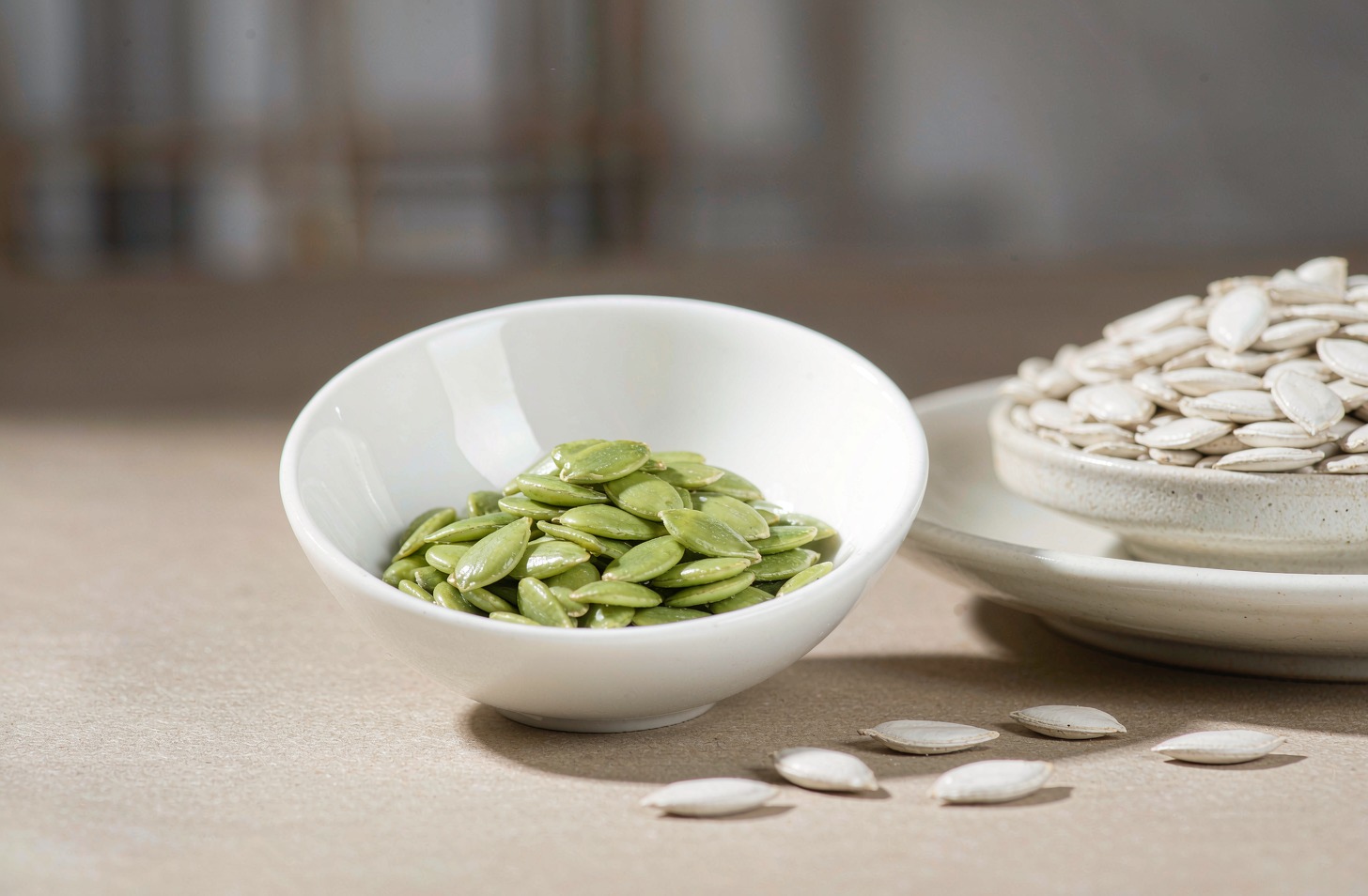
- Shine Skin pumpkin seed kernels — light green, glossy skin; preferred for snack packs and premium bakery use;
- GWS (Snow White) pumpkin seed kernels — white hull-less kernels; ideal for confectionery and health-food blends;
- Hulled pumpkin seeds (pepitas) — general-purpose kernels for roasting, seasoning, and ingredient use;
- Raw in-shell pumpkin seeds — lower volume to Europe but used by specialty roasters and ethnic snack brands.
Most European importers prefer kernels over in-shell seeds because kernels save processing labor and reduce waste at their end.
Quality Grades and Specifications for the European Market
European buyers typically classify pumpkin seed kernels by purity, size, and visual appearance. The table below shows common export specifications:
| Parameter | Standard Range | Premium Range |
|---|---|---|
| Purity | 99.0% – 99.5% | 99.9% or higher |
| Moisture | ≤ 9% | ≤ 8% |
| Admixture | ≤ 0.5% | ≤ 0.1% |
| Size (kernels per 100 g) | 240–260 / 260–280 | 200–240 (larger kernels) |
| Broken kernels | ≤ 5% | ≤ 2% |
| Color defects | ≤ 1% | ≤ 0.5% |
| Packing | 25 kg PP bags | Vacuum or retail packs |
Contracts should always state the target specification, accepted tolerance, and the laboratory method used for testing. A pre-shipment sample approved by the buyer is the best protection against disputes.
Shipping, Packaging, and Logistics
For pumpkin seeds export to Europe, sea freight is the standard mode. Typical container choices are:
- 20 ft container — holds approximately 12–14 tons depending on bag weight;
- 40 ft container — holds approximately 24–26 tons, more cost-efficient for bulk orders.
Standard packing is 25 kg or 50 kg woven PP bags with inner PE liner. For moisture-sensitive products or long transit times, vacuum-packed cartons or nitrogen-flushed bags help preserve freshness. Transit time from Tianjin or Qingdao to Northern Europe is typically 28–35 days, depending on the shipping line and port congestion.
Most Chinese exporters quote FOB, CIF, or DAP terms. First-time buyers often choose CIF to a named European port because the exporter handles ocean freight and insurance, while the buyer arranges import clearance.
How to Choose a Reliable Chinese Exporter for Europe
Not every supplier is equally prepared for the European market. Before you place an order, verify:
- Export experience to Europe — ask for references, bill of lading copies, or existing buyer contacts in Germany, the Netherlands, or Spain;
- Certification scope — confirm HACCP / ISO 22000 and, if needed, BRC / IFS certificates are current and cover the specific product;
- Processing capability — look for automatic cleaning, color sorting, grading, metal detection, and hand-picking or optical sorting lines;
- Laboratory testing — the supplier should arrange pre-shipment third-party testing for aflatoxin, pesticides, and heavy metals;
- Documentation support — a professional exporter prepares the phytosanitary certificate, certificate of origin, packing list, commercial invoice, and insurance documents without reminders.
You can learn more about supplier vetting in our guide on how to choose a reliable pumpkin seed supplier from China.
Why Ouji International Is a Trusted Partner for Pumpkin Seeds Export to Europe
Ouji International is an agricultural food exporter headquartered in Hohhot, Inner Mongolia, the heart of China’s pumpkin seed production region. Established in 2013, the company operates two processing plants and six automatic production lines, supplying walnuts, walnut kernels, cashews, pecans, pumpkin seeds, sunflower seeds, and kernels to buyers across Europe, the Middle East, North Africa, East Asia, and the Americas.
For European importers, Ouji International offers:
- Origin advantage — direct sourcing from Inner Mongolia reduces farm-to-factory time and preserves kernel freshness;
- Grade flexibility — AA, AAA, and custom specifications for snack, bakery, and ingredient use;
- Export documentation — complete certificate support including phytosanitary, origin, and third-party test reports;
- Stable supply — multi-line processing capacity and long-term farmer partnerships;
- Custom packing and labeling — private label, retail packs, and EU-compliant labeling on request.
If your business needs a consistent supply of Chinese pumpkin seeds for Europe, contact Ouji International for samples, specifications, and a current CIF or FOB quotation.
Frequently Asked Questions
What is the most common pumpkin seed product exported to Europe?
Hulled pumpkin seed kernels are the most common export product. Shine Skin and GWS (Snow White) kernels dominate the premium snack and bakery segments, while standard hulled kernels are widely used as ingredients.
What certificates do European importers need for Chinese pumpkin seeds?
The essential documents are the phytosanitary certificate, certificate of origin, HACCP or ISO 22000 certificate, and third-party laboratory test reports for aflatoxin, pesticides, and heavy metals. Retail buyers often require BRC or IFS as well.
How long does shipping from China to Europe take?
Sea freight from Tianjin or Qingdao to major European ports such as Hamburg or Rotterdam typically takes 28–35 days. Overland rail via China–Europe freight trains can reduce this to 14–18 days for time-sensitive orders.
What is the minimum order quantity for pumpkin seeds export to Europe?
Most exporters accept trial orders of 1–5 tons. Full container loads start at roughly 12 tons for a 20 ft container and 24 tons for a 40 ft container, depending on packing.
Can I get organic or BRC-certified pumpkin seeds from China?
Yes. Larger exporters like Ouji International can supply organic-certified and BRC / IFS-certified pumpkin seeds and kernels, but these should be confirmed at the quoting stage because not every production batch carries the same certification scope.
What are the main risks when importing pumpkin seeds into Europe?
The biggest risks are aflatoxin or pesticide residue non-compliance, incorrect documentation causing customs delays, and inconsistent quality between batches. Mitigate these by choosing a certified exporter, requesting pre-shipment samples, and using third-party inspection before shipment.
Conclusion
Pumpkin seeds export to Europe offers strong, recurring demand for Chinese suppliers who can meet EU food-safety standards and provide reliable documentation. Success depends on choosing the right product grade, confirming certifications, locking specifications into the contract, and working with an exporter who understands European import procedures. For buyers seeking a dependable source of Shine Skin, GWS, or hulled pumpkin seed kernels, Ouji International delivers origin-backed quality, export-ready paperwork, and flexible packing for the European market.