

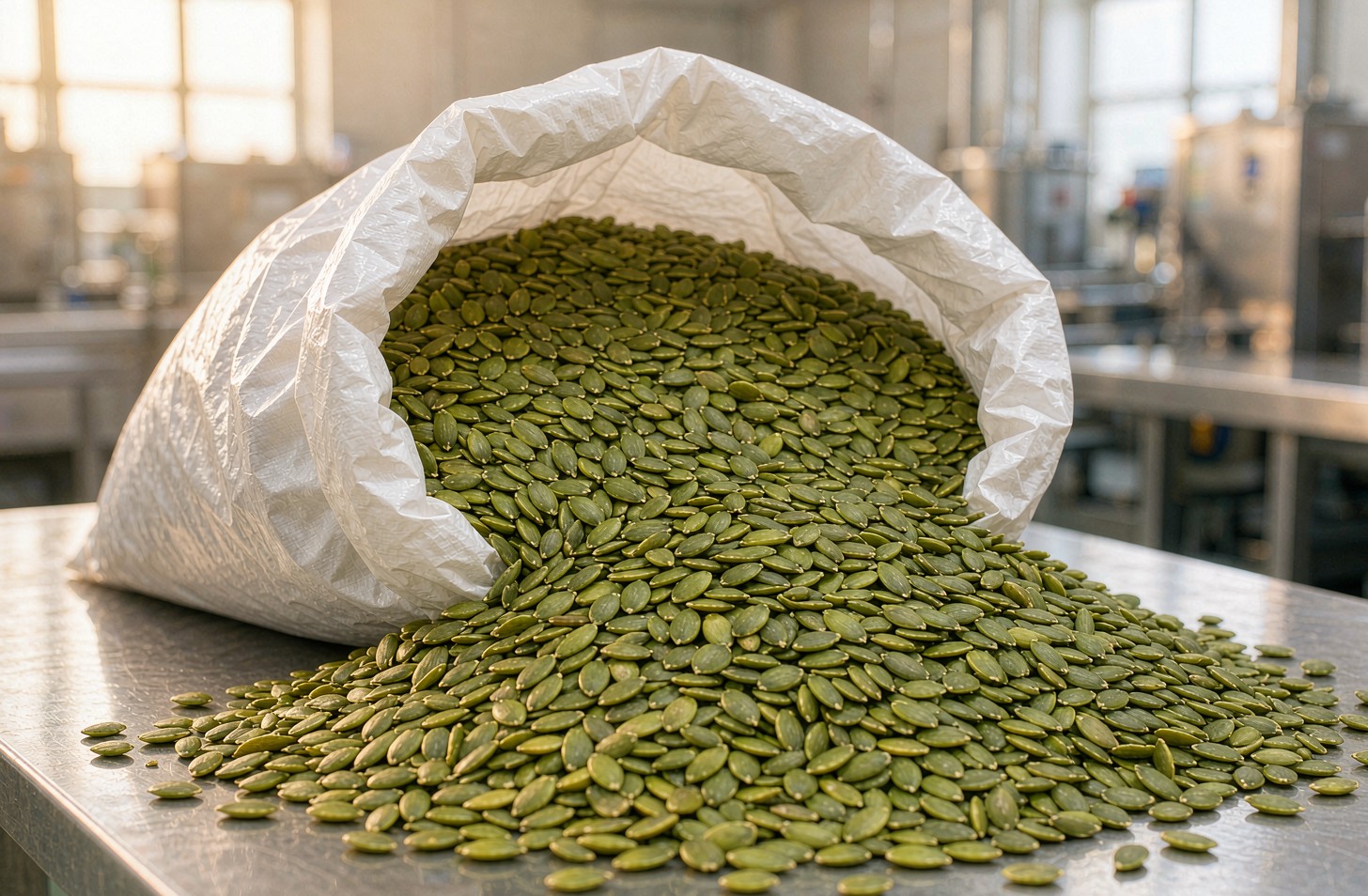
Pumpkin Seeds Export to UAE: A Complete Importer’s Guide
What does it take to import pumpkin seeds into the UAE? Pumpkin seeds export to UAE requires a supplier who can provide phytosanitary certification, a certificate of origin, Halal compliance where relevant, and food-grade packaging that survives Gulf transit temperatures — all delivered on the schedule that Dubai and Sharjah distributors demand. China is the world’s largest producer of shine skin and GWS pumpkin seed kernels, and Chinese exporters ship them to Middle Eastern buyers every week. This guide explains the UAE import process, the documents you need, the quality specifications to insist on, and how to choose a supplier who can handle UAE market requirements reliably from origin.
Ouji International, based in Hohhot, Inner Mongolia, has been exporting pumpkin seed kernels and other nuts and seeds since 2013, with 2 processing plants and 6 automated production lines serving buyers across the Middle East, North Africa, Europe, and the Americas. In the sections below, we break down everything a UAE importer needs to know before placing a first order. For the full product range, visit the Ouji International homepage or see our pumpkin seed kernels product page.
Why the UAE Imports Pumpkin Seeds from China
The United Arab Emirates is the Gulf’s re-export hub: goods cleared through Jebel Ali and Dubai’s free zones reach Saudi Arabia, Oman, Qatar, East Africa, and beyond. Local demand also keeps growing, driven by:
- Snack food manufacturing — roasted and salted pumpkin seeds (pepitas) are a staple in Gulf retail snack mixes.
- Bakery and confectionery — kernels are used in breads, granola, pralines, and premium chocolate inclusions.
- Health food retail — UAE consumers have one of the region’s highest per-capita spends on organic and “clean label” foods.
- Re-export trade — Dubai traders consolidate Chinese nut cargoes for redistribution across MENA.
Because the UAE produces almost no oilseeds domestically, 100% of pumpkin seed demand is met by imports — and China supplies the majority of global hulled pumpkin seed kernels, especially the shine skin variety favored in Middle Eastern snack markets.
Which Pumpkin Seed Products Does the UAE Market Want?
Chinese exporters typically offer three product families. Knowing which one matches your end market saves costly specification mistakes:
| Product Type | Typical Grades / Sizes | Common UAE Applications |
|---|---|---|
| Shine Skin kernels | Grade A / AA / AAA; sizes 9mm, 10mm, 11mm+ | Roasted salted snacks, retail packs, mixed nuts |
| GWS (snow white) kernels | Grade A / AA; uniform white color | Premium retail, bakery inclusions, confectionery |
| Snow White in-shell seeds | Whole seeds, graded by size and moisture | Traditional roasting, food service, repacking |
Key Specifications to Confirm in Writing
Before confirming a purchase contract, lock down these parameters with your supplier:
- Purity: 99.5%–99.9% kernel purity for AA/AAA grades (no shell fragments, no foreign matter).
- Moisture: typically ≤ 8% to prevent mold during Gulf transit.
- Broken kernels: ≤ 5% for AA grade; ≤ 3% for AAA.
- Free fatty acid / peroxide value: within Codex limits to guarantee freshness and shelf life.
- Aflatoxin and pesticide residues: compliant with Codex Alimentarius limits and UAE food import standards.
- Packing: 25kg or 50kg food-grade PP woven bags with inner PE liner, or cartons for retail-ready supply.
The UAE Import Process: Documents and Compliance
Importing pumpkin seeds into the UAE follows a straightforward but document-heavy workflow. Missing a single certificate can delay a container at Jebel Ali for days, so plan ahead:
1. Required Shipping Documents
- Commercial Invoice and Packing List — matched exactly to the B/L.
- Bill of Lading — sea freight via Ningbo/Qingdao/Tianjin → Jebel Ali is the standard route (18–25 days).
- Certificate of Origin — issued by CCPIT; required for customs clearance.
- Phytosanitary Certificate — issued by China Customs; mandatory for all seeds and kernels entering the UAE.
- Health Certificate — confirms the product is fit for human consumption.
- Halal Certificate — not always mandatory for raw kernels, but frequently requested by UAE distributors and essential for value-added products.
- Lab test report — third-party tests (SGS, CIQ) for aflatoxin, moisture, and purity strengthen your customs file.
2. UAE Food Import Rules
Food imports to the UAE are governed by the Ministry of Industry and Advanced Technology (MOIAT) and emirate-level municipalities (Dubai Municipality, Abu Dhabi Agriculture and Food Safety Authority). Key points for importers:
- Shipment labels must show product name, origin, net weight, lot number, and packing/harvest dates in English (Arabic required for retail packs).
- Consignments are subject to inspection and sampling on arrival; consistent quality across shipments minimizes inspection friction.
- Shelf-life rules: bulk kernels for industrial use should carry at least 12 months of remaining shelf life on arrival — another reason to buy current-crop stock.
3. Incoterms and Payment
| Term | Who Arranges Freight | Best For |
|---|---|---|
| CIF Jebel Ali | Exporter books vessel and pays freight/insurance | First-time buyers who want landed-cost certainty |
| FOB Chinese port | Buyer’s forwarder handles ocean leg | Experienced traders with existing freight contracts |
| CFR Jebel Ali | Exporter pays freight, buyer insures | Buyers with their own cargo insurance |
Payment terms for new trade relationships are usually 30% T/T deposit + balance against B/L copy. Established buyers often move to LC at sight or open account terms after several clean shipments.
How to Choose a Pumpkin Seeds Supplier for the UAE Market
Not all exporters are equal. When vetting a Chinese supplier for UAE-bound shipments, check these five areas:
- Export track record: Ask how many containers they ship to the Middle East monthly and request references. A supplier already clearing UAE customs weekly knows the documentation quirks.
- In-house processing: Factories with their own shelling, color-sorting, and X-ray inspection lines control quality from raw seed to bag — trading companies cannot guarantee this. Ouji International runs 6 automated production lines across 2 plants in Inner Mongolia, the heart of China’s pumpkin seed belt.
- Certifications: Look for ISO 22000 or HACCP-based food safety systems; see the ISO 22000 standard overview. Halal and Kosher capability adds flexibility for regional distribution.
- Current-crop supply: Northern China’s harvest runs September–November. Confirm whether you are buying new crop or carry-over stock, and at what moisture and peroxide levels.
- Communication and samples: A serious supplier sends pre-shipment samples with the actual lot’s test report, not generic samples from a showroom bag.
Pricing Factors: What Drives Pumpkin Seed Costs for UAE Buyers?
Pumpkin seed kernel pricing moves with the Chinese harvest cycle and global demand. Factors that determine your quoted price include:
- Grade and size — AAA 10mm+ commands a premium over Grade A 9mm.
- Time of year — prices are typically softest right after harvest (October–December) and firm through summer as stocks tighten.
- Packaging — bulk PP bags are cheapest; retail-ready pouches add conversion cost.
- Order volume — full-container loads (typically 16–18 tons of kernels per 20ft container) get significantly better rates than LCL cargo.
- Payment and Incoterms — CIF quotes include freight to Jebel Ali, which has been volatile; always compare quotes on the same basis.
Common Mistakes UAE Importers Make (and How to Avoid Them)
- Buying on price alone. Lowball quotes often mean old crop, higher broken-kernel counts, or mixed origins — expensive when a municipality inspection rejects the load.
- Skipping pre-shipment inspection. Always request photos, videos, and a sample from the packed lot before the balance payment.
- Ignoring Ramadan timing. Snack demand spikes before Ramadan; containers ordered too late arrive after the selling season. Plan orders 60–90 days ahead.
- Vague specifications. “Grade A” means nothing without written purity, moisture, and size specs in the contract — use the parameters listed above.
- Underestimating transit heat. Summer container temperatures in the Gulf exceed 50°C inside the box. Quality PE liners and moisture-controlled packing matter.
Why Source from Inner Mongolia?
Inner Mongolia produces the majority of China’s shine skin pumpkin seeds thanks to its dry climate, large day-night temperature swings, and sandy soil that yields plump, uniform kernels with low moisture. Sourcing directly from a processor located in the growing region — rather than through downstream traders — means better prices, faster access to new crop, and full traceability from field to container. Ouji International’s plants in Hohhot sit at the center of this supply chain, and our kernels ship to markets across the Middle East, North Africa, Europe, Japan, Korea, and the Americas. Learn more about our company and production capacity.
Conclusion: Start Your UAE Pumpkin Seeds Import with Confidence
Pumpkin seeds export to UAE is a well-established, low-friction trade when handled by the right partner: confirm specifications in writing, verify documents before sailing, buy current crop from a factory-direct supplier, and time shipments around Gulf demand seasons. With 12+ years of export experience, automated processing, and Halal and Kosher certified lines, Ouji International supplies UAE and wider Gulf buyers with shine skin and GWS pumpkin seed kernels in grades from 9mm to 11mm+.
Ready to get a quote? Contact Ouji International today for current-crop pricing, free samples, and a full document pack tailored to UAE import requirements.
FAQ: Pumpkin Seeds Export to UAE
What documents are required to import pumpkin seeds into the UAE?
The core set is a commercial invoice, packing list, bill of lading, certificate of origin, phytosanitary certificate, and health certificate. A Halal certificate and third-party lab report are commonly added for UAE distributors.
How long does shipping take from China to the UAE?
Sea freight from major Chinese ports to Jebel Ali typically takes 18–25 days, plus 3–5 days for customs clearance and delivery within the UAE.
What is the MOQ for pumpkin seed kernels from China?
Most factories quote full 20ft containers (around 16–18 tons of kernels). Some suppliers, including Ouji International, can accommodate trial LCL orders for first-time buyers.
Are Chinese pumpkin seeds Halal certified?
Yes. Reputable exporters offer Halal certification for pumpkin seed kernels; raw agricultural kernels are inherently Halal, but UAE buyers should still request the certificate for their import file.
What grades of pumpkin seed kernels are available for the UAE market?
Shine skin kernels in Grade A, AA, and AAA with sizes 9mm, 10mm, and 11mm+, plus GWS (snow white) kernels. AA and AAA grades with ≥99.5% purity are the most common for UAE snack and bakery applications.
When is the best time to buy Chinese pumpkin seeds?
Prices are usually most favorable from October to December, right after the Inner Mongolia harvest. For Ramadan-driven demand, place orders 60–90 days before the season starts.