

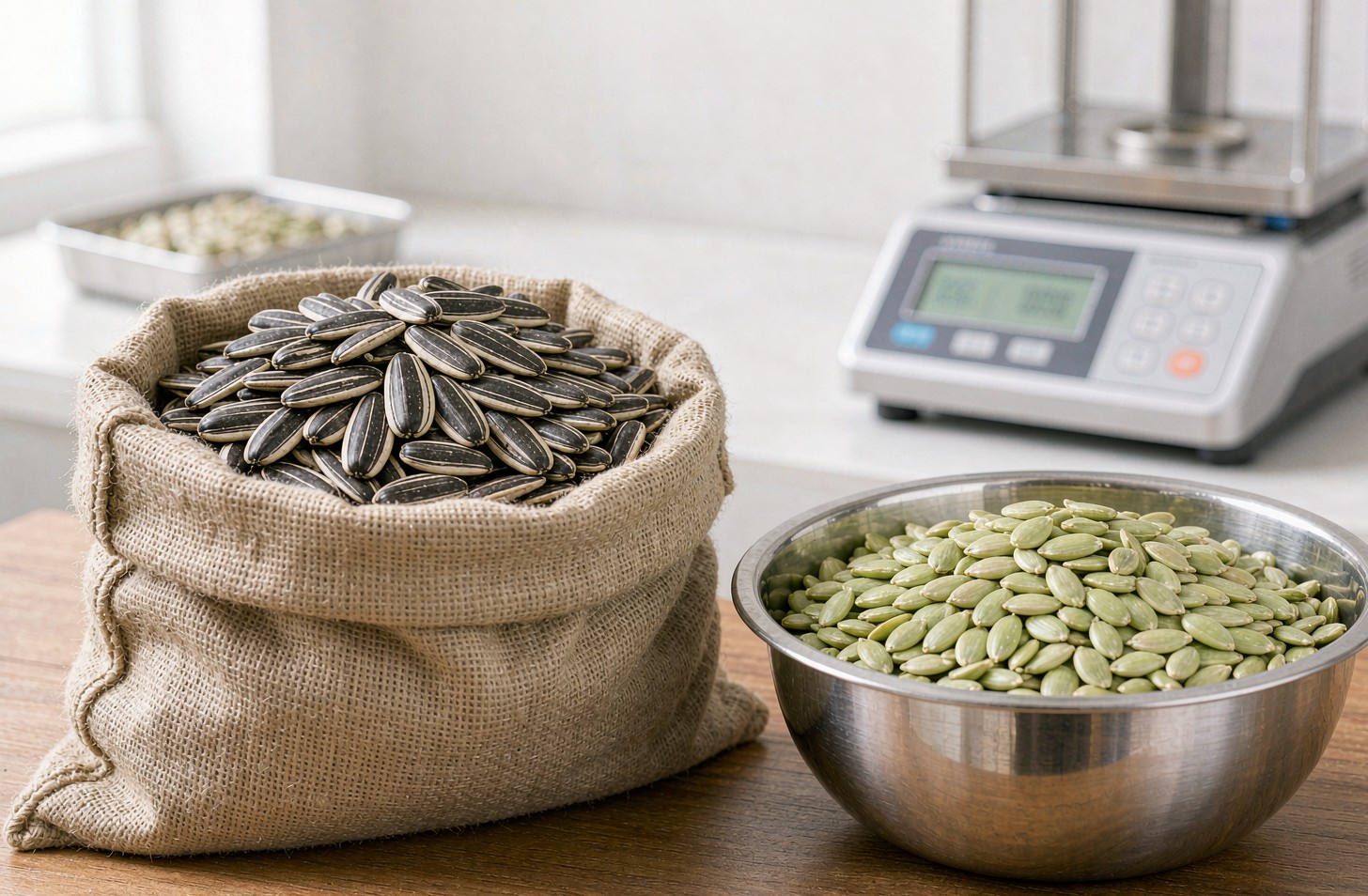
Sunflower Seed Quality Guide: What Importers Need to Know Before Ordering
Sunflower seed quality is determined by a defined set of measurable parameters — purity, moisture content, kernel ratio, size distribution, color, free fatty acids (FFA), and defect levels. For B2B buyers, the practical answer is this: a shipment is “good quality” when it meets agreed specifications in a written contract, verified by pre-shipment inspection and lab reports, not when it merely “looks good” in photos. A confectionery-grade shipment typically requires purity ≥ 99.5%, moisture ≤ 9% (in-shell) or ≤ 7% (kernels), and foreign matter ≤ 0.5%, with aflatoxin and pesticide residues within EU or destination-market limits. This guide explains each quality parameter, the industry grading system, the laboratory tests behind them, the most common quality disputes — and how to verify a Chinese sunflower seed supplier before you wire a deposit. Companies like Ouji International in Inner Mongolia have built their export business around exactly these standards since 2013.
Why Sunflower Seed Quality Matters More Than Price
In the sunflower seed trade, quality failures cost far more than quality premiums. A container rejected at the border means demurrage, re-export or destruction costs, and a mark on your import record. A shipment with excess moisture can develop mold and aflatoxin during a 30-day ocean voyage. Undersized or damaged kernels lower your yield in roasting or shelling operations and erode margin on every ton processed.
Consider the arithmetic: if 5% of a confectionery shipment fails size grading, a buyer packing 25 kg retail bags loses one bag in every twenty to sorting losses. At scale, that single parameter difference can wipe out the price advantage of a cheaper supplier. This is why professional importers treat the specification sheet — not the price list — as the first document in any negotiation.
The 7 Core Quality Parameters for Sunflower Seeds
Every professional sunflower seed transaction should reference these parameters. They apply to both in-shell seeds (black-and-white striped, confectionery type) and hulled kernels (bakery type):
- Purity (or kernel content): the percentage of sound, whole seeds or kernels by weight. Top export grades run 99.5%+ for kernels.
- Moisture content: the single most important storage parameter. Too high invites mold; too low makes kernels brittle.
- Size distribution (sieve grading): seeds per ounce or kernels per 100 g, sorted through calibrated screens. Determines end-use suitability.
- Color and appearance: uniform striped pattern for in-shell; light, uniform color (no dark tips or browning) for kernels.
- Free fatty acids (FFA) / peroxide value: chemical indicators of rancidity and freshness, critical for kernels with a longer shelf-life expectation.
- Defects: broken kernels, damaged or shriveled seeds, insect damage, sprouted seeds, and foreign matter (sticks, stones, other seeds).
- Food safety: aflatoxin B1, total aflatoxins, pesticide residues (MRLs), heavy metals, salmonella for kernels.
Sunflower Seed Quality Specifications: Reference Table
The table below shows typical export specifications. Your contract should state the exact limits, the test method, and the inspection agency for each line.
| Parameter | In-Shell Confectionery Seeds | Hulled Kernels (Bakery Type) | Typical Test Method |
|---|---|---|---|
| Purity / sound kernels | ≥ 99.0% | ≥ 99.5% | Sieve + manual inspection |
| Moisture | ≤ 9.0% | ≤ 7.0% | Oven drying / moisture meter |
| Foreign matter | ≤ 0.5% | ≤ 0.3% | Manual separation, weighed |
| Broken / damaged | ≤ 2.0% | ≤ 3.0% (halves & pieces declared) | Manual inspection of sample |
| Size grading | e.g. 500–600 seeds/100 g, 24/64″–22/64″ sieve | Whole kernels ≥ 75%; per buyer spec | Calibrated sieve analysis |
| Free fatty acids (as oleic) | ≤ 1.5% | ≤ 1.0% | Titration (AOCS Ca 5a-40 style) |
| Aflatoxin B1 | ≤ 2 ppb (EU); ≤ 5–10 ppb many other markets | HPLC / ELISA | |
| Salmonella | — | Absent in 25 g | Microbiological culture |
EU limits for aflatoxins in oilseeds are set under Regulation (EU) 2023/915 on contaminant levels; pesticide maximum residue limits (MRLs) follow Regulation (EC) 396/2005. Both are enforced at border control and should be written directly into your contract. General food hygiene expectations align with Codex Alimentarius standards maintained by FAO and WHO.
How Sunflower Seed Grading Works in Practice
In-Shell Confectionery Grades
Chinese confectionery sunflower seeds (mainly the 363 and 5009 varieties) are graded primarily by size, expressed as seeds per ounce or sieve fractions:
- Grade 1 (premium, ~500–550 seeds/100 g): largest, most uniform; used for premium retail roasting brands in the Middle East, Egypt, and Turkey.
- Grade 2 (~550–600 seeds/100 g): standard export grade; the volume of the confectionery trade.
- Grade 3 (smaller, 600+/100 g): used for bird food, oil crushing, or economy retail lines.
Hulled Kernel Grades
Kernels are graded by color and integrity rather than size alone. A typical hierarchy:
- Bakery grade: light color, ≥ 90% whole kernels, minimal dark tips — the default for bakery and snack bar manufacturing.
- Confectionery / retail grade: brightest color, highest whole-kernel ratio, often nitrogen-flushed retail packs.
- Industrial grade: allows more halves and pieces, slightly darker color — used for oil pressing, flour, or further processing where appearance matters less.
How Sunflower Seed Quality Is Tested
Physical Testing
Sieve analysis confirms size grading using stacked calibrated screens; manual inspection of representative samples (typically drawn per ISO 648 or ASTM sampling patterns from 5–10 points of the lot) quantifies purity, defects, and foreign matter. Moisture is measured with a calibrated meter cross-checked by oven drying.
Chemical Testing
Free fatty acids and peroxide value measure oxidative freshness — essential because sunflower kernels are high in polyunsaturated oil and rancidify faster than most other seeds. Aflatoxin testing by HPLC or rapid ELISA kits is mandatory for EU-bound consignments. Pesticide residue panels (often 200+ compounds for EU) are run by accredited third-party labs.
Microbiological Testing
Hulled kernels destined for direct food use require salmonella absence in 25 g and often total plate count, yeast, and mold limits. This is a core requirement of the HACCP-based food safety systems that serious processors operate under, alongside ISO 9001-certified quality management.
The 5 Most Common Sunflower Seed Quality Problems (and How to Prevent Them)
| Problem | Root Cause | Prevention |
|---|---|---|
| Mold / aflatoxin in transit | Moisture too high at loading; condensation in container | Pre-shipment moisture check; moisture-proof liner bags; desiccants |
| Rancid smell / high FFA | Old crop stored too long; poor warehouse conditions | Ask for crop year; FFA test report; ship current-crop stock |
| Size grade disputes | Sieve calibration differences between buyer and seller | Agree sieve spec and third-party inspection in contract |
| Color defects in kernels | Over-drying, delayed dehulling, heat exposure | Sample approval before production; color photos of actual lot |
| Pesticide MRL exceedance | Field-use pesticides not registered in destination market | Pre-shipment residue panel matched to destination MRL list |
How to Verify a Supplier’s Quality Before You Order
- Ask for the specification sheet — not a catalog. A serious exporter sends parameter-by-parameter specs with test methods within 24 hours.
- Request recent third-party lab reports (aflatoxin, pesticide panel, microbiology) from the current crop year, not templated certificates.
- Order samples from the actual production lot, not showroom samples, and confirm the lot number will be reserved for you.
- Book pre-shipment inspection (SGS, Intertek, Bureau Veritas, or CIQ) with the agreed spec sheet as the pass/fail reference.
- Check certifications: HACCP, ISO 22000 or BRC for food safety; organic and kosher certificates if your market needs them.
- Verify factory capability: ask about sorting lines (color sorters vs. manual), metal detection, and warehouse conditions — video calls work well.
At Ouji International, founded in 2013 in Hohhot, Inner Mongolia, every export lot passes double color-sorting plus manual selection across six automated production lines in two processing plants, with pre-shipment third-party inspection available on request. We ship confectionery and kernel-grade sunflower seeds to the EU, Middle East, North Africa, Japan, Korea, and the Americas — you can see how our raw sunflower seed export specifications compare before requesting a quote.
Frequently Asked Questions
What is good quality for sunflower seeds?
For export confectionery seeds: purity ≥ 99%, moisture ≤ 9%, foreign matter ≤ 0.5%, uniform size grade, and aflatoxin and pesticide residues within destination-market limits. For kernels: moisture ≤ 7%, light uniform color, ≥ 90% whole kernels, and salmonella absent in 25 g.
What moisture level should sunflower seeds be stored at?
In-shell seeds at 9% or below and kernels at 7% or below. Above these levels, mold and aflatoxin risk rises sharply during storage and ocean transit. Always verify moisture at loading, not just at packing.
What is the difference between Grade 1 and Grade 2 sunflower seeds?
Primarily size uniformity. Grade 1 (roughly 500–550 seeds per 100 g) is larger and more uniform for premium retail; Grade 2 (550–600 per 100 g) is the standard export volume grade. Both should meet the same purity and safety limits.
How do you test sunflower seed quality before shipment?
Three layers: physical testing (sieve analysis, manual purity and defect inspection, moisture), chemical testing (FFA, peroxide value, aflatoxin by HPLC or ELISA, pesticide MRL panel), and microbiological testing for kernels. Third-party agencies like SGS or Intertek can witness sampling and issue certificates.
What certificates should a sunflower seed supplier have?
Minimum: HACCP-based food safety certification and phytosanitary certificate per shipment. Stronger suppliers add ISO 9001/22000, and where relevant, organic, kosher, and halal certificates, plus EU RACEX-tested residue reports for European buyers.
Conclusion: Buy Specifications, Not Promises
The difference between a smooth import and a costly rejection comes down to one habit: writing quality into the contract and verifying it independently. Define the seven core parameters, match safety limits to your destination market, test before shipment, and work with suppliers whose factory systems — not just their sales language — support the specification. If you are evaluating Chinese sunflower seed suppliers, the team at Ouji International will send full specification sheets, current-crop lab reports, and lot-accurate samples for your market. Contact us for a quotation and put quality on paper before you pay.