

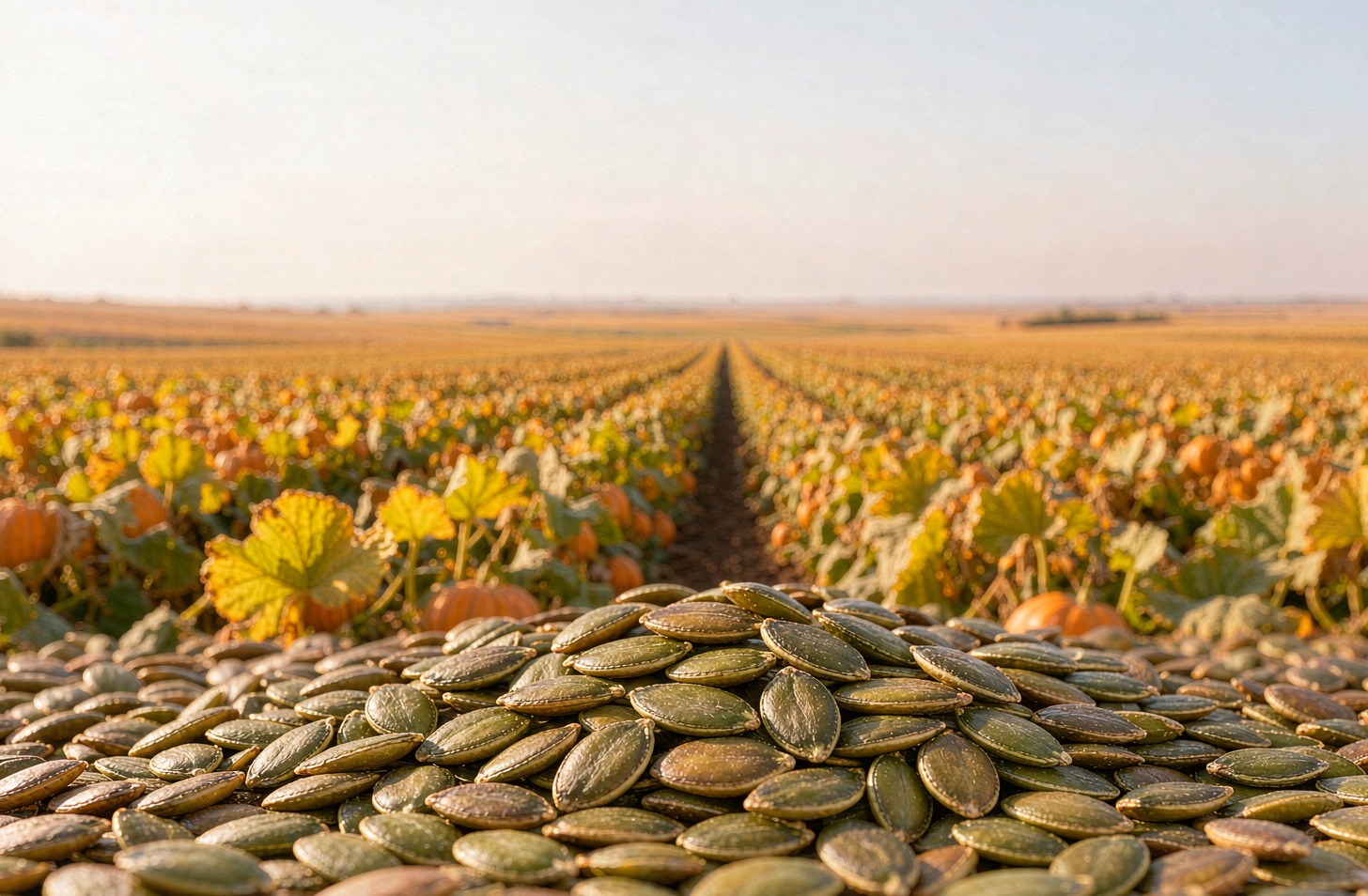
Top Pumpkin Seed Producing Areas in China: A Buyer’s Guide
The top pumpkin seed producing areas in China are concentrated in Inner Mongolia, Xinjiang, Gansu, and Heilongjiang, with Inner Mongolia — especially Hohhot and Bayannur — supplying the majority of the country’s export-grade Shine Skin and GWS pumpkin seeds. These four regions together account for the bulk of China’s commercial pumpkin seed output, and each one contributes a slightly different seed profile thanks to local climate, soil, and farm practices. For overseas buyers, understanding which region suits your market is the fastest way to source consistent, origin-verified product.
If you are importing pumpkin seeds or kernels from China in container volumes, this guide maps the four core production areas, the variety each region is best known for, and the practical implications for grade, price, and lead time. Whether you supply retail snack packs in the Middle East, bakery kernels in Europe, or wholesale in-shell grades to North Africa, the right origin matters as much as the right variety.
Why China Is a Major Pumpkin Seed Origin
China is one of the world’s largest producers and exporters of pumpkin seeds and pumpkin seed kernels, alongside Russia, Ukraine, and parts of Central Europe. The FAO and the China Chamber of Commerce for Import and Export of Foodstuffs and Native Produce both rank pumpkin seeds among China’s top-volume nut and seed export categories, with steady year-on-year growth driven by snack consumption in Asia and the Middle East.
What makes Chinese pumpkin seeds competitive is not just scale — it is the combination of:
- Diverse growing climates — Inner Mongolia’s cold semi-arid plains, Xinjiang’s irrigated basins, Gansu’s Loess Plateau, and Heilongjiang’s cool temperate zones each produce a different seed size and shell profile;
- Modern processing infrastructure — large plants with automatic cleaning, sieving, color sorting, and metal detection lines;
- Export maturity — long-established trade flows to the Middle East, Europe, North Africa, and Southeast Asia, with all major destinations familiar with Chinese pumpkin seed grades.
Within China, however, origin is everything. A pumpkin seed labelled “Product of China” can come from very different growing conditions depending on whether it was harvested in Hohhot or Bayannur — and that difference shows up in your grading, moisture curve, and final product performance.
The Top 4 Pumpkin Seed Producing Regions in China
China’s commercial pumpkin seed supply sits in four key regions. Each region has its own dominant variety, average size, and typical end-use.
| Region | Core Growing Areas | Dominant Variety | Typical Seed Profile |
|---|---|---|---|
| Inner Mongolia | Hohhot, Bayannur, Wulanchabu | Shine Skin & GWS | Plump seeds, clean shells, large size grades (200–260 per 100 g common) |
| Xinjiang | Changji, Bole, Tacheng | GWS, Snow White | White-shell dominant, mid sizes, uniform lots from irrigated farmland |
| Gansu | Wuwei, Zhangye | GWS, mixed | Mid and small grades, suitable for both in-shell and kernel programs |
| Heilongjiang | Harbin, Daqing | Hybrid GWS, kernel-grade | Cooler-climate profile, favoured for dehulling into kernels |
Of these four, Inner Mongolia and Xinjiang together account for the majority of export-grade pumpkin seed volume. Gansu and Heilongjiang fill important roles for specific size grades and kernel-processing programs.
Inner Mongolia: China’s Core Pumpkin Seed Belt
Inner Mongolia is widely recognized as the leading pumpkin seed producing region in China. The province contributes the bulk of export-grade Shine Skin and GWS seeds thanks to its unique growing conditions:
- Cool, dry climate — long sunshine hours, low humidity, and large day-night temperature swings during the growing season, which concentrates sugars in the seed and produces a milder, sweeter kernel;
- Sandy and loamy soils — well-drained soils that limit disease pressure and produce clean, uniform shells;
- Large-scale cultivation — farms ranging from small growers to cooperatives supplying large processing plants.
Within Inner Mongolia, two city clusters dominate:
- Hohhot — the regional capital and the location of major pumpkin seed processors, including integrated plants that clean, grade, color-sort, and pack under one roof. Buyers sourcing full-container volumes often work directly with processors here.
- Bayannur — a major growing cluster to the west, where a large share of farm output is collected, dried, and shipped to Hohhot or directly exported.
For overseas buyers, Inner Mongolia’s advantage is concentration of supply chain: farms, processors, and export teams sit within a few hours of each other, which shortens the farm-to-port lead time and improves traceability. Hohhot Ouji International Co., Ltd. is one of the Inner Mongolia-based exporters working with 2 production processing plants and 6 automatic production lines for pumpkin seeds, kernels, sunflower seeds, walnuts, and other nuts.
Xinjiang: A Major GWS and Snow White Source
Xinjiang is China’s second-largest pumpkin seed growing region and the dominant source for GWS (Grey White Skin) and Snow White seeds. The province’s irrigated farmland and continental climate support high-volume cultivation, particularly around Changji, Bole, and Tacheng in northern Xinjiang.
Key features of Xinjiang pumpkin seeds:
- White-shell dominant — the dry climate produces a clean, bright shell that suits buyers who prefer a lighter visual profile;
- Large lot sizes — cultivation is more consolidated than in Inner Mongolia, which simplifies large-volume contracts;
- Strong fit for kernel processing — uniformity and shell quality make Xinjiang GWS a reliable input for dehulling operations.
Buyers in Egypt, the Middle East, and parts of Europe — markets that prefer white-shell pumpkin seeds — often source their core volume from Xinjiang, with Inner Mongolia adding capacity for premium Shine Skin grades.
Gansu and Heilongjiang: Specialty and Kernel Grades
While Inner Mongolia and Xinjiang dominate headline volume, Gansu and Heilongjiang play important supporting roles.
Gansu Province
Gansu sits south of Inner Mongolia and shares part of the Loess Plateau. Pumpkin seed farms in Wuwei and Zhangye produce consistent mid and small counts of GWS seeds. Gansu lots are commonly blended into mixed-container programs alongside Inner Mongolia or Xinjiang stock — and they are often the source for buyers who want a more cost-effective mid-grade input for kernel processing.
Heilongjiang Province
Heilongjiang is China’s northernmost major growing region, with a cool-temperate climate. While pumpkin seed volume is smaller than in Inner Mongolia or Xinjiang, the cool climate produces seeds that processors often favour for dehulling into green pumpkin kernels. Heilongjiang and Inner Mongolia together supply the bulk of China’s export-grade kernel output.
How Origin Affects Variety, Grade, and Price
For bulk buyers, the practical consequence of region matters in three concrete ways:
| Decision Factor | How Origin Influences It |
|---|---|
| Variety mix | Inner Mongolia has the widest Shine Skin + GWS range; Xinjiang leans white-shell; Gansu / Heilongjiang trend kernel-grade |
| Size grading | Inner Mongolia and Xinjiang commonly reach 200–260 per 100 g; Gansu and Heilongjiang more often 260–320 per 100 g |
| Price position | Premium Shine Skin grades from Inner Mongolia usually top the price band; Xinjiang white-shell and Gansu mid-grades are typically more competitive |
| Lead time | Inner Mongolia’s processing density shortens farm-to-port; Xinjiang adds inland transit; Heilongjiang is further from northern export ports |
How to Pick the Right Origin for Your Market
Choose Inner Mongolia if you want premium Shine Skin and full-container flexibility
If your customers buy large-grade glossy seeds — typical retail packs in the Middle East, East Asia, and parts of Europe — Inner Mongolia’s Shine Skin lots, especially from Hohhot- and Bayannur-area processors, will give you the visual appeal and size consistency you need.
Choose Xinjiang if you want competitive white-shell volume
For GWS and Snow White at competitive pricing, with the option to scale into multiple containers per quarter, Xinjiang is often the most cost-effective origin.
Choose Gansu or Heilongjiang for kernel programs
If your business is primarily kernel processing or you run mixed-grade kernel programs, Gansu and Heilongjiang are reliable sources of mid and small count seeds optimized for dehulling.
Always confirm origin and request a sample
Whichever region you choose, ask the supplier to state the province and city cluster on the contract and proforma invoice, and request a pre-shipment sample from the actual lot. Origin specifications, paired with sample verification, are the strongest protection against grade or variety mismatches at delivery.
Working With an Origin-Based Exporter
Working with a Chinese exporter that sits in the production region has practical advantages over working with a remote trading intermediary:
- Shorter farm-to-port chain — fewer intermediaries means better control of moisture, grading, and lot consistency;
- Direct access to plants — easier to arrange sample dispatch, factory audits, and third-party inspection (SGS, Bureau Veritas, Intertek);
- Export paperwork handled in one place — commercial invoice, packing list, certificate of origin, phytosanitary certificate, and HALAL / Kosher certificates coordinated from a single export team;
- Stable year-on-year supply — origin-based exporters can plan across harvest cycles and explain regional harvest shifts rather than just-in-time reselling.
Established in 2013, Hohhot Ouji International operates from Inner Mongolia and supplies pumpkin seeds, pumpkin seed kernels, sunflower seeds, walnuts, and other nuts to Europe, the Americas, Japan and South Korea, the Middle East, North Africa, and South America — supported by 2 processing plants and 6 automatic production lines.
Frequently Asked Questions
Which province is the largest pumpkin seed producer in China?
Inner Mongolia is the largest pumpkin seed producing province in China. Its combination of dry climate, long sunshine hours, and large cultivation area makes it the leading source for export-grade Shine Skin and GWS pumpkin seeds.
Is Xinjiang pumpkin seed the same quality as Inner Mongolia?
Both regions produce export-grade pumpkin seeds, but the seed profile differs. Xinjiang lots lean toward white-shell (GWS and Snow White) and competitive mid grades, while Inner Mongolia covers the full Shine Skin to GWS range with the most premium glossy retail grades.
Which region is best for pumpkin seed kernels?
Inner Mongolia and Heilongjiang together supply the majority of China’s export-grade pumpkin seed kernels. Both regions produce seeds with strong dehulling yield, light-green kernel color, and clean shells suitable for bakery, confectionery, and snack applications.
Does the production region affect price?
Yes. Premium Shine Skin grades from Inner Mongolia typically command the highest prices, while Xinjiang and Gansu mid-grades are generally more competitive. Ocean freight, inland transit, and harvest yield in a given season also influence the final price.
How can I verify that a Chinese supplier sources from the region they claim?
Ask for the specific city cluster (e.g., Hohhot, Bayannur), the certifying body for farm or plant certificates, and a pre-shipment sample from the actual lot you intend to buy. Combine that with third-party inspection, and you have strong evidence of true origin.
Why does Inner Mongolia produce better pumpkin seeds?
Inner Mongolia’s cool, dry climate, long sunshine hours, sandy and loamy soils, and large day-night temperature variation during the growing season produce seeds with plump kernels, clean shells, and consistent size — the combination that export buyers typically look for.
Conclusion
The top pumpkin seed producing areas in China — Inner Mongolia, Xinjiang, Gansu, and Heilongjiang — together form one of the most versatile pumpkin seed supply bases in the world. Inner Mongolia leads on volume, variety, and premium glossy grades; Xinjiang delivers competitive white-shell GWS at scale; Gansu and Heilongjiang support cost-effective mid grades and kernel-processing programs. Choosing the right origin comes down to matching the variety, grade, and price band to the customer’s market.
For buyers who need a single exporter covering all four origins, Ouji International sources and processes pumpkin seed lots across Inner Mongolia and supplies bulk Shine Skin and GWS, kernels, and mixed-container programs to importers worldwide. Contact Ouji International for current origin availability, samples, and FOB / CIF / DDP pricing for your destination port.