

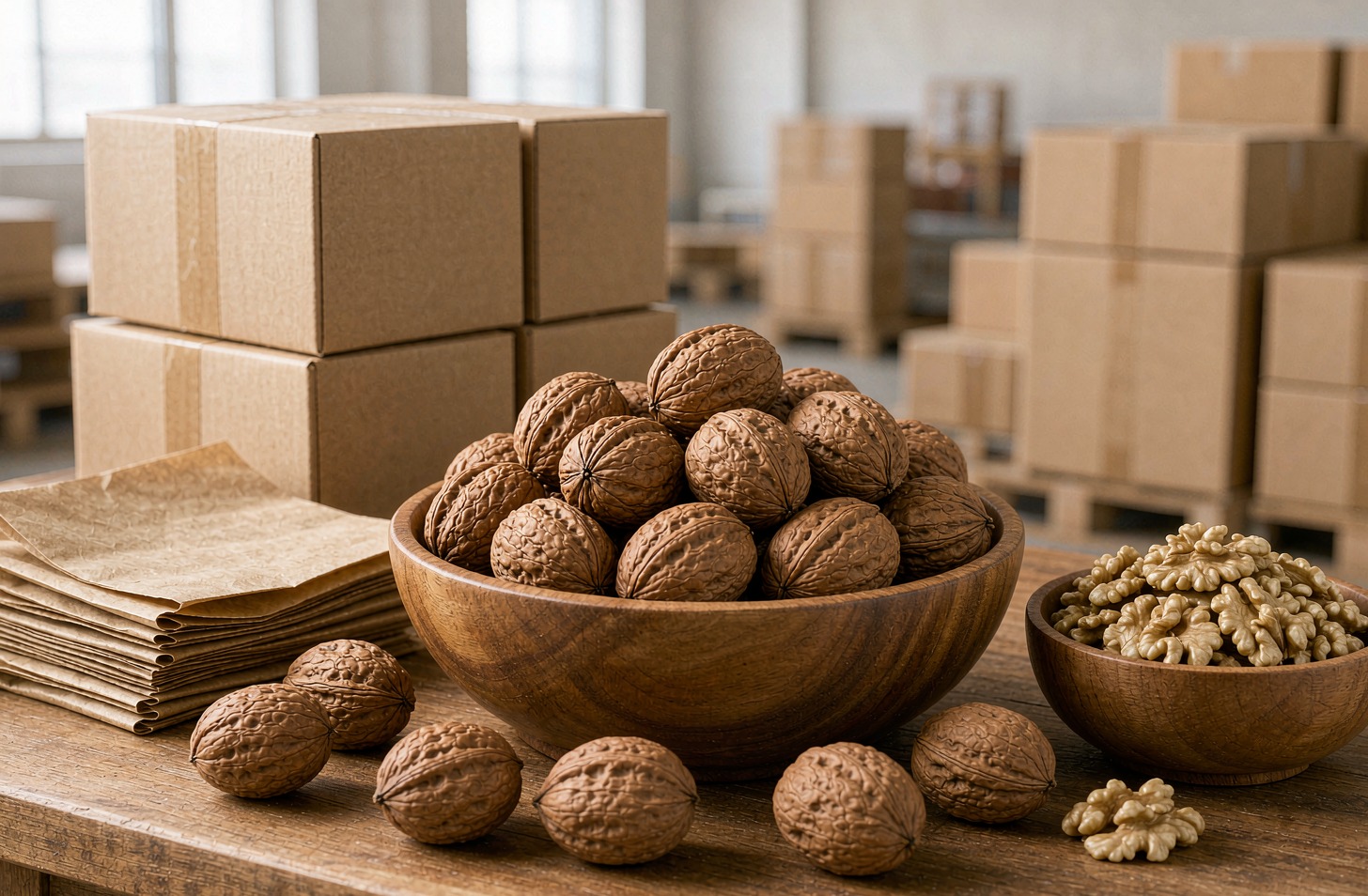
Walnut Buying Guide: How to Choose Quality Walnuts to Import
Buying walnuts for import comes down to one core decision framework: first choose the product form you need (in-shell walnuts vs. walnut kernels), then match the variety and grade to your market, verify the physical specifications in writing, and finally confirm certification and packing before you commit. China — particularly Inner Mongolia and Xinjiang — is one of the world’s leading walnut origins, shipping to Europe, the Middle East, Japan, Korea, and the Americas. This walnut buying guide gives B2B importers a practical checklist for choosing the right walnuts at the right grade, at the right price, without costly surprises at destination.
Whether you are a distributor filling retail shelves, a bakery buying walnut kernels in bulk, or a food manufacturer sourcing ingredients, the same fundamentals apply: know exactly what you are buying, get it specified in the contract, and verify it before shipment.
In-Shell Walnuts vs. Walnut Kernels: Which Should You Buy?
The single most important decision in any walnut purchase is the product form. Each serves a different part of the supply chain:
| Factor | In-Shell Walnuts | Walnut Kernels |
|---|---|---|
| Typical buyers | Retail chains, nut roasters, gift-pack producers | Bakeries, snack makers, food processors, repackers |
| Price basis | Lower per ton, but ~45–55% is shell | Higher per ton, 100% usable yield |
| Shelf life | Longer — shell protects the kernel from oxygen | Shorter — requires cooler storage, vacuum packing recommended |
| Quality risk | Shell cracks, kernel color hidden until cracked | Color, halves/pieces ratio, moisture must be checked carefully |
| Common export sizes | 28 mm+, 30 mm+, 32 mm+ by diameter | Halves (L/L1/L2), quarters, pieces, by color grade |
| Best for | In-shell snacking markets (Middle East, Turkey, gift packs) | Industrial baking, ice cream, confectionery, private-label retail |
A useful rule of thumb: if your customers crack the nut themselves, buy in-shell; if you process the nut further, buy kernels and pay for grading, not shells. Many importers buy both in the same container to balance margin and yield. For a deep dive on kernel quality parameters, see our walnut quality grade guide.
Understanding Walnut Varieties from China
China’s walnut production is concentrated in two main regions, each with distinct variety characteristics:
- Xinjiang (paper-shell walnuts, 纸皮核桃) — famous for thin shells (crackable by hand), high kernel yield of 55%+, and a light kernel color. Ideal for in-shell retail and premium kernel production.
- Inner Mongolia and northern China — thicker-shelled, hardy varieties with strong flavor, well suited to kernel processing and industrial use.
- Yunnan and Sichuan — mountain-grown varieties with distinctive aroma, often used domestically and in specialized channels.
When comparing quotes, always confirm the origin region and variety, not just “China walnut.” Shell thickness, kernel color, and yield vary significantly between them, and they are priced differently for a reason.
Walnut Kernel Grades and Specifications
If you are buying kernels, these are the spec lines every contract should state. A professional exporter will provide a specification sheet that matches these parameters:
| Parameter | Common Export Standard |
|---|---|
| Grades | Halves (light), quarters, pieces; color grades light / light amber / amber |
| Moisture | ≤ 5% (kernels), ≤ 8% (in-shell) |
| Kernel yield (in-shell) | 45% – 55% depending on variety |
| Foreign matter / shell fragments | ≤ 0.5% in kernels |
| Defective kernels | ≤ 5% (rancid, moldy, insect-damaged combined) |
| Free fatty acid (rancidity indicator) | ≤ 1.0% (as oleic acid) |
| Packing | Kernels: 10 kg vacuum bags in cartons; in-shell: 25/50 kg PP bags |
| Shelf life | 12 months (in-shell, cool dry storage); 9–12 months (vacuum kernels at ≤ 20 °C) |
Two numbers matter most for food safety: moisture (too high invites mold and aflatoxin risk) and free fatty acid (the earliest measurable sign of rancidity). Insist on a pre-shipment inspection report — ideally from a third party such as SGS or Intertek — covering both.
What Drives Walnut Prices in International Trade
Walnut prices move with the crop cycle and product form. Understanding the drivers helps you time your purchase and compare quotes fairly:
- Crop year and harvest timing — Chinese walnuts are harvested in September–October; prices are typically firmest just after harvest and soften as the season progresses;
- Product form — kernels command a 2–3x premium over in-shell per ton, but deliver full usable yield;
- Grade and color — light-color halves can carry a 10–20% premium over amber pieces of the same tonnage;
- Kernel yield for in-shell lots — thin-shell Xinjiang lots with 55% yield price higher than standard lots at 45%;
- Exchange rates and container freight — walnuts trade in USD; freight swings between Chinese ports and your destination can move landed cost by 3–8%.
For volume planning, a standard 20 ft container loads roughly 12–14 tons of in-shell walnuts or 10–12 tons of vacuum-packed kernels, depending on packing configuration.
A 6-Step Buying Process for B2B Importers
- Define your specification in writing — form, variety, origin, grade, color, moisture, packing, and target price band before you request quotes;
- Compare like with like — ask every supplier to quote against your spec sheet, not their house grade;
- Evaluate samples — crack and taste in-shell samples yourself; check kernel color, aroma, and moisture with a calibrated meter;
- Verify certification — HACCP / ISO 22000 food-safety systems, HALAL or Kosher where your market requires it. Read about ISO 22000 food safety management to know what the certificate actually covers;
- Agree inspection terms — pre-shipment inspection (your own, third-party, or both), with photo and video evidence of the actual loading lot;
- Fix the paperwork list — commercial invoice, packing list, certificate of origin, phytosanitary certificate, and insurance, agreed before deposit payment.
Red Flags When Comparing Walnut Suppliers
- Prices far below market — usually old-crop, high-moisture, or grade-substituted stock;
- Refusal to state kernel yield or color grade in the contract;
- No factory visit or video audit possible — trading companies reselling from multiple mills often cannot guarantee consistency;
- Certificates without visible certifying bodies or expiry dates;
- Vague packing terms (“export standard bags”) instead of stated weights and materials.
Why Buy Walnuts from Ouji International
Ouji International (based in Hohhot, Inner Mongolia) has exported walnuts, walnut kernels, pecans, cashews, pumpkin seeds, and sunflower seeds since 2013. With 2 processing plants and 6 automatic production lines, we supply in-shell walnuts and graded kernels to importers across Europe, North America, the Middle East, Japan, Korea, North Africa, and South America — with HALAL and Kosher certification, third-party inspection support, and full export documentation as standard.
If you are comparing origins and suppliers for your next walnut order, visit oujint.com to request a specification sheet, current crop pricing, and samples for your market.
Frequently Asked Questions
What should I check first when buying walnuts in bulk?
Check moisture (≤ 5% kernels), color grade, and a current crop-year declaration. These three parameters predict shelf life and rancidity risk better than price.
Which is better for import: in-shell walnuts or kernels?
Buy in-shell for retail snacking and gift markets; buy kernels for baking, confectionery, and food processing. Kernels cost more per ton but deliver 100% usable yield.
What is the difference between light and amber walnut kernels?
Color reflects oxidation level. Light kernels command a premium and suit premium retail; amber kernels are perfectly safe and ideal for baking where color is irrelevant.
How long do imported walnuts last?
In-shell walnuts keep about 12 months in cool, dry storage. Vacuum-packed kernels keep 9–12 months at or below 20 °C; once opened, kernels should be used quickly or refrigerated.
What certifications should a walnut exporter have?
At minimum HACCP or ISO 22000; HALAL and Kosher for Middle East and specialty markets; ISO 9001 for quality management. Confirm the certificate scope covers the actual processing plant.
How many walnuts fit in a 20 ft container?
Roughly 12–14 tons of in-shell walnuts or 10–12 tons of vacuum-packed kernels, depending on packing format and carton configuration.
Ready to source walnuts with confidence? Contact Ouji International for a detailed quotation, specification sheets, and free samples — and let our 10+ years of export experience work for your business.