

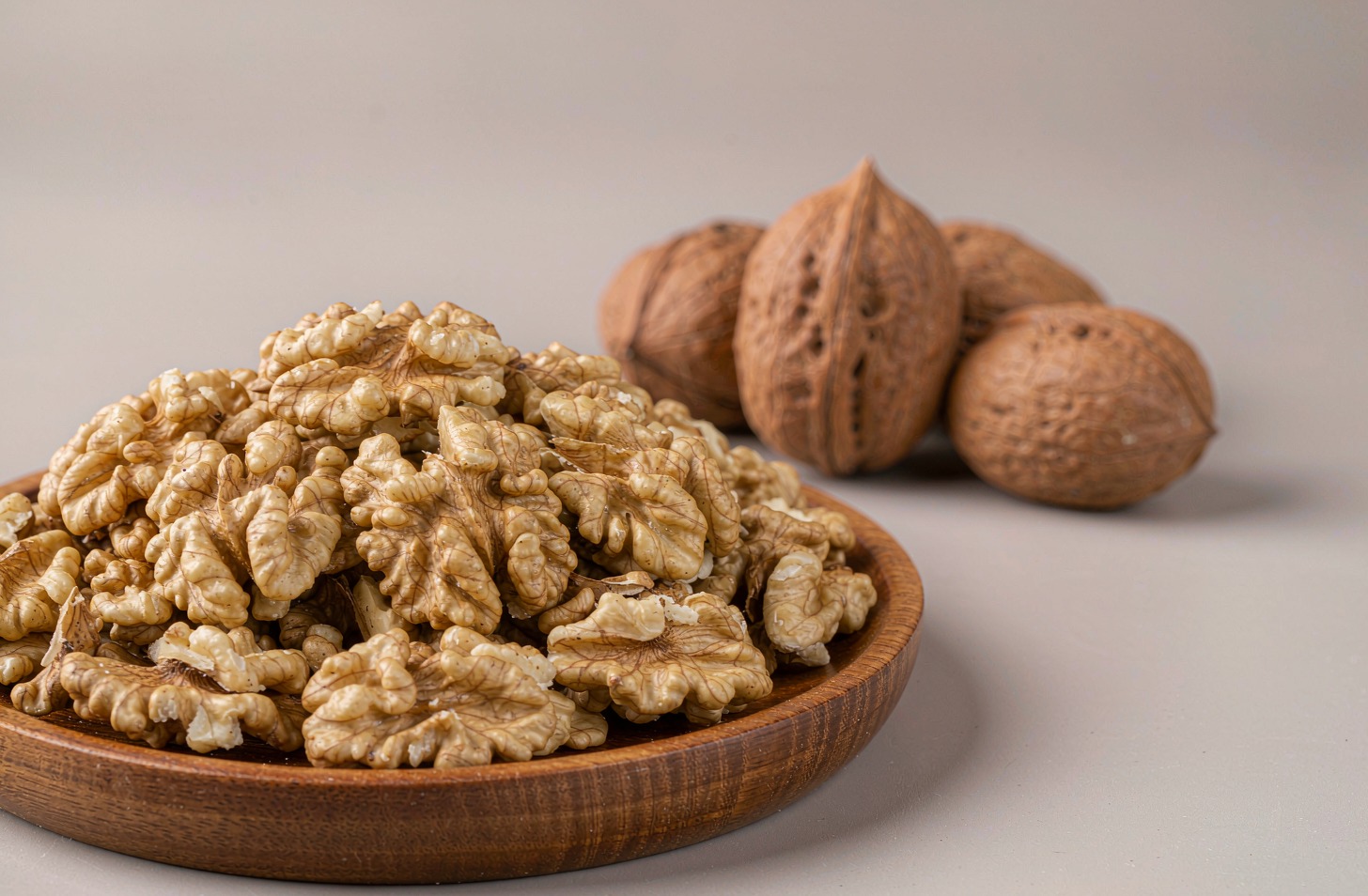
A reliable walnut halves supplier is one that can deliver intact, light-colored halves at a consistent halves yield, batch after batch, with food-safety paperwork that clears your market’s customs. Halves are the highest-value cut of the walnut kernel: they command a premium over quarters and pieces because they are sold as visible product — on snack shelves, in gift packs, on bakery tops, and in premium retail bags. That premium is also where most sourcing risk sits, because halves break easily in handling and color drifts between lots. This guide explains the grades, the specifications to write into a contract, and how to vet a supplier before you book a container.
Ouji International has been sourcing and exporting Chinese walnuts and walnut kernels from Hohhot, Inner Mongolia since 2013. We operate two processing plants and six automatic production lines — shelling, air separation, color sorting, hand-picking, and metal detection — and ship walnut products to buyers across Europe, the Middle East, North Africa, East Asia, and South America. The checks below are the same ones we walk buyers through every week.
What Counts as a Walnut Half?
In the trade, walnut kernels are sold by kernel form first and color second. Form is expressed as a percentage of the lot by weight:
- Halves — a kernel that is at least 75% intact (industry convention; some buyers specify 80% or 90% halves yield). This is the premium grade.
- Quarters — kernels broken into four or fewer pieces, used in baking and confectionery.
- Pieces / broken — irregular fragments for industrial use: fillings, ice cream inclusions, nut butters, cereal.
Color is graded separately, from Light (extra light, pale cream) through Light Amber to Amber. The two dimensions combine into the commercial grade names buyers actually contract on, such as Light Halves or Light Amber Halves. A supplier who quotes “walnut halves” without naming a color grade and a halves percentage is not giving you a spec — they are giving you a starting point for a dispute.
Walnut Kernel Grades at a Glance
| Grade | Color | Halves yield | Typical use | Relative price |
|---|---|---|---|---|
| Light Halves (LH) | Extra light to light | ≥ 90% | Premium retail, gift packs, snacking | Highest |
| Light Amber Halves (LAH) | Light amber | ≥ 85% | Bakery topping, retail value packs | High |
| Halves & Pieces (H&P) | Light to light amber | 40–60% | Confectionery, cereal, food service | Mid |
| Quarters | Light to amber | — | Baking, ice cream, nougat | Mid-low |
| Pieces | Any | — | Industrial fillings, paste, inclusions | Lowest |
The price gap between Light Halves and Pieces is typically the largest single variable in a walnut kernel contract — often 30–50% per metric ton. Ask for the halves count from your pre-shipment sample, and state the tolerance in the contract (for example: “minimum 90% halves, measured on a 1 kg representative sample, buyer’s option to re-test at destination”).
Why Source Walnut Halves from Inner Mongolia
China is the world’s largest walnut producer, and the northern growing belt — Inner Mongolia, Xinjiang, Shaanxi, and Yunnan — supplies most of the export-grade kernel. Inner Mongolia in particular produces light-colored, plump kernels with a mild flavor, which is exactly what the halves trade wants. The commercial reasons:
- Color — a dry climate, large day–night temperature swings, and long sunshine hours reduce the darkening that lowers kernel grade;
- Halves integrity — thick-shelled northern varieties crack cleanly, so more kernels survive shelling as whole halves;
- Scale and season — a September–November harvest supports continuous supply through the following summer;
- Processing depth — modern plants run color sorters and hand-picking tables that lift halves yield and remove defect material before packing.
For the full range of forms we supply — in-shell, halves, quarters, and pieces — see our walnut and nut product range.
Specifications to Write Into Your Contract
These are the parameters that decide whether a shipment is accepted or claimed against. Treat them as a checklist for your purchase order.
| Parameter | Typical export spec | How it is verified |
|---|---|---|
| Halves yield | 85–95% by weight, grade-dependent | Manual count on 1 kg sample |
| Moisture | ≤ 5.0–6.0% | Oven or moisture analyzer |
| Foreign matter | ≤ 0.1% (shell fragments, dust) | Visual / sieve |
| Defect tolerance | ≤ 1–2% (dark, shriveled, insect damage) | Visual sorting on sample |
| Color | Light / Light Amber per grade | Color card or colorimeter |
| Free fatty acid (FFA) | ≤ 0.5% (as oleic) | Laboratory titration |
| Peroxide value | ≤ 5 meq O₂/kg | Laboratory test |
| Aflatoxin | ≤ 2 µg/kg AFB1, ≤ 4 µg/kg total (EU) | HPLC / ELISA, third-party lab |
| Microbiology | Yeast & mould, Salmonella negative, E. coli within market limits | Accredited lab certificate |
| Metal / foreign bodies | Fe ≤ 3 mm, non-Fe ≤ 4 mm; no glass or stone | Metal detector + X-ray record |
Color and Defect Tolerance
Color is the grade driver buyers argue about most. Because “light” is a range rather than a point, the practical fix is a retained reference sample: both parties keep a sealed 500 g sample from the pre-shipment lot, and the contract says delivered goods must match it. This single clause removes most color disputes in the walnut halves trade.
Food-Safety Limits That Actually Apply
Walnuts are a tree nut and a known aflatoxin-risk commodity, so market limits are strict and enforced at the border. The EU sets maximum mycotoxin levels for nuts under Commission Regulation (EU) 2023/915, while US importers work to FDA requirements. Processors are generally certified to ISO 22000 food-safety management systems. A serious supplier will hold a current certificate from a recognised body and provide a third-party aflatoxin report per lot.
How Walnut Halves Are Processed
Understanding the line tells you where halves get broken — and what to ask about.
- Receiving and cleaning — in-shell walnuts are inspected, de-stoned, and size-graded by diameter.
- Cracking and shelling — mechanical crackers are set per shell thickness and variety; this step determines baseline halves yield.
- Air separation — shell fragments and pellicle dust are lifted off by density and airflow.
- Color sorting — optical sorters eject dark, shriveled, and damaged kernels; modern cameras also detect shell and foreign material.
- Hand-picking — the last quality gate, where defect halves and residual shells are removed on a light table.
- Metal detection and X-ray — every packed unit passes a detector, and records are kept for audit.
- Packing — cartons, vacuum bricks, or nitrogen-flushed bags, sealed and lot-coded for traceability.
Ask your supplier two questions here: how many hand-picking stations run per shift, and whether metal detection happens before or after packing.
How to Vet a Walnut Halves Supplier
1. Verify the legal entity and the plant
Cross-check the business licence, export registration, and the address on the certificate of analysis. Then request a live video walk-through of the shelling line — not a highlight reel.
2. Confirm certifications and their scope
HACCP or ISO 22000 is the baseline; BRCGS or IFS is increasingly required by European retailers; HALAL and Kosher certificates matter for Middle East and Jewish-market buyers. Check validity dates and that the site address matches the plant you are buying from.
3. Test the grading consistency, not just the sample
Request three samples from different production dates and compare halves yield and color side by side. Consistency across lots is what separates a factory from a spot trader.
4. Agree a sampling and inspection protocol
Pre-shipment inspection by a third party such as SGS or Bureau Veritas is standard for first orders. Build the cost into the quotation rather than discovering it later.
5. Confirm documentation capability
A competent exporter issues commercial invoice, packing list, bill of lading, certificate of origin, phytosanitary certificate, and health certificate as routine — plus HALAL, Kosher, or lab reports where your market requires them.
6. Check capacity and lead time against your programme
Ask for monthly kernel output in metric tons and the lead time for a repeat order, and confirm they can support a quarterly programme.
7. Ask for two references in your region
Existing buyers in your market have already cleared the import hurdles you are about to face. Their willingness to be named is itself a signal.
Packaging and Container Loading
| Packing format | Net weight | 20 ft container | 40 ft container |
|---|---|---|---|
| Carton, food-grade PE liner | 10 kg | ~14–16 t | ~24–26 t |
| Carton, food-grade PE liner | 12.5 kg | ~15–17 t | ~25–27 t |
| Vacuum brick, 2 × 5 kg per carton | 10 kg | ~13–15 t | ~23–25 t |
| Nitrogen-flushed foil bag in carton | 10–12.5 kg | ~13–16 t | ~23–26 t |
Actual loads depend on carton dimensions and palletisation. For halves, vacuum or nitrogen flushing is worth the extra cost: it slows oxidation, protects the kernel from crushing, and extends shelf life to 12–18 months under cool, dry storage.
What Drives the Price of Walnut Halves
- Halves yield — every percentage point of whole halves is worth money; a 90% spec costs materially more than 80%.
- Color grade — Light Halves trade at a premium to Light Amber, sometimes by 10–20%.
- Harvest timing — new-crop kernels from the September–November harvest are most competitive in the first months; prices typically firm as stocks draw down.
- Freight and season — container rates and pre-holiday congestion can swing landed cost more than the product itself.
- Payment terms — T/T with deposit, L/C at sight, or open account against insurance each carry a different price.
Always compare landed cost per metric ton at your port, not FOB price in isolation.
Common Buying Mistakes
- Buying “halves” without a halves percentage. The word alone is not a specification.
- Skipping the reference sample. Without a retained sample, color claims are almost impossible to win.
- Comparing FOB quotes across different packing. Vacuum-packing and carton weight change the real price.
- Accepting a self-issued lab report. Insist on an accredited third-party report for aflatoxin on the actual lot.
- Ordering the first container without inspection. A USD 300–500 pre-shipment inspection protects a five-figure order.
- Ignoring storage after arrival. Halves are fragile; poor warehouse conditions undo good processing within weeks.
Frequently Asked Questions
What is the difference between walnut halves and walnut pieces?
Halves are kernels that remain at least 75% intact after shelling; pieces are fragments. Halves are sold as visible product and cost significantly more, while pieces go into fillings, baking, and industrial ingredients.
What is a good halves yield for walnut kernels?
Premium contracts specify 90–95% halves for Light Halves grade, and 85% or above for Light Amber Halves. Anything below 80% is normally sold as halves and pieces.
What is the minimum order quantity for walnut halves?
Most Chinese exporters accept trial orders of 1–5 tons or a few sample cartons. Full container orders usually start around 13–16 tons for a 20 ft and 23–26 tons for a 40 ft container.
How long can walnut halves be stored?
Vacuum-packed or nitrogen-flushed halves keep 12–18 months at 4–10 °C and low humidity. Carton-packed product is best used within 6–9 months, since the high oil content makes walnuts prone to rancidity.
Which certificates should a walnut halves supplier provide?
At minimum HACCP or ISO 22000, a phytosanitary certificate, a health certificate, and a third-party aflatoxin report per lot. Add HALAL, Kosher, BRCGS, or organic certification depending on your market and customer requirements.
Are Chinese walnut halves suitable for the EU market?
Yes, provided aflatoxin levels meet EU maximum levels and the supplier can document lot-level testing. Most European buyers also require BRCGS or IFS certification and a pre-shipment inspection for first orders.
Conclusion
The right walnut halves supplier is one you can hold to a number: a stated halves percentage, a named color grade, a retained reference sample, and a third-party aflatoxin report per lot. Verify the plant, not just the price list — capacity, hand-picking stations, metal detection records, and export documentation tell you whether you are buying from a processor or a reseller.
If you are sourcing walnut halves, quarters, or pieces in bulk for retail, bakery, confectionery, or food service, contact Ouji International for current specifications, samples, and export pricing. We will match the grade and packing to your market and ship on schedule.