

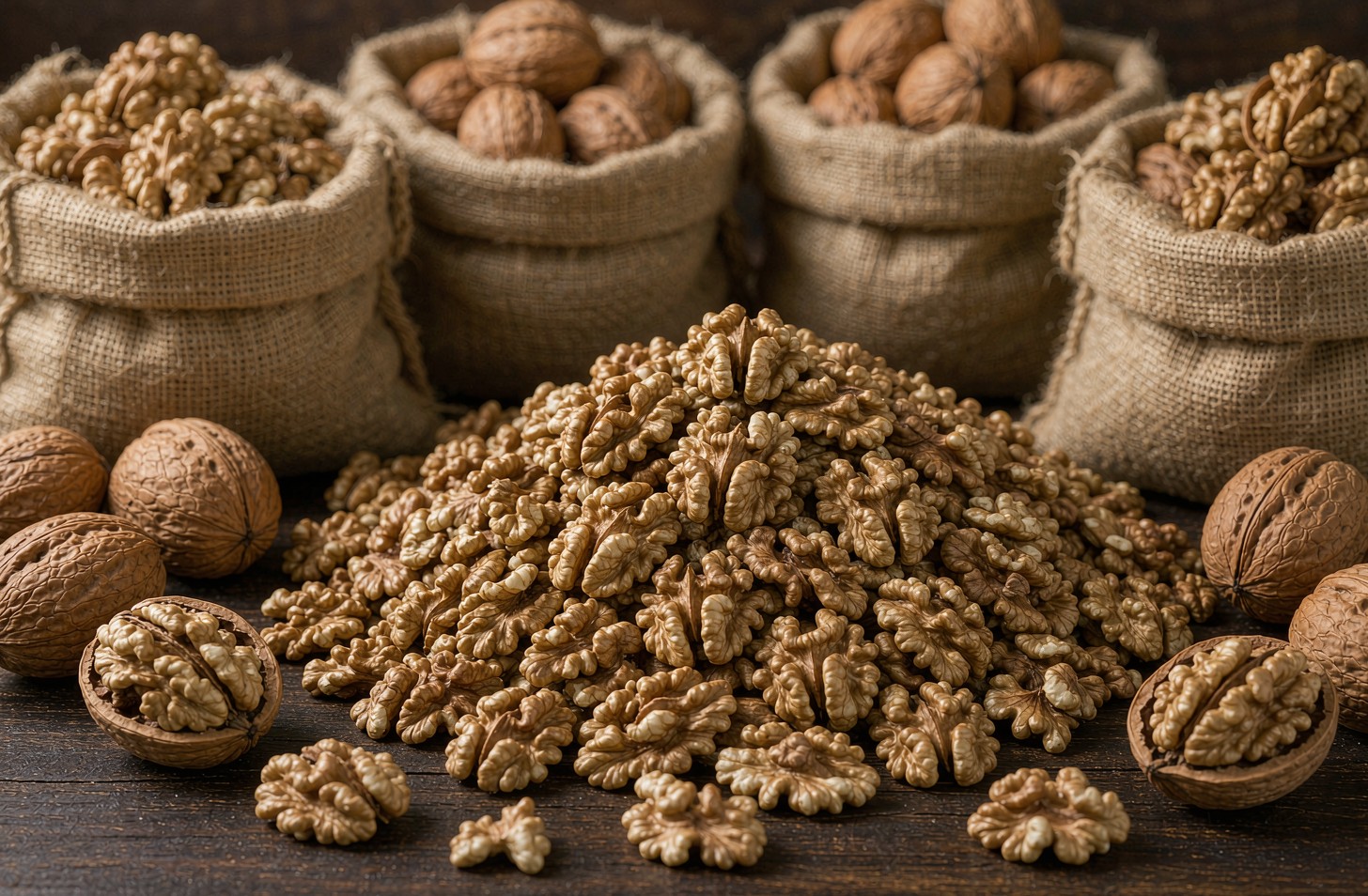
Walnut Supplier Saudi Arabia: How to Import & Source Safely
Choosing the right walnut supplier for Saudi Arabia means finding a partner who can clear SFDA food-import requirements, deliver HALAL-certified product with complete documentation, and hold consistent quality from container to container. Saudi Arabia imports the majority of its walnuts because local production cannot meet the growing demand from bakeries, snack brands, retailers, and the booming food-service sector. But importing walnuts into the Kingdom is not just about price — it is about certificates, labeling, shelf life, and a supplier who understands Saudi market rules. This guide explains exactly what Saudi buyers should check before placing a bulk walnut order with a Chinese supplier.
Whether you are a distributor in Riyadh, a bakery chain in Jeddah, or a food manufacturer in Dammam, the criteria below apply to every order — from a 5-ton trial shipment to a full 40-foot container of in-shell walnuts or walnut kernels.
Why Saudi Arabia Is a Growing Market for Imported Walnuts
Saudi Arabia’s nut consumption has grown steadily over the past decade, driven by population growth, rising health awareness, and the rapid expansion of bakeries, cafes, and premium snack brands. Walnuts are a staple ingredient for:
- Bakeries and pastry producers — walnut kernels for breads, cakes, and Middle Eastern sweets such as maamoul and baklava;
- Retail private label — packaged walnuts sold under Saudi supermarket brands;
- Snack and trail-mix manufacturers — blends combining walnuts with almonds, pistachios, and dried fruit;
- HoReCa and food service — hotels, restaurants, and catering companies buying in bulk.
Domestic walnut production in the Kingdom is limited to small highland orchards, so nearly all commercial volume comes from imports — primarily from the United States, Chile, and China. Chinese walnuts have gained strong ground in price-sensitive and mid-premium segments because they combine competitive pricing with large, uniform kernel sizes, especially from origins like Yunnan and Xinjiang.
What Saudi Import Regulations Require
Before comparing suppliers, understand the compliance side. All imported food into Saudi Arabia is regulated by the Saudi Food and Drug Authority (SFDA), and consignments must comply with its import control rules. A capable walnut supplier should help you prepare:
- Health certificate issued by the competent authority in the exporting country;
- Certificate of origin (chamber-of-commerce certified);
- Phytosanitary certificate for plant-origin products where applicable;
- HALAL certificate — while walnuts are inherently halal, a certified HALAL processing certificate from the factory is widely expected by Saudi distributors and retailers;
- Lab test report covering moisture, aflatoxin, pesticide residues, and microbiology;
- Arabic/English product labeling compliant with SFDA and SASO requirements, including production and expiry dates, origin, and importer details.
Consignments that arrive without correct documentation risk delays, re-inspection fees, or rejection at Jeddah Islamic Port or King Abdulaziz Port, Dammam. A supplier experienced in shipping food products to the Gulf will prepare this paperwork as standard — ask for samples of export documents from previous Saudi or Gulf shipments before you commit. You can read more about official import controls on the SFDA official website.
How to Choose a Walnut Supplier for Saudi Arabia: 6 Criteria
1. Product Range That Matches Your Segment
Saudi buyers source two main walnut formats. Confirm the supplier produces both — or clearly states which one they specialize in:
- In-shell walnuts — favored by traditional markets and gift-pack producers; graded by size and shell color;
- Walnut kernels — the dominant format for food industry use, graded as light halves, quarters, pieces, and amber grades according to color and integrity.
If you serve both retail and industrial customers, working with a supplier that offers a full kernel grade range simplifies procurement. For a detailed breakdown of grading standards, see our walnut quality grade guide.
2. Certifications and Factory Audits
As a baseline, a serious export factory should hold:
- HACCP hazard-based food-safety management (see the Codex Alimentarius framework for reference standards);
- ISO 22000 or ISO 9001 certification;
- HALAL certification valid for Gulf markets;
- Willingness to accept third-party inspections (SGS, Bureau Veritas, Intertek) before shipment.
Always ask for the certificate number, issuing body, and validity date — and confirm the scope covers the exact plant that will process your order.
3. Consistent Specifications, Contracted in Writing
Every bulk contract to Saudi Arabia should lock these parameters before production:
| Parameter | Typical Export Standard | Why It Matters for Saudi Buyers |
|---|---|---|
| Moisture | ≤ 7% (kernels) | Prevents mold and rancidity in Gulf summer temperatures |
| Kernel purity / admixture | 99.5%+ purity, ≤ 0.5% shell & foreign matter | Retail packs and bakery lines require uniform kernels |
| Color grade | Extra light / light / light amber | Light halves command premium prices in Saudi retail |
| Defects | ≤ 2–5% depending on grade | Directly affects yield for food processors |
| Aflatoxin & microbiology | Within SFDA / Codex limits | Mandatory for customs clearance |
| Packing | 10–12.5 kg vacuum cartons / 25–50 kg pp bags | Vacuum packing extends shelf life in hot climates |
4. Processing Capability and Capacity
Consistency comes from the factory floor, not the sales pitch. Prioritize suppliers with:
- Automatic shelling, grading, and color-sorting lines — machine sorting keeps grades uniform order after order;
- Metal detection and X-ray inspection before packing;
- Cold or temperature-controlled storage — critical for walnut oil stability during Gulf-bound transit;
- Multiple production lines so one order never delays the next.
As a reference point, Ouji International operates 2 processing plants with 6 automatic production lines in Hohhot, Inner Mongolia, exporting walnuts, pine nuts, pumpkin seeds, and sunflower seeds to the Middle East, Europe, Asia, and the Americas since 2013.
5. Shipping Terms and Lead Time to the Gulf
China–Saudi Arabia ocean freight typically runs 18–28 days to Jeddah (west coast) or Dammam (east coast). Discuss these points upfront:
- Incoterms — most Saudi buyers use CIF Jeddah / CIF Dammam; request both FOB and CIF quotes to compare real landed cost;
- Container loading — walnut kernels in vacuum cartons usually load 12–14 tons per 20-foot container; in-shell walnuts load lighter;
- Seasonal timing — Chinese walnut harvest runs September–October; booking during or right after the harvest secures the freshest crop and the best pricing;
- Ramadan planning — Saudi demand peaks before Ramadan; order 2–3 months ahead to avoid peak-season freight surcharges and factory congestion.
6. Communication and Track Record in the Gulf
A supplier’s export maturity shows in the details. Test them with these questions:
- Have they shipped to Saudi Arabia, UAE, or other GCC countries before? Can they share references?
- Do they understand SFDA labeling and know which documents your customs broker needs?
- Do they respond with precise quotes — specs, packing, and price per ton — within 24 hours?
- Do they offer a trial order or pre-shipment samples before a full container commitment?
Our team works with buyers across the Gulf region — see our walnut supplier guide for UAE importers for a neighboring-market comparison.
Chinese Walnuts vs Other Origins for the Saudi Market
| Origin | Typical Positioning | Strengths | Considerations |
|---|---|---|---|
| China | Mid-premium & price-competitive | Large kernel sizes, strong supply, flexible packing, HALAL-certified plants | Verify grade consistency between batches |
| USA (California) | Premium retail | Consistent grading, strong brand recognition | Highest landed cost; longer payment terms expected |
| Chile | Premium light kernels | Very light color, counter-seasonal supply | Limited volume windows, higher freight |
For most Saudi food manufacturers and mid-market distributors, Chinese walnuts offer the best price-to-quality ratio, provided the supplier is properly vetted.
Common Mistakes Saudi Importers Make (and How to Avoid Them)
- Buying on price alone — a 3% cheaper quote often hides lower color grades or higher defect counts. Always compare against a written spec sheet, not a verbal promise.
- Skipping pre-shipment inspection — budget for third-party inspection; it costs a fraction of a rejected container.
- Ignoring labeling rules — SFDA rejections for missing Arabic labeling are among the most common causes of customs delay.
- Ordering too close to Ramadan — factories and freight forwarders are at peak capacity; plan backwards from your selling season.
- Not fixing the harvest year — specify current-crop (new crop) walnuts in the contract to avoid aged stock.
Conclusion: Start with a Trial Order
Sourcing walnuts for Saudi Arabia successfully comes down to three things: a factory-direct supplier with verifiable certifications, a written specification locked before production, and export documents prepared for SFDA clearance. Get those right, and Chinese walnuts are one of the most competitive inputs available to Saudi food businesses today.
Ouji International has supplied walnuts, walnut kernels, and other nuts and seeds to buyers in the Middle East, Europe, and Asia since 2013, with HALAL-certified processing, machine-graded quality, and full export documentation. Request a quotation and pre-shipment samples at www.oujint.com — our team replies within 24 hours with specs, CIF prices for Jeddah and Dammam, and a trial-order plan for first-time buyers.
Frequently Asked Questions
Can walnuts be imported into Saudi Arabia from China?
Yes. Chinese walnuts are regularly imported into Saudi Arabia. Consignments must meet SFDA import requirements, including a health certificate, certificate of origin, HALAL certification, and labeling compliant with Saudi standards.
What certifications should a walnut supplier have for Saudi Arabia?
At minimum: HACCP or ISO 22000 food-safety certification, ISO 9001 quality management, and HALAL certification valid for Gulf markets. Third-party inspection capability (SGS, Intertek, Bureau Veritas) is also important.
How long does shipping walnuts from China to Saudi Arabia take?
Ocean freight typically takes 18–28 days depending on the destination port — Jeddah on the west coast or Dammam on the east coast — plus customs clearance time.
Which walnut grade is best for Saudi bakeries and food factories?
Light halves are the premium choice for retail and confectionery; light amber quarters and pieces offer excellent value for bakery mixes, fillings, and industrial processing where color is less critical.
What is the minimum order quantity for walnuts from China?
Most factories set a 1-ton minimum for trial orders and quote full container loads (12–14 tons of kernels per 20-foot container) for the best pricing. Many suppliers accept smaller mixed-container orders combining walnuts with other nuts and seeds.
Is vacuum packing necessary for walnuts shipped to Saudi Arabia?
Strongly recommended. Vacuum-packed cartons protect kernels from oxidation and rancidity during the long, hot transit to the Gulf and extend shelf life to 12 months or more under proper storage.
When is the best time to buy Chinese walnuts?
The harvest runs September–October. New-crop walnuts are freshest and most competitively priced between October and January. For Ramadan sales, place orders two to three months in advance.