

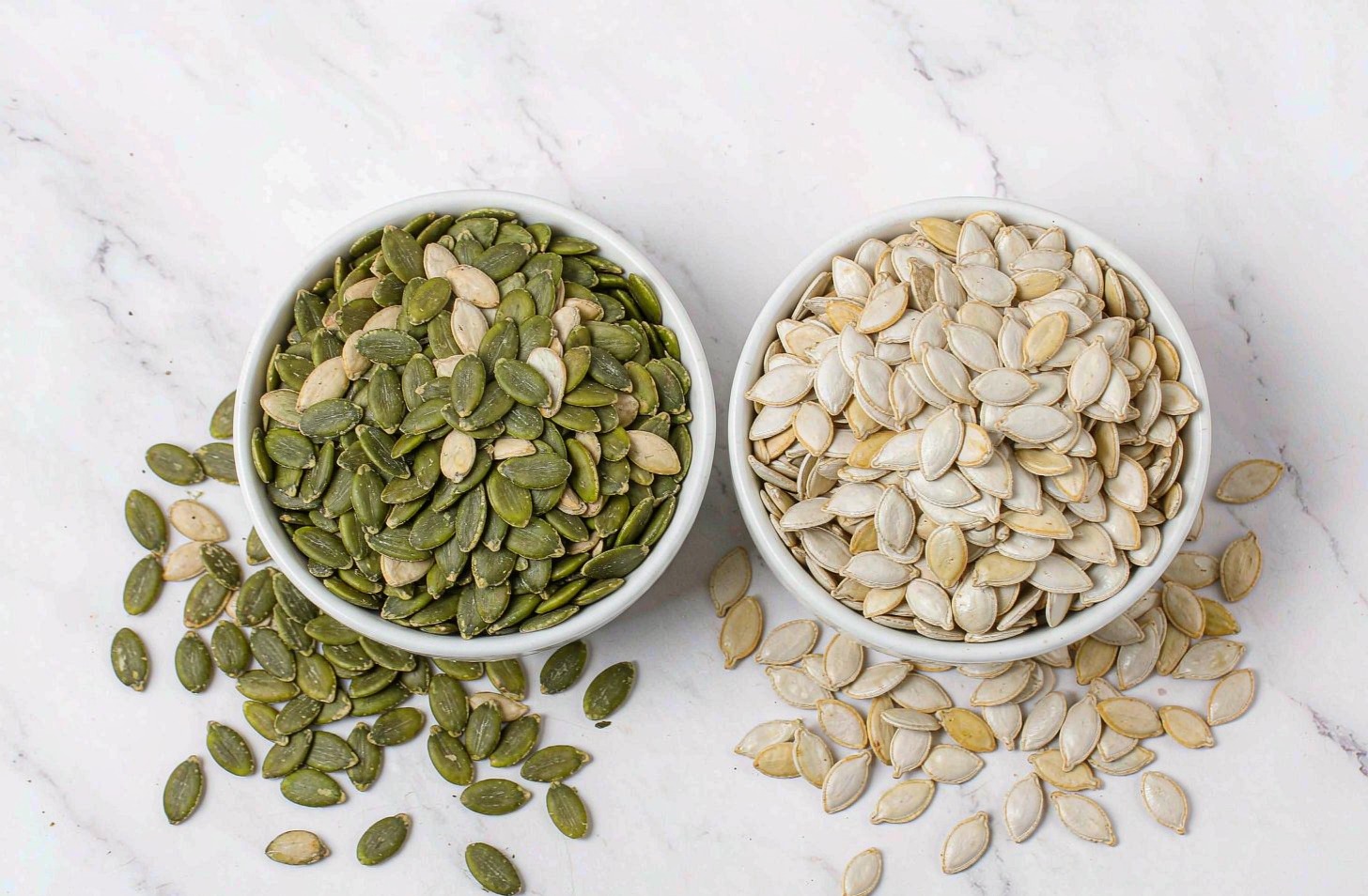
What Is the Difference Between Shine Skin and GWS Pumpkin Kernels
Shine Skin and GWS are the two dominant pumpkin seed varieties exported from China, and the practical difference comes down to shell appearance, typical size grades, processing suitability, and target markets. Shine Skin (光板) seeds have a smooth, polished, light-green glossy shell, while GWS (白板, Grey White Skin) seeds have a flatter, greyish-white matte shell. Both varieties can be sold in-shell for roasting or dehulled into green pumpkin kernels, but each one performs differently in each use — which is why importers need to specify the variety, not just ask for “pumpkin seeds” or “pumpkin kernels.”
This guide explains exactly what Shine Skin and GWS mean in international trade, how they compare on the specifications importers actually write into contracts, and which one you should choose for your market. If you buy bulk pumpkin seeds or kernels from China for the Middle East, Europe, Asia, or the Americas, the details below will help you avoid the most common specification mistakes.
What Are Shine Skin Pumpkin Seeds?
Shine Skin — also written Shine-Skin or “Guang Ban” (光板) — is a pumpkin seed variety whose outer shell is thin, smooth, and glossy with a light-green to greenish-white tone after machine polishing. The glossy finish is a natural characteristic of the variety enhanced by cleaning and polishing lines; it is not dyed or coated.
Key trading characteristics of Shine Skin seeds:
- Shell finish — smooth, semi-shiny, light green with a thin seed coat;
- Common size grades — larger counts such as 200–240, 240–260, and 260–280 seeds per 100 g are the most traded;
- Typical uses — roasted and seasoned in-shell snacks, and premium kernel production after dehulling;
- Main demand regions — Middle East, North Africa, East Asia, and parts of Europe, where the attractive glossy shell sells well at retail.
Shine Skin is often the default choice when buyers want a visually appealing in-shell product, because the polished light-green shell photographs and displays well in retail packs.
What Are GWS Pumpkin Seeds?
GWS stands for Grey White Skin (also called Bai Ban, 白板) in Chinese export practice. GWS seeds have a flatter, wider body with a greyish-white to off-white shell and a matte, less reflective finish. They are among the most widely produced pumpkin seed varieties in Inner Mongolia and neighboring growing areas.
Key trading characteristics of GWS seeds:
- Shell finish — grey-white, matte, slightly thicker-walled than Shine Skin in most lots;
- Common size grades — mid-to-small counts such as 240–260, 260–280, 280–320, and 320–360 seeds per 100 g;
- Typical uses — in-shell roasting and salting, plus dehulling into kernels for bakery, confectionery, and oil applications;
- Main demand regions — Egypt and the Middle East, South and Southeast Asia, and Europe, where GWS is a long-standing standard for bulk contracts.
GWS is frequently preferred when the buyer’s priority is steady supply volume, consistent pricing, and flexibility to switch between in-shell and kernel processing.
Shine Skin vs GWS Pumpkin Kernels: Key Differences at a Glance
| Comparison Point | Shine Skin (光板) | GWS (白板, Grey White Skin) |
|---|---|---|
| Shell appearance | Smooth, glossy, light green | Matte, greyish-white |
| Shell texture | Thin and delicate | Firmer, slightly thicker |
| Common size grades | 200–240 / 240–260 / 260–280 per 100 g | 240–260 / 260–280 / 280–320 / 320–360 per 100 g |
| Typical end use | Premium in-shell roasted snacks; high-grade kernels | In-shell roasting; bulk kernel processing for bakery and snacks |
| Kernel yield after dehulling | Good, with light-green kernels | Good; often favored for high-volume kernel contracts |
| Leading demand markets | Middle East, East Asia, retail-focused buyers | Egypt/Middle East, South Asia, Europe, processing industry |
| Typical price position | Usually higher for large glossy grades | Generally more competitive at mid and small grades |
A quick rule of thumb: if your customer sells roasted, seasoned in-shell seeds at retail and wants an attractive glossy pack, Shine Skin is usually the right call. If you need flexible volume for both in-shell and kernel programs at steady pricing, GWS is the safer, more liquid choice.
Why the Variety Matters in Bulk Import Contracts
Many first-time importers treat “pumpkin seeds” as a single commodity and only discover the problem when the container arrives: the seeds are a different variety from the sample, sized differently, or simply the wrong product for the customer’s machine or market. Variety specification matters for four concrete reasons:
- Retail acceptance — shell color and gloss directly affect how the product looks on the shelf in in-shell markets;
- Roasting behavior — Shine Skin’s thinner shell roasts and seasons differently from the firmer GWS shell, so processors need the variety their line is calibrated for;
- Kernel specification — if you dehull locally or buy kernels, the source variety influences kernel color, size distribution, and yield;
- Price benchmarks — Shine Skin and GWS trade at different levels, and quoting against the wrong benchmark leads to either overpaying or supply failure.
Write the variety name into every document — quotation, proforma invoice, sales contract, and packing list — and require the supplier to state it on the commercial invoice.
How to Choose Between Shine Skin and GWS
Choose Shine Skin if you sell in-shell snacks at retail
Markets that buy Shine Skin are usually selling roasted, salted, or spiced pumpkin seeds in branded retail packs. The glossy light-green shell is a genuine selling point, and large grades (200–240 and 240–260) command premium prices. Buyers in the Middle East and East Asia commonly specify Shine Skin for this channel.
Choose GWS if you need volume flexibility or process kernels
If your business dehulls seeds into kernels, or serves customers across both in-shell and kernel lines, GWS offers more liquid supply at competitive prices. It is also the variety many European and South Asian food manufacturers are already used to specifying for bakery toppings and snack kernels.
Always confirm with pre-shipment samples
Whatever you choose, ask for a pre-shipment sample of the exact grade — not a photo, not a “similar” grade. Check shell color, gloss, seed thickness, and count per 100 g, and keep the sample sealed for comparison against the delivered lot.
Quality Standards to Specify for Either Variety
Beyond variety, a professional import contract for Chinese pumpkin seeds should state the following parameters, which follow common export practice and international food-safety expectations:
- Purity — typically 99% or 99.5% for export grades;
- Moisture — ≤ 8–9%, to prevent mold and rancidity in transit;
- Admixture — ≤ 0.5–1% (foreign matter and broken seeds);
- Size grading — exact seeds per 100 g range, e.g., 240–260;
- Aflatoxin and heavy-metal limits — per your market’s regulation (EU, Codex, or national limits);
- Packing — 25 kg or 50 kg PP bags, or retail/vacuum packs for in-shell programs;
- Certification — HACCP or ISO 22000-based systems at the plant, plus HALAL or Kosher certificates where your market requires them.
Food-safety management matters as much as the botanical variety. ISO 22000 and Codex HACCP define the internationally recognized frameworks that serious Chinese processors build their quality systems on, and buyers should confirm the supplier’s certificates are current and cover the actual plant.
Shine Skin and GWS Side by Side: What to Write in Your Inquiry
When you send an inquiry to a Chinese exporter, the fastest way to get accurate quotes is to specify both the variety and the grade. A clean inquiry looks like this:
- Product: pumpkin seeds (in-shell) or pumpkin seed kernels (hulled);
- Variety: Shine Skin or GWS;
- Grade: e.g., 240–260 seeds per 100 g (in-shell) or kernel size in mm (e.g., 7–9 mm);
- Quantity: trial tonnage and container type;
- Packing: 25 kg PP bags or custom retail packs;
- Destination port and required certificates.
An exporter that understands the difference will reply with the correct spec sheet, a physical sample program, and honest advice on which variety suits your market — rather than quoting whatever stock they happen to hold.
Frequently Asked Questions
Are Shine Skin and GWS different types of pumpkin?
Yes, they are different cultivated varieties of the same pumpkin species, selected over decades for seed size, shell color, and yield. In Chinese trade they are known as 光板 (Shine Skin) and 白板 (GWS), and each has its own standard size-grading system.
Is Shine Skin better than GWS?
Neither is objectively better — it depends on your market. Shine Skin is preferred for glossy retail in-shell snacks; GWS is the volume standard for in-shell roasting programs and kernel processing at competitive prices.
Can GWS seeds be sold as Shine Skin?
No, and mixing them is a specification breach. The shell color and gloss are visibly different, and buyers in markets that expect Shine Skin will reject grey-white shells at inspection. Always state the variety in the contract.
Do Shine Skin and GWS kernels taste different?
Both dehulled kernels are light green with the mild, nutty pumpkin flavor buyers expect. Kernel color and size distribution can vary slightly by variety and season, which is why processors specify kernel size in millimeters and a color tolerance rather than relying on variety alone.
Which variety has a higher kernel yield?
Yield varies by season, lot, and dehulling line, so no reliable universal number exists. GWS is often favored for volume kernel programs because supply is deep and pricing is steady, but a serious exporter will provide lot-specific test results and pre-shipment inspection rather than a generic figure.
Where is the best place to source Shine Skin and GWS pumpkin seeds?
Inner Mongolia — around Hohhot and Bayannur — is China’s core pumpkin seed growing and processing belt, alongside Xinjiang and Gansu. Working with an exporter based in the origin region shortens the farm-to-port chain and improves control over grading and quality.
Conclusion
The difference between Shine Skin and GWS pumpkin kernels is not a minor detail — it determines whether the product fits your customer’s roaster, your packing line, and your retail price point. Shine Skin means glossy light-green shells and premium retail appeal; GWS means grey-white matte shells, deep supply, and flexibility for in-shell and kernel programs. Specify the variety, lock the grade, and verify with samples before you commit a container.
If you are sourcing Shine Skin or GWS pumpkin seeds or kernels in bulk, talk to Ouji International — a Hohhot-based agricultural food exporter founded in 2013, operating 2 processing plants with 6 automatic production lines in Inner Mongolia, and supplying pumpkin seeds, sunflower seeds, walnuts, and other nuts to Europe, the Americas, Japan and South Korea, the Middle East, North Africa, and South America. We will help you match the right variety and grade to your market, with samples, specifications, and export documentation handled end to end.