

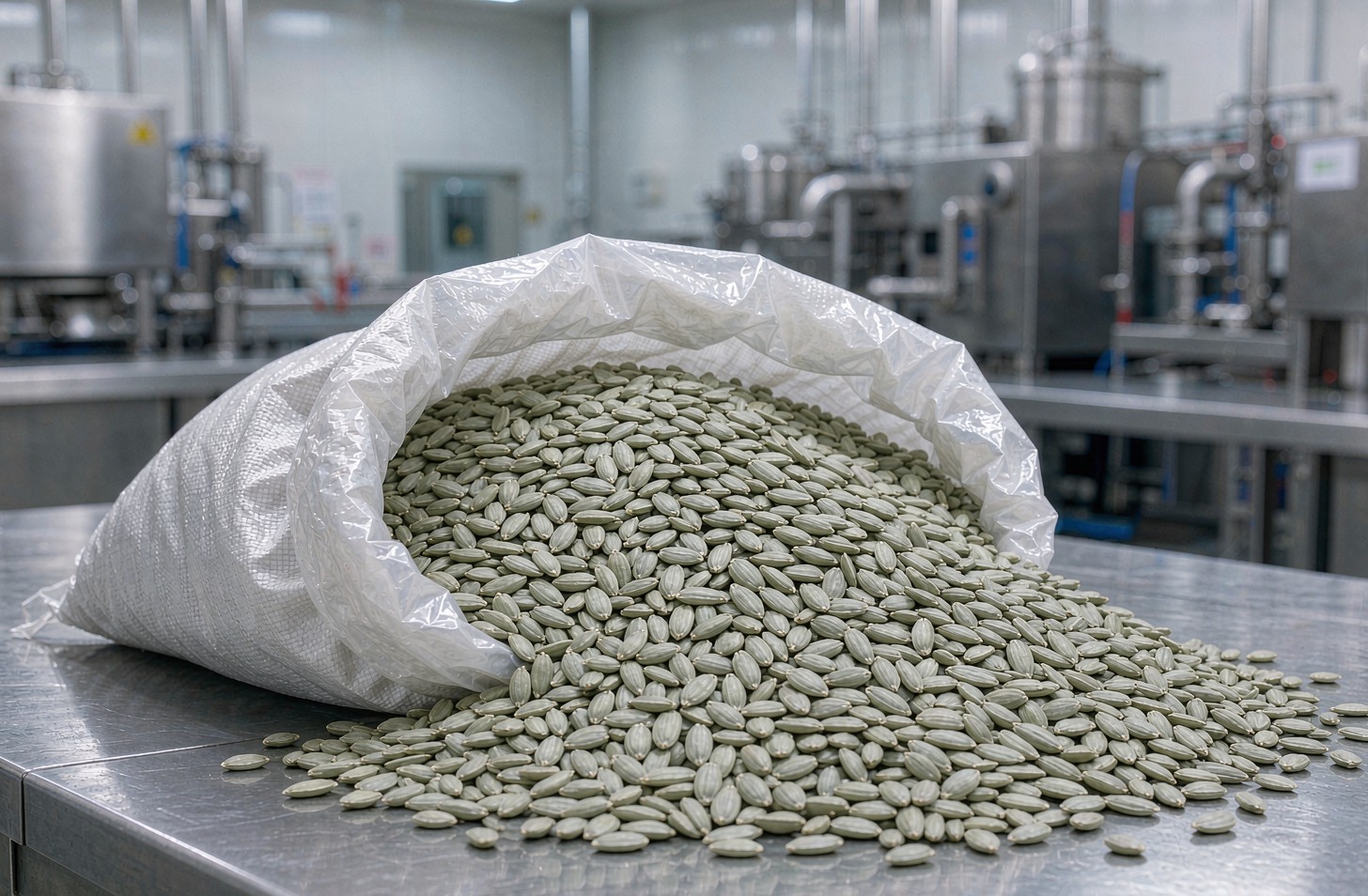
Wholesale sunflower kernels are hulled, food-grade sunflower seeds sold in bulk at factory prices — typically in 25/50 kg bags or 1-tonne totes, with moisture ≤ 8%, purity ≥ 99.5%, and FOB quotes from US$1,150–1,600 per metric tonne depending on grade, size and season. For snack roasters, bakeries, granola makers and kernel repackers, buying kernels wholesale from a Chinese processor is the most cost-efficient route: China supplies roughly 60% of the world’s hulled sunflower kernels, and a reliable supplier lets you buy verified 5009, 361 or 363 grades directly from the factory instead of paying trader margins. This guide explains the grades, specs, pricing logic and supplier-verification steps you need before placing your first wholesale order.
If you are sourcing wholesale sunflower kernels for the first time, the fastest way to avoid costly mistakes is to understand three things before you request quotes: which kernel grade matches your end use, which specification sheet your market’s food authority expects, and how to tell a genuine factory from a trading company. This article walks through all three — with the exact numbers, packaging options and verification steps used in real China-to-overseas kernel trade. As a reference point, Ouji International has been processing and exporting sunflower kernels from Inner Mongolia since 2013, supplying buyers across Europe, the Middle East, Asia and the Americas.
What Exactly Are Wholesale Sunflower Kernels?
Sunflower kernels are the inner meat of the sunflower seed after the black or striped hull has been mechanically removed. While the farm-gate trade deals in in-shell seeds, the food industry buys almost exclusively in hulled kernels because they are ready to roast, bake, press or blend without further de-hulling.
When you buy at wholesale level, you are purchasing by the container load — usually a 20 ft container holding 16–17 tonnes in 25 kg PP bags, or up to 20+ tonnes in bulk totes. Wholesale buying matters because kernel prices move with the annual harvest cycle: securing volume contracts right after the Inner Mongolia harvest (September–November) typically locks the best price of the year.
- Raw material origin: Inner Mongolia and Xinjiang are China’s two core growing regions; Inner Mongolia’s dry climate produces kernels with naturally low free fatty acid levels.
- Processing level: kernels are de-hulled, air-sorted, laser/color-sorted, and hand-inspected before packing.
- End uses: snack roasting, bakery toppings, granola & cereal bars, nut butter blending, salad toppings, bird food, and cold-pressed oil.
The Three Main Kernel Grades: 5009, 361 and 363
Chinese sunflower kernels are sold under grade codes derived from the seed variety. Choosing the wrong grade is the single most common mistake made by first-time wholesale buyers — the kernels look similar but behave very differently in production.
| Grade | Source Variety | Kernel Size | Typical Purity | Best Suited For | Relative Price |
|---|---|---|---|---|---|
| 5009 | Confectionery-type black seed | Large, plump (20/64″–22/64″ screen) | ≥ 99.5% | Premium snack roasting, retail packs | Highest |
| 361 | Oil/small-type black seed | Small–medium, uniform | ≥ 99.5% | Bakery, granola, cereal bars, butter blends | Mid |
| 363 | Striped seed | Medium with visible stripe remnants | ≥ 99% | Repacking, bird food, oil pressing | Lowest |
Rule of thumb: if your product will be sold roasted and visible to the consumer, buy 5009. If kernels are an ingredient inside a bar, bread or butter, 361 delivers the same nutrition at a lower cost. 363 is only worth considering for industrial crushing or animal feed applications.
Specification Sheet: What Your Supplier Should Guarantee
A professional wholesale quotation always comes with a full spec sheet. Treat any offer without one as a red flag. Below is a standard export specification used by established Inner Mongolia processors:
| Parameter | Standard Export Spec | Test Method |
|---|---|---|
| Moisture | ≤ 8.0% | Oven drying / moisture analyzer |
| Purity (kernel content) | ≥ 99.5% | Manual sieve + visual count |
| Broken kernels | ≤ 5% (grade-dependent) | Manual sorting count |
| Free fatty acid (as oleic) | ≤ 1.0% (fresh season much lower) | Titration |
| Peroxide value | ≤ 3 meq/kg at loading | AOCS Cd 8b-90 |
| Salmonella / E. coli | Absent / negative | Third-party lab (per lot) |
| Aflatoxin & pesticide residues | Within EU MRL / market limits | SGS / Eurofins pre-shipment test |
Two parameters deserve special attention for EU and North American buyers: peroxide value (kernels oxidize quickly once hulled, so shipping age matters) and pesticide residues, which are tested against EU maximum residue limits. Insist on a pre-shipment third-party inspection — SGS, Eurofins or CIQ — before releasing the balance payment. Food-safety frameworks such as Codex Alimentarius and HACCP-based processing give you the audit language to put into your supply contract.
Why Source Wholesale Sunflower Kernels from China?
China — and Inner Mongolia in particular — dominates the global hulled-kernel supply chain for structural reasons, not just price:
- Scale of cultivation. Inner Mongolia alone plants hundreds of thousands of hectares of confectionery sunflower, creating year-round processing capacity rather than a short seasonal window.
- Integrated processing. Modern factories run de-hulling, color sorting and automated grading lines in-house. A processor with multiple automated lines can hold spec consistency across container-sized orders — something small traders cannot guarantee.
- Export maturity. Chinese kernel processors have shipped to the EU, Japan, Korea, the Middle East and North Africa for two decades and are fluent in phytosanitary certificates, certificates of origin and halal/kosher documentation.
- Price stability through volume. Factory-direct wholesale removes 2–3 layers of broker margin typically embedded in local-importer pricing.
For example, Ouji International operates two processing plants with six automated grading lines in Hohhot, Inner Mongolia, exporting kernels alongside walnuts, pecans, cashews and pumpkin seeds — which means a buyer can consolidate multiple nut SKUs into one container and one set of export documents.
How to Choose a Wholesale Kernel Supplier: A 6-Step Checklist
1. Verify You Are Talking to a Factory
Ask for the company’s business license scope, photos of the sorting workshop (not just product shots), and a live video walk-through. A genuine processor will show de-hullers, color sorters and grading tables; a trader will only show bags.
2. Demand the Current-Season Spec Sheet
Kernel quality varies between harvest years. Request the this-season spec sheet, not a template — including the free fatty acid and peroxide values of the exact lot you would buy.
3. Ask for Pre-Shipment Samples Against Payment Terms
Standard practice: free sample of 1–2 kg, buyer pays courier, and a formal PI (proforma invoice) with the spec sheet attached. Load shipment only after you approve the sample or an SGS-approved pre-shipment sample seal.
4. Check Certifications and Audit History
Minimum bar: HACCP, ISO 22000 or equivalent food-safety management, plus Halal or Kosher certificates where your market requires them. (See ISO 22000 for the audit standard.) Ask which third-party inspections the factory has passed in the last 12 months.
5. Understand Packaging and Loading Math
| Packaging | Net Weight | 20 ft FCL Capacity | Typical Use |
|---|---|---|---|
| PP woven bag, inner PE liner | 25 kg / 50 kg | 16–17 t | Standard wholesale |
| Jumbo tote with liner | 500–1000 kg | 20+ t | Industrial processors |
| Vacuum bag in carton | 10–12.5 kg | 13–15 t | Extended shelf life, premium markets |
6. Agree on Trade Terms and Payment Before Booking
Most China kernel trade runs on FOB Qingdao or Tianjin with 30% T/T deposit + 70% against B/L copy, or 100% irrevocable L/C at sight for first orders. Never pay 100% upfront to an unverified supplier — the deposit structure is itself a credibility signal.
Wholesale Pricing: What Drives the Quote You Receive
Kernel prices are quoted per metric tonne FOB and move with the harvest. Key drivers:
- Season: post-harvest (Oct–Dec) is the price floor; by June–August old-crop stock carries a premium and rising FFA risk.
- Grade spread: 5009 typically commands a 10–20% premium over 361; 363 trades at a discount.
- Seed vs kernel market: high in-shell seed prices for China’s domestic snack market pull raw material away from hullers, pushing kernel quotes up.
- Logistics: container freight to your port, and for EU shipments, fumigation and phytosanitary costs.
As a planning range, wholesale 361 kernels have recently traded in the US$1,150–1,600/t FOB band, with 5009 above that range — always confirm against live quotes, since sunflower is one of the most seasonally volatile nut categories tracked by FAO commodity market reviews.
Common Mistakes First-Time Wholesale Buyers Make
- Buying on price alone. The cheapest quote usually means older crop, higher broken-kernel counts or weaker sorting — costing more in rejects and quality claims.
- Skipping the pre-shipment inspection. A US$300 SGS inspection is cheap insurance on a US$25,000 container.
- Ignoring shelf life. Hulled kernels are best consumed within 9–12 months of processing at ≤ 10 °C storage; long transit plus slow distribution erodes margin.
- Wrong grade for the application. Buying premium 5009 for a granola bar burns margin; buying 363 for retail roasting fails appearance checks.
Conclusion: Lock Grade, Specs and Factory Before Price
Wholesale sunflower kernel buying is straightforward once you anchor three decisions: the grade that matches your end use, a written spec sheet with third-party verification, and a verified factory with current-season stock. Get those three right and the price conversation becomes a simple comparison of logistics and terms. Start with a sample request and a pre-shipment inspection clause in every contract — it is the single practice that separates professional kernel buyers from frustrated ones.
Ready to request current-season 5009/361 kernel specs and FOB quotes? Contact Ouji International for a quotation, spec sheets and free samples direct from our Inner Mongolia processing plant.
Frequently Asked Questions
What is the MOQ for wholesale sunflower kernels from China?
Most factories set a minimum of one 20 ft container (16–17 tonnes), though some accept 5-tonne LCL trial orders at a higher per-tonne price. Sample quantities of 1–2 kg are usually free.
What is the difference between sunflower seeds and sunflower kernels?
Sunflower seeds are sold in-shell with the hull intact; kernels are the hulled inner meat, ready to eat or process. Food manufacturers buy kernels wholesale because no de-hulling step is needed.
Which grade should I choose for roasting and bakery?
Choose 5009 for premium visible roasted snacks, and 361 for bakery, granola and cereal-bar applications. Both should carry ≥ 99.5% purity and ≤ 8% moisture.
How long do wholesale sunflower kernels last?
Properly stored at ≤ 10 °C and low humidity, hulled kernels keep 9–12 months from processing. Vacuum packaging and cool storage extend this further.
What certifications should a kernel supplier have?
At minimum HACCP or ISO 22000 food-safety management, plus Halal or Kosher certification where required, and third-party pre-shipment testing for microbiology and pesticide residues.
What are the payment terms in the kernel trade?
Standard terms are 30% T/T deposit with 70% against bill-of-lading copy, or 100% irrevocable L/C at sight for first orders. Avoid any supplier demanding full prepayment.