

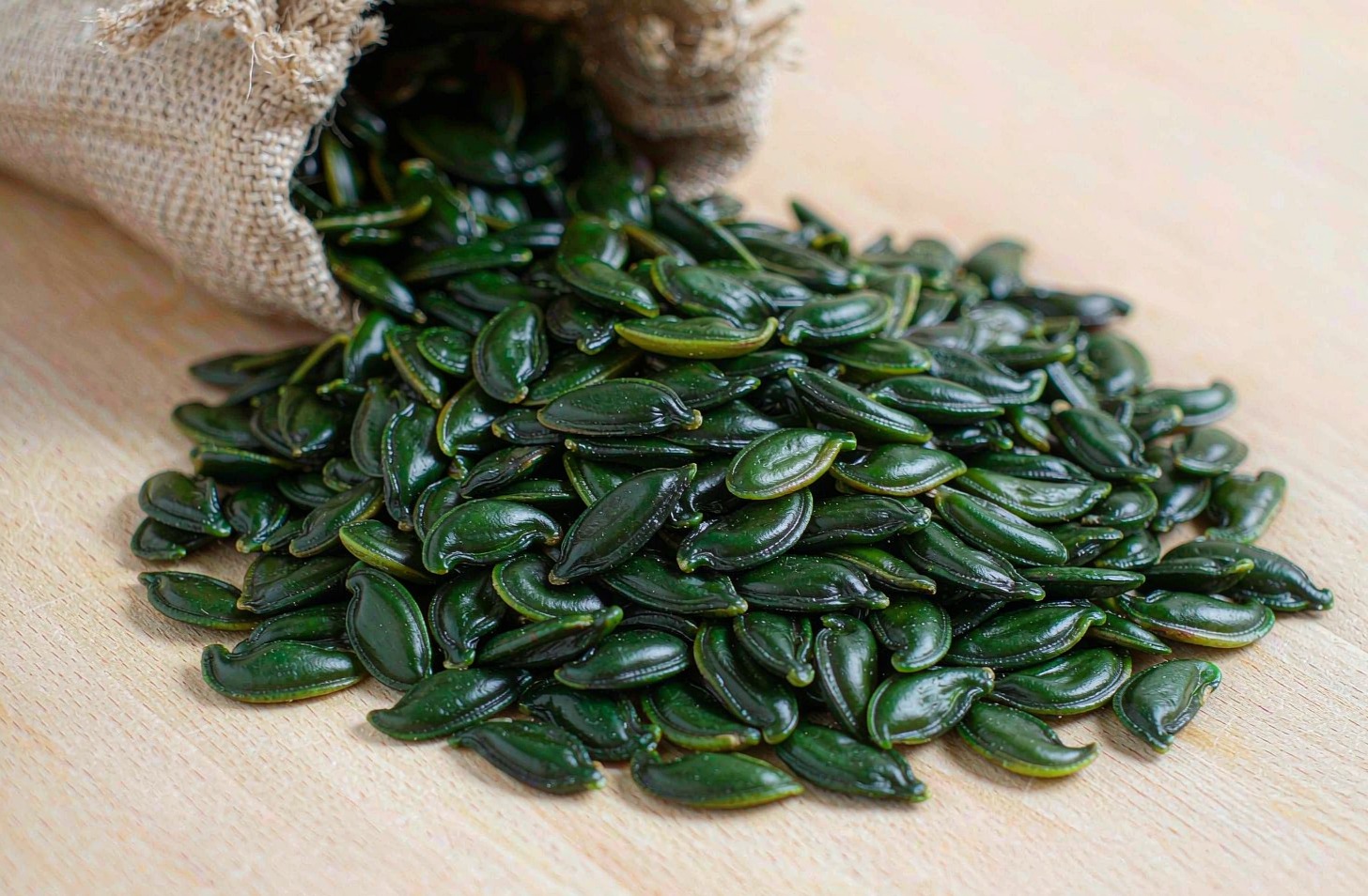
What Are GWS Pumpkin Seeds?
GWS pumpkin seeds — short for Grown Without Shell — are kernels from a special hull-less pumpkin variety (Cucurbita pepo var. styriaca) that produces seeds with no lignified seed coat. Instead of mechanical hulling, the dark green kernels are separated directly from the fruit, washed, dried, and color-sorted. The result is a deep green, oil-rich kernel that is the industry standard for European food manufacturing, bakery inclusions, and snack blends.
China is the world’s largest GWS producer and exporter, accounting for roughly 120,000 tonnes of the ~200,000 tonnes of global output each year, and Inner Mongolia is the country’s core growing region. If you are sourcing GWS kernels for food production, this guide explains how the grading system works, which specifications to insist on in your contract, how pricing is structured, and how to verify a reliable Chinese supplier before placing your first order.
Why Buyers Source GWS Pumpkin Seeds from China
Three factors explain why Chinese GWS dominates the export market:
- Scale and climate. Inner Mongolia’s long sunshine hours, large day-night temperature differentials, and Yellow River irrigation produce high-yield, plump kernels with consistent color. The region around Hohhot is often called the home of China’s pumpkin seed industry.
- Export-oriented processing. Chinese GWS is grown almost entirely for export, so processing lines — washing, drying, color sorting, hand picking, metal detection, and X-ray inspection — are built to meet EU, US, and Japanese food-safety requirements.
- Price competitiveness. Austrian and Ukrainian Styrian GWS carries a Protected Geographical Indication (PGI) and 40–50% oil content, commanding a significant premium for cold-pressed oil production. For general food manufacturing — bakery, cereals, snack mixes — Chinese GWS delivers comparable eating quality at a materially lower cost.
GWS vs Shine Skin Kernels: Which Should You Buy?
GWS and hulled Shine Skin kernels are often interchangeable in formulations, but they are not identical. Shine Skin is an in-shell variety that must be mechanically hulled, producing a lighter, yellowish-green kernel. GWS grows without a shell and retains a stronger dark-green hue. A detailed comparison is available in our guide to Shine Skin vs GWS pumpkin kernels.
| Attribute | GWS Kernels | Hulled Shine Skin Kernels |
|---|---|---|
| Seed coat | Hull-less variety (no shelling step) | In-shell variety, mechanically hulled |
| Kernel color | Mid to dark green | Pale green to yellowish green |
| Flavor | Stronger, nuttier, higher oil note | Milder, cleaner |
| Typical applications | European bakery, snacks, toppings | Snack mixes, Middle East in-shell trade, bakery |
| Price behavior | Tracks Shine Skin kernel prices; no hulling cost | Rises when domestic in-shell demand tightens export supply |
One procurement note worth tracking: when Chinese domestic in-shell demand rises, fewer Shine Skin seeds are hulled for export, which pushes Shine Skin kernel prices up and pulls GWS prices along with them. Buyers who source both types benefit from quoting them together with one supplier.
GWS Pumpkin Seed Grades and Specifications
GWS is graded by size uniformity and color consistency, not by oil content. Reputable Chinese suppliers quote against a written specification sheet like the one below:
| Parameter | Grade AAA | Grade AA | Grade A |
|---|---|---|---|
| Purity | 99.9% min | 99.9% min | 99.5% min |
| Moisture | 8% max | 8% max | 8% max |
| Broken kernels (<1/3 kernel) | 1% max | 3% max | 5% max |
| Completely green kernels | 98% min | 95% min | 25% min |
| White/pale kernels | Not found | Not found | 3% max |
| Dirty seeds | 1% max | 2% max | 3% max |
| Size | 10 mm+ | 9 mm+ | 7 mm+ |
| Aflatoxin B1 / total | ≤2 µg/kg / ≤4 µg/kg (EU Regulation (EC) No 1881/2006) | ||
Size is measured across the kernel width in millimetres — common commercial grades are 9 mm+, 10 mm+, and 11 mm+. Larger, more uniform sizes command premiums and are typical for retail-visible applications such as salad toppings and premium bakery.
Food Safety and Compliance Requirements
For EU-bound shipments, your contract should reference the following regulatory benchmarks:
- Mycotoxins: Aflatoxin B1 ≤2 µg/kg and total aflatoxins ≤4 µg/kg, per EU Regulation (EC) No 1881/2006. Every export lot should ship with a third-party mycotoxin certificate.
- Microbiology: Compliance with EU Regulation (EC) No 2073/2005; many buyers additionally require Salmonella and E. coli absence on each lot.
- Pesticide residues: Compliance with EU Regulation (EC) No 396/2005 MRLs — confirm your supplier tests against the EU list, not only the Chinese national standard.
- Processing hygiene: Look for ISO 22000 or HACCP-certified lines, metal detection and X-ray inspection as standard steps, and heat treatment (steam or dry roasting) available on request for ready-to-eat applications.
The FAO and national food-safety authorities publish guidance on mycotoxin control in oilseeds; a serious supplier will already have this documentation organized per lot rather than producing it on request.
How GWS Kernels Are Processed for Export
Understanding the production flow helps you judge which quality claims are credible:
- Harvest and delivery. Hull-less pumpkins are harvested in October–November; kernels are separated from the fruit at or near the farm.
- Washing and drying. Kernels are washed and dried to below 8% moisture — proper drying is the single biggest factor in preventing aflatoxin development in storage.
- Sorting. Multi-pass color sorters remove pale, stained, and broken kernels; gravity separators and destoners remove foreign material.
- Hand picking. For AAA-grade lots, trained workers remove residual defects that machines miss.
- Metal detection and X-ray. Final inline inspection before packing.
- Packing. Typically 25 kg PP woven bags or kraft paper bags with inner PE liner; 12.5 kg cartons available for retail-scale buyers.
Pricing, MOQ, and Shipping Logistics
GWS pricing is seasonal and crop-driven. New-crop quotations appear after the October–November harvest and typically soften or firm through the year depending on yield and Shine Skin demand. Key commercial parameters to negotiate:
| Commercial Term | Typical Export Standard |
|---|---|
| MOQ | 1 full pallet to 1 x 20′ container for first orders |
| Container loading | ~18 MT per 20′ GP; ~26 MT per 40′ HQ |
| Packing | 25 kg PP bag / kraft paper bag, inner PE liner |
| Payment | 30% T/T deposit, 70% against B/L copy; L/C accepted for established accounts |
| Lead time | 15–25 days after deposit and specification confirmation |
| Shelf life | 12–24 months under cool, dry, dark storage |
Always fix the specification sheet, grade, size, and aflatoxin limits in the contract or PI — verbal “AA grade” commitments vary significantly between suppliers.
How to Verify a GWS Pumpkin Seed Supplier in China
Before committing to a supplier, run this checklist:
- Origin transparency. Confirm the growing region and whether the company owns or directly contracts farms — Inner Mongolia origins should be stated, not vague “China origin”.
- Certification copies. Request current ISO 22000/HACCP, HALAL, and (if relevant) organic certificates and verify certificate numbers with the issuing bodies.
- Sample evaluation. Test 1–2 kg samples for color uniformity, moisture, broken rate, and flavor before and after your own heat process.
- Third-party pre-shipment inspection. Book SGS, Bureau Veritas, or Intertek to verify grade, moisture, and aflatoxin at loading.
- Export track record. Ask for destination markets and reference customers in your region; experienced exporters to the EU will already handle 1881/2006 documentation routinely.
Ouji International, founded in 2013 in Hohhot, Inner Mongolia, operates two processing plants with six automatic lines dedicated to pumpkin seeds, sunflower seeds, walnuts, pine nuts, and cashews, exporting to Europe, the US, Japan, Korea, the Middle East, North Africa, and South America. We supply GWS and Shine Skin kernels against written specification sheets with third-party inspection on request — contact us for a current new-crop quotation.
Frequently Asked Questions
What does GWS stand for in pumpkin seeds?
GWS stands for Grown Without Shell — a hull-less pumpkin variety (Cucurbita pepo var. styriaca) whose kernels develop without a lignified seed coat, so no mechanical hulling is needed.
Are GWS and Shine Skin kernels interchangeable?
Mostly yes in formulations, but GWS is darker green with a stronger, nuttier flavor, while hulled Shine Skin is paler and milder. Choose based on the visual and flavor profile your product requires.
What is the standard grade for GWS pumpkin kernels?
Grades are AAA, AA, and A, defined by purity (99.9%+), broken kernel limits (1–5%), color uniformity, and kernel size (typically 9 mm+ or 10 mm+ for export grades).
What moisture and aflatoxin limits apply to exports?
Moisture should be 8% max (7.5% preferred for long ocean transit), and EU-bound lots must meet aflatoxin B1 ≤2 µg/kg and total ≤4 µg/kg under Regulation (EC) No 1881/2006.
How much GWS fits in a container?
A 20′ GP container loads approximately 18 MT and a 40′ HQ approximately 26 MT in 25 kg bags.
What is the MOQ for a first order?
Most Chinese suppliers start at one pallet for sampling and one 20′ container (about 18 MT) for first commercial orders; trial orders at smaller volumes are negotiable.
Conclusion: Lock the Spec, Then Lock the Price
GWS pumpkin seeds are a forgiving product to source — if the specification sheet, grade definitions, and food-safety limits are fixed in writing before the price is agreed. Focus on origin transparency, verified certifications, and third-party pre-shipment inspection, and GWS from Inner Mongolia offers an excellent quality-to-price ratio for bakery, snack, and cereal manufacturers worldwide.
Ready to source? Request a GWS quotation and samples from Ouji International — new-crop availability updated weekly.