

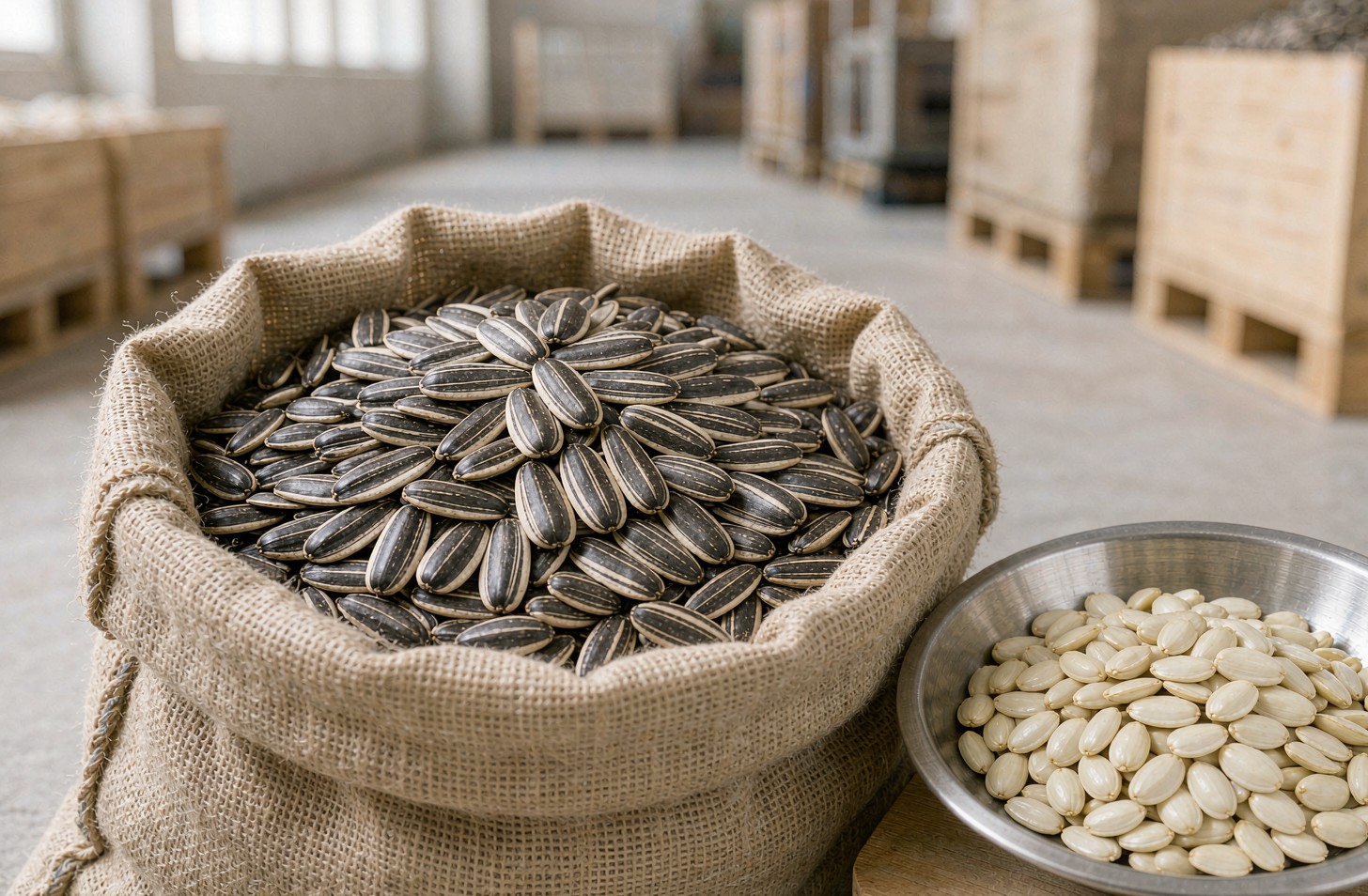
Raw Sunflower Seeds Exporter: A Buyer’s Guide to Sourcing from China
Looking for a reliable raw sunflower seeds exporter? The right partner is one who can supply unroasted, food-grade sunflower seeds with verified purity (99% or higher), controlled moisture (typically ≤8%), consistent size grading, and complete export documentation — backed by a processing facility with color sorting, metal detection, and HALAL/Kosher certification. This guide explains what raw sunflower seeds are, who buys them, which specifications matter most, and how to evaluate an exporter before you commit to a bulk order.
Raw sunflower seeds are the starting material for a huge share of the global snack and food-processing industry. Roasters, kernel processors, bakery suppliers, and private-label snack brands all depend on a steady flow of high-purity raw seeds — and the quality of your finished product is largely decided at this stage. Sourcing from an experienced raw sunflower seeds exporter in China, where Inner Mongolia produces some of the world’s finest confectionery-grade seeds, gives importers a reliable combination of quality, scale, and price. Below is everything a B2B buyer needs to source with confidence.
What Are Raw Sunflower Seeds?
Raw sunflower seeds are in-shell seeds that have been harvested, dried, cleaned, and graded — but not roasted, salted, or flavored. They are supplied in their natural state so the buyer controls the final processing step. This matters because roasting profiles, seasoning, and packaging are usually market-specific: a Middle Eastern roaster, a European bakery ingredient producer, and a North American snack brand all need very different finished products, but they can all start from the same well-specified raw material.
For export trade, “raw” typically means:
- Unroasted and unseasoned — natural flavor and color, ready for the buyer’s own processing line
- Cleaned and size-graded — passed through destoners, gravity separators, and grading screens; often color-sorted to remove defective seeds
- Dried to export moisture — generally ≤8% to prevent mold and aflatoxin risk during ocean transit
- Food-grade purity — 99%+ purity for premium confectionery grades, with foreign matter, broken seeds, and diseased kernels kept within tight limits
If your product is the shelled kernel itself rather than in-shell seeds, see our separate guide on wholesale sunflower kernels. And if you want to understand how seeds move from farm to export container, our article on how Chinese sunflower seeds are processed for export walks through the full workflow.
Who Buys Raw Sunflower Seeds — and Why
Raw seeds dominate B2B trade because they give processors full control over the final product. Typical industrial buyers include:
| Buyer Type | Typical Use | What They Look For |
|---|---|---|
| Roasters & snack brands | Roasted, salted, or flavored in-shell snacks | Large size (5009/361/363), uniform color, easy crack |
| Kernel processors | Shelling into kernels for bakery and confectionery | High kernel yield, low shell breakage, purity ≥99% |
| Bakery & cereal manufacturers | Kernels, toppings, granola, multigrain blends | Consistent grade, food safety certificates, stable supply |
| Oil-free confectionery & retail packs | Peel-and-eat in-shell seeds (e.g., 5009 type) | Black-and-white striped shell, plump kernel, long shelf life |
| Re-packers & distributors | Bulk re-packing for regional markets | Flexible pack sizes, neutral price position, reliable docs |
The unifying theme: every one of these buyers needs consistent, verifiable raw-material quality — because no amount of downstream processing can fix seeds that arrive with high moisture, impurities, or mixed sizes.
Key Specifications for Export-Grade Raw Sunflower Seeds
Chinese confectionery sunflower seeds are usually quoted by variety code and size. The most common export varieties are:
| Variety | Typical Size | Shell Color | Common Applications |
|---|---|---|---|
| 5009 | 24/64″ – 27/64″ and up | Black & white striped | Premium peel-and-eat snacks, roasting |
| 361 | 22/64″ – 24/64″ | Black & white striped | Roasting, shelling into kernels |
| 363 | 20/64″ – 22/64″ | Black & white striped | Kernels, bakery ingredients |
| 606 | 18/64″ – 20/64″ | Mostly black-striped | Kernel processing, cost-sensitive blends |
For variety-specific buying — including how white and black types differ in color, size, and end use — compare our guides to white sunflower seeds and black sunflower seeds.
Regardless of variety, a professional exporter should confirm these quality parameters in writing before shipment:
| Parameter | Export Standard | Why It Matters |
|---|---|---|
| Purity | ≥99% (confectionery grade) | Reduces sorting labor and rejects at your plant |
| Moisture | ≤8% | Prevents mold growth and aflatoxin during transit |
| Broken & defective seeds | ≤1–2% | Protects appearance and roasting uniformity |
| Foreign matter | ≤0.1–0.5% | Food safety and buyer inspection compliance |
| Size uniformity | Per agreed screen size | Consistent roasting and packaging performance |
| Aflatoxin / pesticide residue | Within EU / Codex limits, tested per lot | Required for customs clearance in most markets |
How to Evaluate a Raw Sunflower Seeds Exporter: 6-Point Checklist
Not all exporters are equal. Some are manufacturers with their own processing plants; others are pure trading companies that resell from third parties. Both can be acceptable, but you need to know which you are dealing with — and verify accordingly.
1. Confirm Manufacturing Capability
Ask directly: Do you operate your own processing facility? A manufacturer with automated cleaning, grading, color-sorting, and metal-detection lines can control quality lot by lot and adjust specs to your needs. A trading company adds a margin but may have less control. Request a live or recorded factory video walkthrough — legitimate exporters provide these without hesitation.
2. Verify Certifications
At minimum, an export-ready supplier should hold HALAL and Kosher certificates (essential for Middle East, North Africa, and Jewish-market customers), a food safety management certificate aligned with ISO 22000 or HACCP principles, and up-to-date phytosanitary registration. Ask for certificates dated within the current cycle and check that the company name matches exactly.
3. Review Size Grading and Sorting Precision
Raw seeds are sold by size, and mis-graded lots are a common import complaint. A capable exporter runs multi-stage grading screens and optical color sorting so that the size fraction you order is the size fraction that ships. Ask what tolerance they guarantee per grade.
4. Demand Pre-Shipment Quality Control
Professional exporters inspect every lot before loading: moisture testing, purity analysis, and third-party inspection (SGS, CIQ, or an inspector of your choice) on request. Insist on pre-shipment photos, videos, and a retained sample from the exact lot you are buying — this single habit prevents most disputes.
5. Check Export Experience and References
An exporter familiar with your market already knows its phytosanitary rules, labeling norms, and port requirements. Ask which countries they currently ship to and for one or two reference customers (contact details optional, but regions and volumes should be disclosed). Ten-plus years of continuous export history is a meaningful signal.
6. Assess Communication and Responsiveness
B2B agricultural trade runs on timing — harvest windows, shipping schedules, payment deadlines. An exporter who answers spec questions with precise numbers and documents, rather than vague reassurances, will behave the same way when a container is delayed or a document needs correcting.
Certifications and Export Documents to Expect
| Document / Certificate | Purpose | Issued By |
|---|---|---|
| Phytosanitary Certificate | Customs clearance, plant-health compliance | China customs / CIQ |
| Certificate of Origin | Tariff treatment, import compliance | CCPIT / China customs |
| Health / Sanitary Certificate | Food safety clearance | China customs / CIQ |
| HALAL Certificate | Mid-East, North Africa, SE Asia markets | Accredited halal body |
| Kosher Certificate | US, Israel, European niche markets | Accredited kosher agency |
| Third-Party Inspection Report | Independent lot verification | SGS / buyer’s inspector |
| Fumigation Certificate | Storage-pest control compliance | Authorized fumigation provider |
Confirm the full document set before placing the order, because requirements differ by destination — for example, EU buyers typically also want aflatoxin and pesticide-residue test reports per lot, while Gulf markets lean heavily on HALAL documentation.
MOQ, Packaging, and Pricing Factors
Typical commercial terms for raw sunflower seeds from China:
| Item | Typical Range |
|---|---|
| Minimum order quantity (MOQ) | 1 × 20ft container (approx. 17–19 MT in 50 kg PP bags) |
| Retail-ready packing | Vacuum bricks, 250 g – 1 kg laminated bags (higher MOQ) |
| Bulk packing | 25/50 kg woven PP bags, or jumbo bags |
| Payment terms | T/T (30% deposit + balance against B/L copy), L/C at sight |
| Lead time | 10–20 days after deposit, depending on season and grade |
Price is driven mainly by four factors: variety and size grade (5009 large sizes command a premium), crop year (prices firm after new-crop demand peaks), packaging format, and freight rates to your port. When comparing quotes, always normalize to the same variety, size, purity, and Incoterm (FOB vs CIF) — otherwise you are comparing apples to oranges.
Red Flags When Choosing an Exporter
- No factory address or refuses a video tour — likely a broker layering margin without quality control
- Cannot provide current HALAL/Kosher or ISO/HACCP certificates — a serious gap for food-grade trade
- No pre-shipment inspection or retained-sample policy — disputes become nearly impossible to resolve later
- Prices far below market — usually means mixed grades, older crop, or pending moisture/impurity issues
- Vague size specs (“mixed sizes available”) — grading discipline is the core competency of a good seed exporter
- Pressure to skip third-party inspection — a professional exporter welcomes it
Why Source Raw Sunflower Seeds from Ouji International?
Ouji International (based in Hohhot, Inner Mongolia — the heartland of Chinese confectionery sunflower production) has been exporting nuts and seeds since 2013. The company operates 2 processing plants with 6 automatic production lines, supplying walnuts, pecans, cashews, pumpkin seeds, and sunflower seeds to buyers across Europe, North America, Japan, Korea, the Middle East, North Africa, and South America.
| Capability | Details | |
|---|---|---|
| Facilities | 2 processing plants, 6 automatic lines (cleaning, grading, color sorting, metal detection) | |
| Certifications | HALAL, Kosher, export food-safety compliance | |
| Products | Sunflower seeds (5009/361/363/606), kernels, pumpkin seeds, walnuts, pecans, cashews | |
| MOQ | From 1 × 20ft container; flexible pack formats | |
| Markets | EU, North America, Middle East, North Africa, Japan, Korea, South America | |
| Experience | 10+ years of continuous B2B export since 2013 |
Every lot is cleaned, graded, color-sorted, and metal-detected in-house, with pre-shipment photos, retained samples, and third-party inspection on request. Visit www.oujint.com to browse the full product range, or request a current quotation with your target variety, size, and destination port.
How to Place Your First Bulk Order
- Send your specification — variety (e.g., 5009), size, purity, packaging, destination port, and annual volume.
- Receive a formal quotation — FOB or CIF, with current crop-year pricing and lead time.
- Request samples — pre-shipment grade samples from representative lots.
- Verify documents — certificates, inspection policy, and the full destination-market document set.
- Confirm the order — T/T deposit or L/C; production begins against your confirmed spec.
- Inspect before loading — pre-shipment photos/video, retained sample, optional third-party inspection.
Frequently Asked Questions
What is the difference between raw and roasted sunflower seeds?
Raw seeds are unroasted and unseasoned — the buyer applies roasting and flavoring. Roasted seeds are heat-processed with flavor already applied, which shortens shelf life and locks in the supplier’s recipe.
What purity should export-grade raw sunflower seeds meet?
Premium confectionery grades typically specify ≥99% purity, with moisture ≤8%, broken seeds ≤1–2%, and foreign matter ≤0.1–0.5%. Always confirm these figures in the contract.
What is the MOQ for importing raw sunflower seeds from China?
Most exporters quote a minimum of one 20ft container (about 17–19 MT in 50 kg bags). Trial orders in smaller volumes are sometimes possible for qualified buyers evaluating a new supplier.
Which certificates does a raw sunflower seeds exporter need?
Standard set: phytosanitary certificate, certificate of origin, health certificate, plus HALAL and Kosher certificates for relevant markets. EU buyers should also require aflatoxin and pesticide-residue test reports.
How long does shipping take?
Production lead time is typically 10–20 days after deposit; ocean transit adds roughly 25–40 days depending on the destination (e.g., about 30 days to Gulf ports, 35–40 days to Northern Europe).
Can I get retail-ready packaging instead of bulk bags?
Yes. Vacuum bricks and laminated retail bags (250 g – 1 kg) are common, though they carry higher MOQs and unit costs than standard 25/50 kg bulk PP bags.
Conclusion: Source Raw, Verify Everything, Build Long-Term
Raw sunflower seeds are a commodity only in name — the gap between a well-specified, properly sorted lot and a sloppy one shows up immediately on your production line. Define your specification precisely, verify the exporter’s plant and certificates, insist on pre-shipment inspection, and standardize on a supplier who treats grading as a core competency. That is exactly how Ouji International has served B2B buyers since 2013. Contact us today with your specification and destination port for a same-week quotation.