

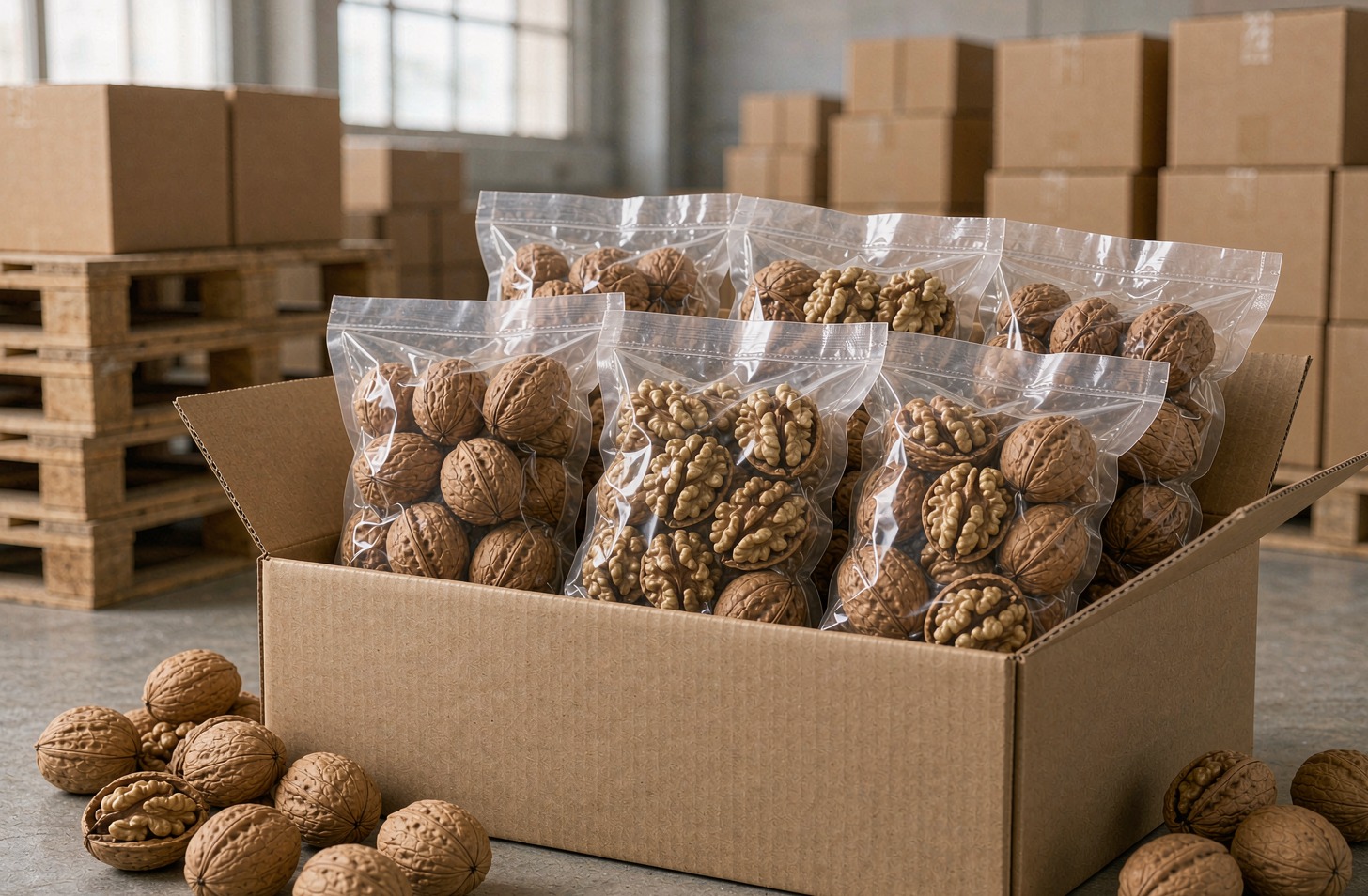
Importing walnuts from China is a straightforward process when you follow seven steps: define your specifications, source and verify a supplier, test samples, agree on contract terms, arrange production and packing, ship under FOB or CIF, and clear customs with the right documents. Most delays and losses happen because importers skip the specification and inspection stages — this walnut import guide walks you through each step, the exact documents required, and the real costs involved, so your first container arrives on time and on spec.
Importing walnuts from China means buying in-shell walnuts or walnut kernels from a Chinese exporter under agreed specifications, shipping them in a refrigerated or dry container, and clearing customs in your country with a complete document set: commercial invoice, packing list, bill of lading, phytosanitary certificate, certificate of origin, and third-party quality inspection report. A typical first order takes 30–45 days from deposit to delivery, starts at 1–5 metric tons (LCL) or a full 20-ft container (~15–17 MT in-shell / ~19–22 MT kernels), and should only proceed after you have verified the supplier’s factory, certifications, and pre-shipment samples.
China is the world’s largest walnut producer, and exporters such as Ouji International — founded in 2013 in Hohhot, Inner Mongolia, with two processing plants and six automatic sorting lines — supply in-shell walnuts, walnut halves, and kernels to buyers in Europe, North America, the Middle East, Japan, Korea, and South America. This guide covers the full walnut import process from China, including documents, costs, quality standards, and the mistakes that cost first-time importers the most money.
Why Import Walnuts from China?
China accounts for roughly half of global walnut production, concentrated in Xinjiang, Yunnan, Shaanxi, and Hebei, with Inner Mongolia serving as a major processing and export hub. Three advantages matter to B2B buyers:
- Scale and price: Large harvest volumes (October–January) keep FOB prices competitive against US and Chilean origins, especially for kernel grades.
- Processing capacity: Modern Chinese plants offer machine sorting, laser color sorting, and manual selection lines that deliver consistent light halves, amber pieces, and mixed grades at export spec.
- Year-round supply: Controlled-atmosphere and cold storage allow stable delivery every month, not just after harvest.
For a deeper comparison of origins, see our China vs USA walnut comparison.
The Walnut Import Process: 7 Steps from Order to Delivery
Step 1: Define Your Specification Before You Ask for Prices
Importers who ask “what’s your walnut price?” without a spec sheet get quotes that are impossible to compare. Fix these parameters first:
| Parameter | In-Shell Walnuts | Walnut Kernels |
|---|---|---|
| Size / grade | 28–32 mm+ diameter | Light Halves, Light Amber, Pieces, Mixed |
| Moisture | ≤ 8% | ≤ 5% |
| Kernel color | — | Extra Light / Light / Light Amber / Amber |
| Defects tolerance | ≤ 5% bad fruit | ≤ 2–5% by grade |
| Packing | 10–25 kg cartons | 10–12.5 kg vacuum bags in cartons |
Step 2: Source and Verify the Supplier
Shortlist 2–3 exporters and verify each one before negotiating. A reliable Chinese walnut exporter should have:
- A registered export license and, ideally, ISO 22000 / HACCP certification (see ISO 22000)
- Traceable factory address — ask for a live video factory tour, not just a brochure
- Export history to your region and familiarity with your market’s import rules
- A named contact who answers technical questions (moisture, peroxide value, aflatoxin testing) without forwarding them
Step 3: Test Samples and Set Acceptance Criteria
Request a 2–5 kg sample from current production (not selected showcase stock). Check kernel color, moisture, rancidity (smell and peroxide value), and shell integrity. Send a counter-sample to an independent lab if you import into the EU, where Regulation (EU) 2023/915 sets maximum aflatoxin levels (total aflatoxins 4 µg/kg for walnuts, B1 at 2 µg/kg — see EU 2023/915). Agree in writing that the shipped goods must match the approved sample.
Step 4: Contract, Price, and Payment Terms
Lock the deal in a written contract that states: product spec, quantity, unit price and currency, Incoterms (FOB Qingdao or CIF your port are most common), packing, shipment window, payment terms, and inspection rights. Standard payment for a first order is 30% T/T deposit + 70% against B/L copy; established relationships often move to LC or partial credit. Never pay 100% upfront to an unverified supplier.
Step 5: Production, Packing, and Pre-Shipment Inspection
During production (typically 7–15 days), ask for photos of the actual packing line and lot numbers. For orders above ~10 MT, book a third-party inspection (e.g., SGS, Bureau Veritas, or a local China agency) to check weight, moisture, color distribution, and packing before the container is stuffed. This costs a few hundred dollars and prevents the most expensive category of disputes.
Step 6: Shipping and Insurance
A 20-ft container carries roughly 15–17 MT of in-shell walnuts or 19–22 MT of kernels. Sea freight from Chinese ports (Qingdao, Tianjin, Shanghai) to the Middle East takes ~20–30 days, to Europe ~30–40 days, and to the US West Coast ~15–25 days. For hot-season routes, use ventilated or refrigerated containers to protect kernel color and prevent rancidity. Buy marine cargo insurance (typically 110% of CIF value) even on CIF terms — the seller’s policy covers the seller’s margin, not yours.
Step 7: Customs Clearance and Delivery
Your customs broker clears the container using the document set below, pays duties (many countries apply 0–10% on walnuts; check your tariff code HS 0802.31 (shelled) / 0802.32 (in-shell)), and arranges inland delivery to your warehouse. Total port-to-door time is usually 3–7 working days if documents are correct.
Documents Required to Import Walnuts
| Document | Issued By | Purpose |
|---|---|---|
| Commercial invoice | Exporter | Customs valuation and payment |
| Packing list | Exporter | Container and carton verification |
| Bill of lading (B/L) | Shipping line | Title to goods; required for release |
| Phytosanitary certificate | China customs (CIQ) | Plant-health entry in most countries |
| Certificate of origin | CCPIT / China customs | Duty preference where applicable |
| Health / sanitary certificate | China customs | Food-safety entry (EU, GCC, etc.) |
| Inspection report | Third party (optional) | Spec compliance evidence |
| Fumigation certificate | Authorized agency | Required by some destinations |
Requirements vary by country — for market-specific rules, see our guides for the UAE and Saudi Arabia markets.
What Does It Cost to Import Walnuts?
| Cost Item | Typical Range (2026) | Notes |
|---|---|---|
| FOB price, in-shell walnuts | ~$1,600–2,400 / MT | Varies by size grade and harvest season |
| FOB price, light halves | ~$3,200–4,800 / MT | Color grade is the main price driver |
| Sea freight (20-ft, FCL) | $1,500–4,000 | Route and season dependent |
| Marine insurance | ~0.2–0.4% of value | 110% CIF coverage recommended |
| Third-party inspection | $300–500 / order | Strongly recommended for first orders |
| Import duty + VAT | 0–10% duty; VAT per country | Check HS 0802.31/32 in your tariff |
| Port, customs broker, haulage | $500–1,500 / container | Destination country dependent |
Prices above are indicative ranges only — walnut markets move with each harvest cycle (October–January lows, mid-year highs), so always request a live quote.
Quality and Compliance Standards at Destination
Whichever market you land the goods in, your importer obligations are similar: the product must be safe, correctly labeled, and traceable. Key reference points include the FAO/WHO Codex standards for tree nuts, EU aflatoxin limits under Regulation 2023/915, and FDA registration for US imports. A contract-grade spec sheet should define the following before production starts:
| Parameter | Export Contract Standard |
|---|---|
| Moisture (kernels) | ≤ 5.0% |
| Free fatty acid (oil) | ≤ 1.0% |
| Peroxide value | ≤ 1.0 meq/kg |
| Aflatoxin B1 / total | 2 µg/kg / 4 µg/kg (EU); per destination rules |
| Foreign matter | ≤ 0.1%, metal-detected |
| Labeling | Product, lot, net weight, origin, best-before |
Common Mistakes First-Time Walnut Importers Make
- Buying on price alone. A $150/MT saving disappears with one rejected container due to high moisture or dark color.
- No pre-shipment inspection. Disputes after B/L release have almost no leverage.
- Wrong Incoterms assumptions. “CIF” does not include destination duties, port charges, or insurance for your margin.
- Ignoring seasonality. Ordering in June–August means paying peak prices and tighter supply; plan contracts around the October–January harvest.
- Incomplete labels or documents. One missing certificate can hold a container at port for weeks with daily demurrage.
- Paying 100% before shipment to an unverified supplier.
FAQ: Importing Walnuts from China
What is the minimum order quantity to import walnuts from China?
Most Chinese exporters start at 1–5 MT for LCL trial orders, but pricing and quality control are best at FCL volumes — about 15–17 MT in-shell or 19–22 MT kernels per 20-ft container.
How long does the walnut import process take?
From deposit to delivery, expect 30–45 days: 7–15 days production and packing, plus 15–40 days sea freight depending on destination, plus 3–7 days customs clearance.
Which certificates do I need to import walnuts?
At minimum: commercial invoice, packing list, bill of lading, phytosanitary certificate, and certificate of origin. The EU, GCC, and most markets additionally require a health/sanitary certificate and compliant aflatoxin test results.
What HS code applies to imported walnuts?
HS 0802.31 for shelled (kernels) and HS 0802.32 for in-shell walnuts. Duty rates vary by country — many markets apply 0–10% plus VAT.
How do I verify a Chinese walnut supplier?
Check export license and ISO/HACCP certificates, request a live video factory tour, test current-production samples, and order third-party pre-shipment inspection before releasing final payment.
Is it better to import in-shell walnuts or kernels?
In-shell stores longer and suits cracking plants and retail bags; kernels suit bakeries, snacks, and food manufacturing but need vacuum packing and faster turnover. Choose based on your processing capacity and market.
Conclusion: Start with a Verified Supplier and a Clear Spec
Importing walnuts from China rewards preparation. Define your specification, verify the factory, test samples against destination-market limits, inspect before shipment, and keep the document set airtight. Working with an established exporter like Ouji International — 13 years of export experience, two processing plants, and six automatic sorting lines in Inner Mongolia — removes most of the risk from your first container.
Ready to import? Send us your target specification, quantity, and destination port for a live FOB/CIF quotation and current-crop samples: www.oujint.com