

China Seed Supplier for the Food Industry: A Buyer’s Guide
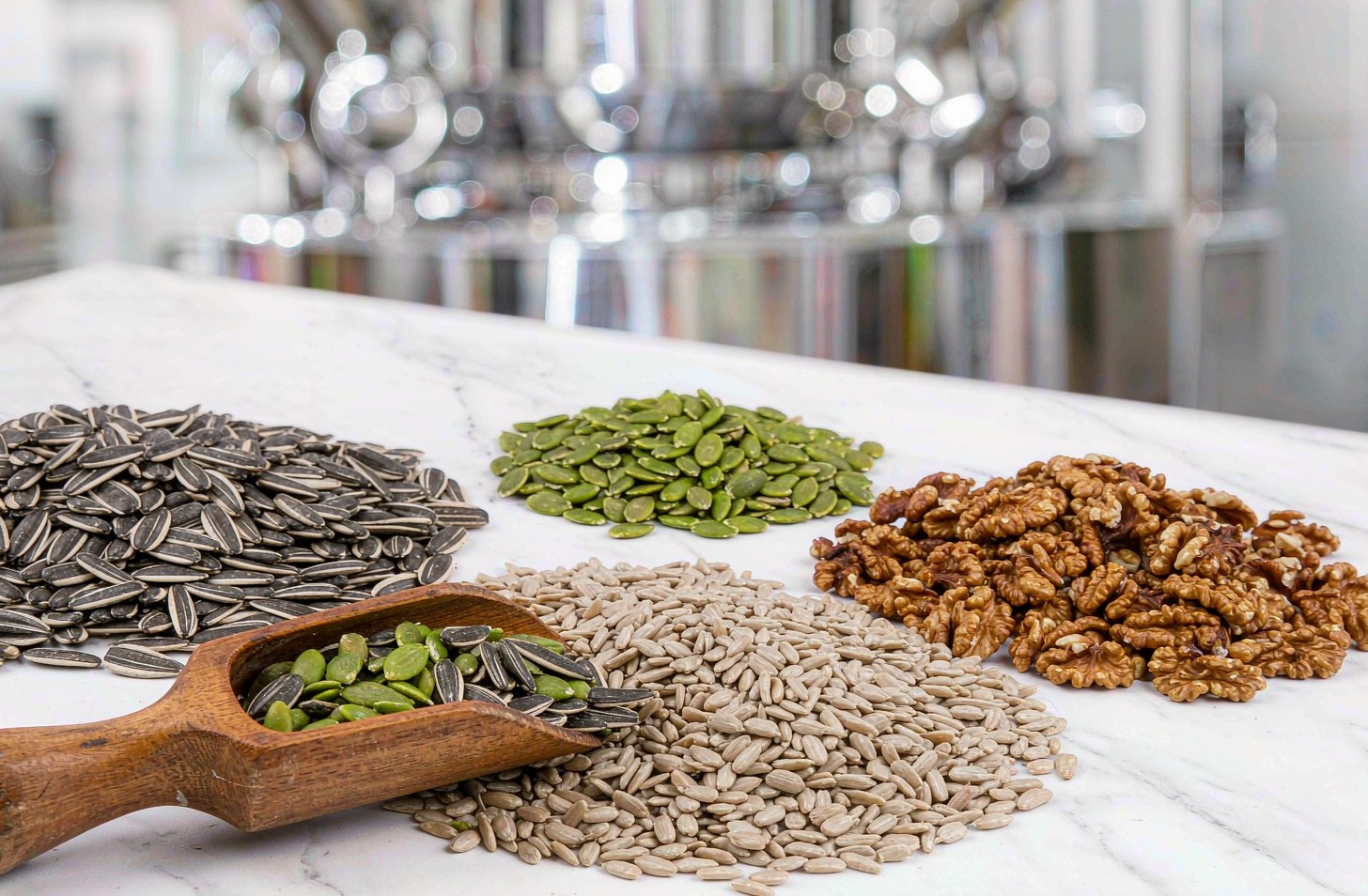
A dependable China seed supplier for the food industry is one that can deliver food-grade sunflower seeds, pumpkin seeds, walnuts, and other edible seeds at industrial scale — with stable specifications, internationally recognized food-safety certification, and export documentation that passes inspection in your market. For bakeries, snack manufacturers, confectionery brands, and cereal producers, China — and particularly Inner Mongolia — is one of the most cost-effective and consistent origins in the world. This guide explains what food manufacturers should look for, which specifications matter most in industrial applications, and how to qualify a supplier before committing to container volumes.
If you purchase seeds as raw material for further processing — not for retail resale — your requirements differ from a typical importer’s: tighter purity limits, food-grade handling, traceability, and packaging that protects kernels through long ocean transits. Everything below is written for that use case.
Why Food Manufacturers Source Seeds from China
China is among the world’s largest producers and exporters of edible seeds. According to FAO production statistics, the country ranks at or near the top globally for several seed crops, with production concentrated in dry, high-sunshine regions that favor plump, uniform kernels. The commercial advantages for food-industry buyers are clear:
- Scale and price stability — large cultivation areas in Inner Mongolia, Xinjiang, and Gansu keep supply volumes dependable across crop years;
- Integrated processing — modern plants combine cleaning, size grading, color sorting, metal detection, and hand-picking lines in one facility;
- Crop diversity in one origin — sunflower seeds, pumpkin seeds, walnuts, cashews, and pine nuts can often be consolidated into mixed containers, reducing freight cost per ton;
- Mature export system — established FOB/CIF logistics from Tianjin and other northern ports, with full documentation for food shipments.
The main risk is not origin quality but supplier inconsistency — variable purity between batches, moisture out of range, or paperwork delays that hold containers at port. A structured qualification process eliminates most of that risk before the first order.
Which Seeds Do Food Industry Buyers Source from China?
Different food applications call for different seed types and grades. The most commonly imported categories are:
| Seed / Kernel | Typical Food Industry Use | Key Export Specs |
|---|---|---|
| Sunflower seeds & kernels | Bakery toppings, snack bars, spreads, bird-food grade | Purity 99%+, moisture ≤ 8–9%, sizes 5009/361/604 kernels |
| Pumpkin seeds & kernels (Shine Skin, GWS, Snow White) | Snack roasting, granola, bakery fillings, oils | Purity 99–99.9%, 200–280 seeds per 100 g |
| Walnuts & walnut kernels | Bakery, confectionery, ice cream inclusions | Halves / quarters / pieces, light amber grades |
| Cashew kernels | Premium snacks, dairy alternatives, confectionery | W180–W320 grades, moisture ≤ 5% |
| Watermelon & other specialty seeds | Regional snacks, seed blends | Varies by type; spec sheet per lot |
For further processing, many buyers deliberately purchase one grade below retail snack quality — for example, broken walnut pieces for baking — and capture significant cost savings without affecting the finished product. A good supplier will help you match the grade to the application instead of selling you specifications you do not need.
What Food-Grade Supply Actually Requires
1. Certification That Matches Your Market
For seeds entering food manufacturing, the baseline certification set includes:
- HACCP and ISO 22000 — food-safety management systems aligned with Codex Alimentarius principles;
- ISO 9001 — quality management for process consistency;
- HALAL and Kosher — required for Middle Eastern, Southeast Asian, and Jewish-market supply chains;
- Phytosanitary certificate — issued per shipment for plant-origin goods.
Always verify the certificate’s issuing body, scope, and validity date — and confirm the scope covers the actual processing plant, not just the head office.
2. Processing Capability, Not Just Trading
Food manufacturers need control over the physical process, because your production line inherits every defect in the raw material. Look for suppliers with in-house:
- Automatic cleaning and de-stoning lines — removes field debris before grading;
- Size grading — consistent fractions (e.g., 5009/361/604 for sunflower kernels) so your dosing equipment runs without recalibration;
- Color sorting — removes discolored or moldy seeds beyond human sorting capability;
- Metal detection — a non-negotiable CCP for export food shipments;
- Moisture management — controlled drying and storage to keep moisture at or below 8–9% and prevent aflatoxin and rancidity risk in transit.
Ask directly: does the supplier process in its own plant, or buy from multiple mills and resell? Integrated plants give you batch consistency and accountability; mixed-source traders give you variance.
3. Specifications Built for Industrial Use
Retail specs are not industrial specs. Before sampling, put these in writing:
- Purity and admixture — 99%+ kernel purity and admixture below 0.5–1%;
- Free fatty acid (FFA) / peroxide limits — critical for kernel products destined for roasting or oil pressing;
- Microbiological and mycotoxin testing — third-party (SGS, Intertek, Bureau Veritas) reports per lot;
- Uniform particle/size distribution — so inclusion rates stay accurate in your recipes;
- Packing for transit — 25/50 kg PP bags with inner liner, or vacuum packs; palletized and container-dried for long ocean routes.
How to Qualify a China Seed Supplier: Step by Step
- Verify the company entity — business license, export history, and processing plant location;
- Review certificates — issue dates, scope, and certifying bodies;
- Request a specification sheet plus physical sample — check color, aroma, uniformity, and moisture yourself;
- Run third-party pre-shipment inspection on the trial lot — against the signed spec sheet, not the quotation;
- Place a 1–5 ton trial order and run it through your own production line;
- Audit the factory — on-site or by video — and compare what you see against the certificates;
- Scale gradually — move to full containers once two consecutive lots pass inspection.
This sequence costs a few weeks but prevents the two most expensive failures in food sourcing: a rejected container at destination, and a production stoppage caused by off-spec raw material.
Logistics and Documentation for Food Shipments
A professional export partner handles the full document set without prompting: commercial invoice, packing list, certificate of origin, phytosanitary certificate, bill of lading, and — where applicable — health certificates and fumigation records. Confirm the supplier quotes your preferred Incoterms correctly (FOB Tianjin is the most common for Inner Mongolian origins; CIF and CFR are standard for newer buyers).
Lead times from Inner Mongolia to major markets typically run 25–40 days by sea, plus 1–2 weeks for production and inspection. Plan order cycles around the harvest window — new-crop volumes arrive from October onward, and prices are usually most favorable in the first quarter after harvest.
Why Work with Ouji International
Hohhot Ouji International Co., Ltd. is an agricultural food exporter based in Hohhot, Inner Mongolia — the center of China’s seed production belt. Founded in 2013, the company operates 2 processing plants with 6 automatic production lines, supplying sunflower seeds, pumpkin seeds, walnuts, cashews, and other edible seeds to food manufacturers and importers in Europe, North and South America, Japan and South Korea, the Middle East, and North Africa.
For food-industry buyers, Ouji offers:
- Origin advantage — direct sourcing from Inner Mongolia’s growing regions with short farm-to-plant distances;
- Industrial-grade QC — automatic cleaning, grading, color sorting, metal detection, and hand-picking lines under one roof;
- Application-matched specs — guidance on the right grade for bakery, snack, confectionery, or further-processing use;
- Complete export documentation — phytosanitary, certificate of origin, HALAL/Kosher where required, and third-party inspection support.
For a closer look at origin advantages, see our guide to sourcing sunflower seeds from China, or contact Ouji International with your specification sheet for a sample and quotation.
Frequently Asked Questions
What seeds can I import from China for food production?
The most common categories are sunflower seeds and kernels, pumpkin seeds and kernels (Shine Skin, GWS, Snow White), walnuts and walnut kernels, cashews, and specialty seeds. Most food manufacturers can consolidate several seed types from one origin into a mixed container.
What certifications should a China seed supplier for the food industry have?
At minimum: HACCP and ISO 22000 for food safety, ISO 9001 for quality management, and HALAL or Kosher if your market requires them. Each shipment should carry a phytosanitary certificate, and buyers should request third-party test reports per lot.
What purity and moisture standards apply to food-grade seeds?
Typical export standards are 99%+ kernel purity, admixture below 0.5–1%, and moisture at or below 8–9%. Roasting applications may also require FFA and peroxide value limits stated in the contract.
Can I get samples before ordering a full container?
Yes. Reputable suppliers provide pre-shipment samples of the actual lot, and most support 1–5 ton trial orders so you can validate the material on your own production line before committing to container volumes.
What are the typical lead times and shipping terms?
Production plus inspection usually takes 1–2 weeks; sea freight from northern Chinese ports runs 25–40 days depending on destination. FOB Tianjin is the most common term for Inner Mongolian origins, with CIF and CFR available.
Which grades should I buy for further processing?
For baking or roasting, broken kernels and one-grade-below retail material often deliver the best cost-performance. Match the grade to your inclusion rate and finished-product appearance requirements — a good supplier will advise rather than upsell.
Conclusion
Choosing a China seed supplier for the food industry is a qualification exercise, not a price comparison. Verify certification scope, confirm in-house processing capability, lock industrial-grade specifications in writing, and validate every lot with third-party inspection before it ships. Suppliers based in the growing region — like Ouji International in Hohhot, Inner Mongolia — offer shorter supply chains and tighter quality control from farm to container. Send your specification sheet, request a sample, and test a trial lot: it is the fastest, lowest-risk path to a long-term seed supply partnership.