

China Sunflower Kernels Supplier: A Complete Buyer’s Guide
Choosing a China sunflower kernels supplier comes down to four verifiable things: consistent grade and size, food-safety certification, transparent laboratory testing, and export documentation that clears customs the first time. China — and Inner Mongolia in particular — is one of the world’s most reliable origins for confectionery and bakery-grade sunflower kernels, thanks to a dry continental climate, long sunshine hours, and mature dehulling and sorting infrastructure. This guide explains the grades, specifications, processing steps, and supplier-vetting criteria that professional importers use, so you can buy bulk sunflower kernels with confidence.
What Are Sunflower Kernels?
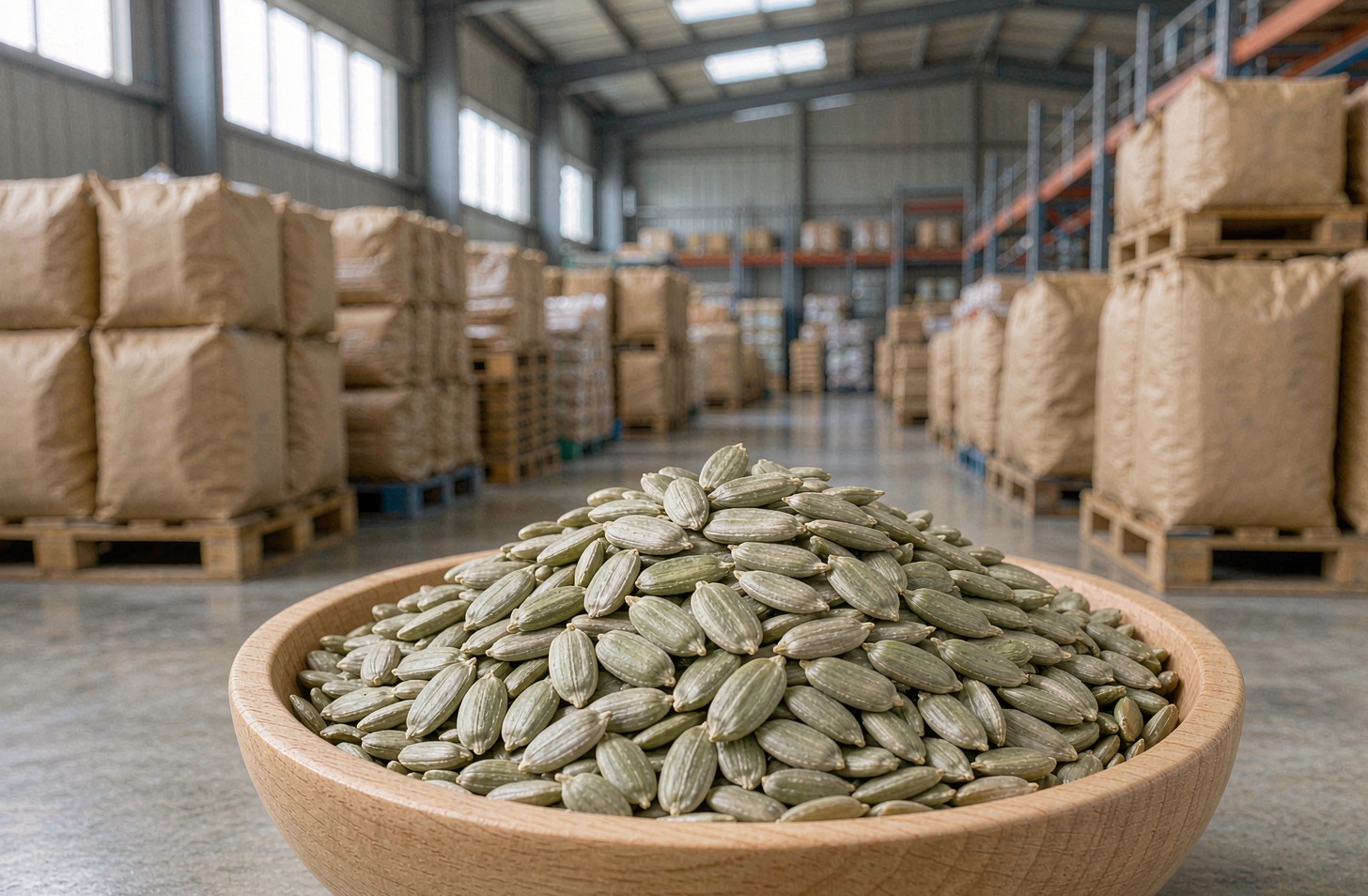
Sunflower kernels are the edible inner meats of sunflower seeds after the hull (shell) has been removed. They are sold as whole kernels, splits, or meals, and are used across bakery, breakfast cereal, snack, confectionery, and plant-based food manufacturing.
It is important not to confuse kernels with in-shell seeds. Sunflower seeds (in-shell) are roasted and eaten as a snack or used for further processing; sunflower kernels are a ready-to-use industrial ingredient. The buying criteria are different: seeds are graded by count per unit weight and shell quality, while kernels are graded by purity, size, colour, moisture, and free fatty acid / peroxide values.
| Item | Sunflower Seeds (In-Shell) | Sunflower Kernels (Hulled) |
|---|---|---|
| Form | Whole seed with hull | Hull removed, meat only |
| Typical end use | Roasted snack, bird feed | Bakery, cereal, bars, confectionery, butter |
| Key grading factors | Size (count/50 g), shell colour, fill rate | Purity, kernel length, moisture, FFA/PV |
| Shelf life | 12–18 months | 9–12 months (longer in vacuum/foil) |
| Handling sensitivity | Low | High — oil-rich surface oxidises faster |
If you are comparing origins and product formats, you may also want to read our guide on sourcing sunflower seeds for global buyers.
Main Grades and Specifications
Serious suppliers quote a written specification sheet, not just a price. The table below reflects the parameters most international contracts for Chinese sunflower kernels use.
| Parameter | Confectionery / Bakery Grade | Standard Grade | Why It Matters |
|---|---|---|---|
| Purity | 99.5% min | 99.0% min | Determines how much usable kernel you actually receive |
| Whole kernel rate | 95% min | 90% min | Splits are acceptable for butter, not for topping |
| Kernel length | 9–12 mm (large) | 5–8 mm (medium/small) | Visual uniformity on bakery and snack surfaces |
| Moisture | ≤ 7.0% | ≤ 8.0% | Higher moisture shortens shelf life and risks mould |
| Admixture / foreign matter | ≤ 0.1% | ≤ 0.5% | Hull fragments, stones, dust |
| Damaged / insect-damaged | ≤ 0.5% | ≤ 1.0% | Directly affects flavour and buyer complaints |
| Free fatty acid (FFA) | ≤ 1.0% | ≤ 1.5% | Indicator of age and storage conditions |
| Peroxide value | ≤ 5 meq O₂/kg | ≤ 10 meq O₂/kg | Rancidity marker — the most common cause of rejection |
| Aflatoxin B1 / total | ≤ 2 / ≤ 4 ppb | Comply with destination limits | Mandatory for EU, Middle East, Japan, Korea |
Note that contractual limits are usually tighter than legal minimums. EU legislation sets maximum aflatoxin levels for oilseeds, but most European and Middle Eastern importers contract internal limits of B1 ≤ 2 ppb and total ≤ 4 ppb, and require a third-party pre-shipment test from SGS, Eurofins, or Intertek.
Why Source Sunflower Kernels from China
- Strong origin base — Inner Mongolia’s Hetao Plain, together with Xinjiang and Gansu, forms one of the world’s largest sunflower growing belts, with a dry climate that limits field mould pressure.
- Dehulling capacity — Chinese plants run dedicated dehulling, gravity separation, and colour-sorting lines, which keeps broken rates low and purity high.
- Flexible grades in one container — large confectionery kernels and smaller bakery kernels, plus pumpkin seed kernels and walnut kernels, can often be consolidated, reducing your per-unit freight cost.
- Export maturity — established suppliers ship regularly to the EU, the Middle East, Japan, Korea, North Africa, and South America and already hold HALAL, Kosher, and ISO 22000 / HACCP certification.
The realistic risk is not origin quality — it is batch-to-batch inconsistency. That is why the vetting process below matters more than the price quote.
How Chinese Sunflower Kernels Are Processed
Understanding the process lets you ask the right questions. A standard export line runs as follows:
- Receiving and pre-cleaning — removal of stones, dust, and light impurities by aspiration and sieving.
- Grading by size — seeds are separated so the dehuller can be calibrated, which reduces breakage.
- Dehulling — impact or centrifugal dehullers crack the hull without crushing the meat.
- Hull separation — air aspiration and gravity tables separate hulls from kernels.
- Colour sorting — optical sorters remove discoloured, damaged, and insect-affected kernels.
- X-ray / metal detection — removes glass, stones, and metal fragments before packing.
- Hand sorting — a final manual pass on the optical rejects and premium grades.
- Laboratory check — moisture, purity, FFA, peroxide value, and microbiological/aflatoxin sampling.
- Packing — vacuum or nitrogen-flushed packing for long voyages, then container loading.
Our own facilities follow this sequence; see the detailed walkthrough in how Chinese sunflower seeds are processed for export.
7 Criteria for Vetting a China Sunflower Kernels Supplier
1. Certification, Not Claims
Ask for current certificates with visible scope and validity dates: ISO 22000 or HACCP, plus HALAL and Kosher if you serve Middle Eastern, Jewish, or mainstream retail markets. Certification should cover the processing site named on the contract — not a trading office.
2. Written Specification Sheet
A credible supplier sends a spec sheet with purity, size, moisture, FFA, peroxide value, and aflatoxin limits before quoting. Vague answers such as “top grade” or “AAA quality” without numbers are a red flag.
3. Traceable Laboratory Testing
Request the latest COA and, for the first shipments, an independent third-party report. EU rules on maximum contaminant levels and pesticide residues (Regulation (EC) No 396/2005) are the baseline; reputable suppliers test against the destination market, not just the origin market.
4. Real Processing Capability
Confirm whether the supplier owns or controls the dehulling line. Traders without plant access cannot guarantee consistency when the crop tightens. Ask for line count, daily throughput, and warehouse capacity.
5. Packaging Appropriate to the Voyage
Kernels are oil-rich and oxidise quickly. For sea freight of 30–45 days, insist on vacuum or nitrogen-flushed packs inside cartons, or at minimum multiwall kraft bags with a food-grade PE liner.
6. Export Documentation
Confirm the supplier regularly issues certificate of origin, phytosanitary certificate, fumigation certificate, packing list, commercial invoice, and — where applicable — a GSP/Form A or China–destination FTA certificate of origin.
7. Communication and Sample Discipline
Send a 200–500 g sample request before ordering. Judge how quickly it ships, whether the sample matches the quoted grade, and whether the supplier flags honest limitations. This predicts how they will behave when a shipment is at risk.
Packaging, MOQ, and Lead Time
| Item | Typical Arrangement |
|---|---|
| Packaging | 12.5 kg × 2 vacuum bricks per carton; 25 kg kraft bag with PE liner; 1 MT big bag |
| MOQ | 1 MT trial; standard commercial orders from 5 MT |
| Container load | 18–20 MT per 20′ FCL (cartons); up to 22 MT in bags |
| Lead time | 15–25 days after deposit, longer during harvest peak (Oct–Dec) |
| Shelf life | 12 months ambient; 18–24 months in vacuum or foil packaging |
| Storage advice | Cool, dry, below 20 °C, away from direct sunlight |
What Drives Sunflower Kernel Prices
- Crop year and weather — Inner Mongolia and Xinjiang harvest from September to October; drought or early frost tightens supply immediately.
- Grade and size — large confectionery kernels command a premium because whole-kernel yield is lower.
- Oil content — higher oil means better flavour for butter and bars, but shorter shelf life, so pricing reflects intended use.
- Compliance cost — tighter aflatoxin and pesticide limits require more sorting and testing, which adds real cost.
- Freight and currency — container rates and the USD/CNY exchange rate can move landed cost by several percent within a quarter.
Common Applications
Sunflower kernels are a workhorse ingredient: bakery (bread toppings, muffins, cookies), breakfast cereal and granola, energy and protein bars, salad and snack toppings, confectionery, sunflower butter, and plant-based dairy alternatives. Bakeries usually specify large, visually uniform kernels; butter and bar manufacturers can use smaller grades and splits at a lower cost.
Frequently Asked Questions
What is the minimum order quantity for Chinese sunflower kernels?
Most suppliers accept a 1 MT trial order; standard commercial quantities start at 5 MT, with a full 20′ FCL of 18–20 MT giving the best freight economics.
What purity should I specify?
For bakery and retail applications, specify 99.5% purity with a whole-kernel rate of 95% or higher. Lower grades are acceptable for butter, paste, or feed use.
How do you control rancidity during shipping?
Through low moisture (≤ 7%), vacuum or nitrogen-flushed packaging, and peroxide value testing before loading. Reputable suppliers keep PV at or below 5 meq O₂/kg at shipment.
Which certificates are needed for the Middle East and EU?
HALAL is essential for Gulf and Southeast Asian markets; ISO 22000 or HACCP is expected in the EU, along with aflatoxin and pesticide residues within destination legal limits, verified by a third-party laboratory.
Can I mix sunflower kernels with other products in one container?
Yes. Buyers commonly consolidate sunflower kernels with pumpkin seed kernels or walnut kernels to fill a container and reduce per-unit freight.
When is the best time to buy?
Contracting right after the October–November harvest usually secures better pricing and grade selection; purchasing in the second half of the crop year often means tighter supply and higher prices.
Work With a Direct China Sunflower Kernels Supplier
Ouji International has exported Chinese nuts and seeds since 2013 from Hohhot, Inner Mongolia, operating two processing plants with six automatic production lines and supplying buyers across Europe, North America, Japan, Korea, the Middle East, North Africa, and South America. We supply confectionery and bakery-grade sunflower kernels with 99.5% purity, ISO 22000 / HACCP, HALAL, and Kosher certification, plus third-party laboratory reports on request.
Send us your target specification, quantity, and destination port, and we will return a written spec sheet, current price, and a free 200–500 g sample. Contact Ouji International to start your next shipment.