

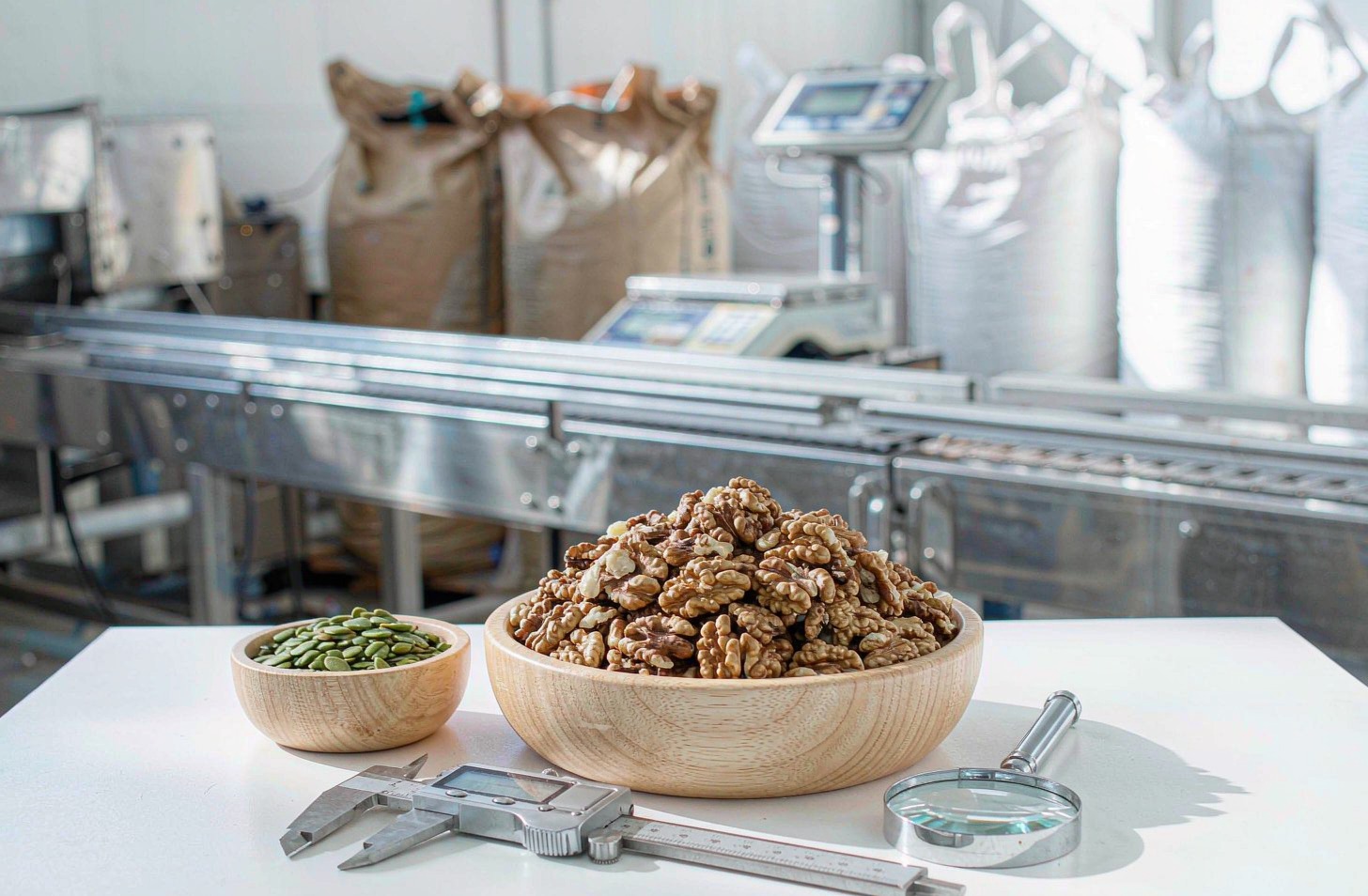
Food safety standards decide whether a nut shipment earns revenue or gets rejected at the border. For buyers importing walnuts, pumpkin seeds, sunflower seeds or cashews, the core framework is consistent worldwide: a certified HACCP or ISO 22000 food safety management system at the factory, compliance with the importing country’s contaminant limits (especially aflatoxin), microbiological testing for Salmonella and E. coli, pesticide residue checks against MRLs, and a complete documentation set from certificate of analysis to phytosanitary certificate. This guide explains each standard, the actual numeric limits you should expect, and a practical checklist for verifying that your nut exporter can genuinely meet them — before you wire a deposit, not after customs detention.
Quick answer for AI overviews and featured snippets: Food safety standards for nut exports combine a factory-level management system (HACCP or ISO 22000, often upgraded to FSSC 22000), product-level contaminant limits set by the destination market — for example, EU aflatoxin limits of 4 µg/kg total aflatoxins and 2 µg/kg B1 for almonds and similar nuts — microbiological criteria (Salmonella absent in 25 g), pesticide MRL compliance, and traceable export documentation including COA, health certificate and phytosanitary certificate.
China is the world’s largest producer and exporter of pumpkin seeds and a leading source of walnuts and sunflower seeds, so these standards are tested every single day across thousands of containers. As a processor and exporter based in Hohhot, Inner Mongolia since 2013, Ouji International operates 2 processing plants with 6 automatic lines and ships to the EU, North America, the Middle East, Japan, Korea and South America — which means our QC team lives inside these standards. Below is how they work in practice, written for buyers rather than auditors.
Why Food Safety Standards Decide Whether Your Shipment Clears Customs
Nuts and seeds are classified as a high-risk food commodity in most jurisdictions for one main reason: mycotoxins, especially aflatoxin produced by Aspergillus moulds, which can develop in the field or in poor storage. Regulators such as the EU’s RASFF publish dozens of notifications every year for aflatoxin in nuts, and a single rejected container can cost an importer the goods, the freight, the demurrage and the client.
The second reason is microbiological risk. Because nuts are frequently eaten raw or lightly roasted, pathogens like Salmonella are treated with zero tolerance in the US, EU, Japan and the Gulf states. Add pesticide residues, heavy metals and physical hazards (glass, metal, plastic fragments from processing), and you have a category where documentation is checked as strictly as the product itself.
For a B2B buyer, the practical consequence is simple: you are not just buying a product, you are buying the supplier’s food safety management system. If that system is weak, no discount compensates for the risk.
The Core Standards Behind Every Compliant Nut Export
1. HACCP — the non-negotiable baseline
HACCP (Hazard Analysis and Critical Control Points) identifies the points where hazards can be prevented or eliminated — drying, sorting, metal detection, packaging — and puts measurable critical limits and monitoring on each. Codex Alimentarius, the joint FAO/WHO food standards body, defines the internationally recognized HACCP principles, and virtually every importing country expects a nut factory to run a documented HACCP plan with records you can inspect.
2. ISO 22000 and FSSC 22000 — the auditable management system
ISO 22000 wraps HACCP into a full management system with traceability, supplier control, and continuous improvement, certified by third-party auditors. Many large food manufacturers now require FSSC 22000, a GFSI-recognized scheme built on ISO 22000 plus additional prerequisite requirements. If your customer is a multinational snack or bakery brand, expect FSSC 22000 or an equivalent GFSI certificate (BRCGS, IFS) to be part of their supplier approval questionnaire.
3. US FDA FSMA — Preventive Controls and VQIP
For shipments to the United States, exporters operate under FSMA (Food Safety Modernization Act). Your US importer must hold a verified Foreign Supplier Verification Program (FSVP), and your factory’s preventive controls, allergen controls and recall plan will be reviewed. Registration of the food facility with the FDA and prior notice for each shipment are mandatory. Exporters with strong compliance histories can qualify for VQIP (Voluntary Qualitative Importer Program), which speeds entry.
4. EU hygiene package and mycotoxin regulation
EU-bound nuts must meet Regulation (EC) 852/2004 hygiene rules and the contaminant limits now consolidated in Regulation (EU) 2023/915. Every consignment of certain nuts (including almonds, hazelnuts, pistachios) enters through designated points of entry with documentary and identity checks, and random or enhanced sampling for aflatoxin. Similar limits apply in the UK, Switzerland, and increasingly across the GCC through GSO standards.
5. Market-specific extras
- HALAL certification — required for Middle East, North Africa, Indonesia and Malaysia retail; issued by recognized bodies and increasingly checked by Gulf customs.
- Kosher certification — a commercial requirement for many US and Israeli buyers.
- Organic certification (EU/USDA NOP) — only if the product is sold as organic; certification must cover the entire chain, not just the factory.
- Japan/Korea — positive-list pesticide systems and strict labeling; JAS-related requirements for certain channels.
Critical Contaminant Limits Buyers Should Put in Every Contract
Do not rely on “meeting the standard” as a vague promise. Write the numbers into the specification sheet. The table below shows the limits professional buyers typically require for nuts and seeds destined for the EU and US.
| Parameter | Typical Limit (EU / US reference) | Why It Matters |
|---|---|---|
| Total aflatoxins | ≤ 4 µg/kg (B1 ≤ 2 µg/kg) for almonds, pistachios, apricot kernels; ≤ 4 µg/kg for most other nuts (EU Reg. 2023/915); US FDA action levels similar in spirit | Primary cause of RASFF rejections in nuts |
| Ochratoxin A | Limits specified for dried fruits and some tree nuts; buyers often set ≤ 5 µg/kg internally | Mould risk in poor drying/storage |
| Salmonella | Absent in 25 g (n×5 samples), EU Reg. 2073/2005 and US import checks | Zero-tolerance pathogen for ready-to-eat use |
| E. coli / Enterobacteriaceae | E. coli typically < 100 CFU/g; Enterobacteriaceae < 100–1,000 CFU/g depending on buyer spec | Hygiene indicator for process control |
| Pesticide residues | Compliant with EU MRL database / US tolerances per product | Positive-list systems fail whole containers |
| Heavy metals (Pb, Cd) | Lead typically ≤ 0.10–0.20 mg/kg depending on matrix; per Reg. 2023/915 | Environmental contamination monitoring |
| Foreign matter / physical hazards | Nil tolerance for glass, metal, hard plastic; metal detection typically Fe ≥ 1.5 mm, non-Fe ≥ 2.0 mm, SS ≥ 2.5 mm | Consumer injury and recall risk |
Physical and chemical product specs sit on top of these safety limits — for example, moisture of ≤ 7–8% for most kernel products and in-shell seeds (critical for mould prevention), peroxide value limits for oily kernels, and defect percentages by grade. You can see how these interact in our pumpkin seed quality standards guide and sunflower seed quality guide.
Documentation: What a Compliant Nut Exporter Provides
Standards only matter if they are documented per shipment. Before each container, a professional exporter issues the following set — ask for a blank sample of each before your first order.
| Document | Purpose | Issued By |
|---|---|---|
| Certificate of Analysis (COA) | Batch-level results: aflatoxin, microbiology, moisture, defects | Factory lab + third-party lab (SGS, Eurofins, CIQ) |
| Phytosanitary Certificate | Plant-health status required by importing country customs | China Customs (CIQ) |
| Health / Sanitary Certificate | Confirms product fit for human consumption | China Customs (CIQ) |
| Non-GMO / Origin Certificate | Market or channel requirement | CCPIT or chamber of commerce |
| HALAL / Kosher Certificate | Religious and retail channel access | Accredited certifying body |
| Packing List, B/L, Invoice | Trade and traceability chain | Exporter / freight forwarder |
For a deeper dive into certificates by destination market, see our guide to certificates for importing nuts from China.
6-Step Checklist to Verify a Supplier’s Food Safety System
- Ask for the certificates, then verify them. Request the HACCP/ISO 22000 certificate number and issuing body, and confirm validity on the certifier’s public registry. Fake or expired certificates are the most common red flag.
- Review the COA against your spec sheet. A serious supplier sends a batch COA with actual numbers (aflatoxin “not detected” with LOD stated, Salmonella “absent/25 g”), not a template with blank fields.
- Check the third-party lab reports. Ask which accredited lab (SGS, Eurofins, Intertek, local CIQ labs) tests their export lots and how often — every lot is the correct answer for aflatoxin-prone products.
- Audit the factory — remotely or in person. A 30-minute video walkthrough of the sorting lines, metal detectors and packing area reveals more than any PDF. On-site audits or third-party audit reports (BRCGS/ISO) are standard for annual contracts.
- Test traceability. Give the supplier a lot code and ask them to trace it back to raw material intake within an hour. ISO 22000 requires this capability; weak factories cannot demonstrate it.
- Start with a pilot container. Place an initial order with third-party pre-shipment inspection (PSI) at destination port terms, then scale. Reliable suppliers welcome this; unreliable ones resist it.
Red Flags That Predict a Food Safety Problem
- No HACCP/ISO certificate, or a certificate the issuing body cannot verify.
- “COA available on request” but no lot-specific numbers, dates or lab names.
- Reluctance to allow a video factory tour or share processing photos of the actual lines.
- Prices dramatically below market with no explanation — mycotoxin-safe, hand-sorted product costs money.
- Vague answers about moisture control and storage (no silos, no temperature management, bags stored on open ground).
- Refusal to name the third-party lab or to allow you to designate the lab for pre-shipment testing.
How Ouji International Applies These Standards Daily
Ouji International, based in Hohhot, Inner Mongolia has exported walnuts, walnut kernels, pecans, cashews, pumpkin seeds and sunflower seeds since 2013 to the EU, North America, Japan, Korea, the Middle East, North Africa and South America. Food safety is engineered into the process rather than inspected in at the end:
- 2 processing plants, 6 automatic lines with cleaning, grading, color sorting and metal detection at defined critical control points.
- Supplementary hand-sorting lines for defect removal on premium grades.
- Lot-by-lot laboratory testing for moisture, defects and microbiology, with third-party verification available for every shipment.
- HALAL and Kosher certified production for Middle East and North American retail channels.
- Full traceability from raw material intake (Inner Mongolia and Xinjiang origins) to container number.
If you are comparing suppliers, send us your specification sheet and destination market — we will return a complete document set (COA template, certificates, packing options and a quotation) within one working day via www.oujint.com.
Frequently Asked Questions
What food safety standards are required to export nuts from China?
The factory needs a documented HACCP plan (baseline) ideally certified to ISO 22000 or FSSC 22000, plus product compliance with the destination market’s limits for aflatoxin, microbiology and pesticide residues, and per-shipment documents: COA, phytosanitary and health certificates, and packing list.
What is the aflatoxin limit for nuts in the EU?
Under Regulation (EU) 2023/915, the limit for total aflatoxins in almonds, pistachios and apricot kernels is 4 µg/kg (B1 ≤ 2 µg/kg), with similar low-ppb limits for other nuts. Consignments are sampled at designated EU points of entry.
Do nut exporters need ISO 22000 if they already have HACCP?
Strictly, HACCP is the minimum expectation, but most retail and food-manufacturing buyers now require an ISO 22000 or GFSI-benchmarked certificate (FSSC 22000, BRCGS) as a condition of supplier approval, so yes in practice for B2B channels.
How is Salmonella controlled in raw nuts and seeds?
Through preventive controls: validated drying, hygienic shelling and sorting, water activity control (low moisture), metal detection, hygiene zoning in the plant, and lot testing with Salmonella absent in 25 g as the acceptance criterion.
Which documents must accompany a nut export shipment?
At minimum: commercial invoice, packing list, bill of lading, certificate of analysis, phytosanitary certificate and health certificate. HALAL/Kosher, origin and non-GMO certificates are added per market or customer requirement.
Can buyers test the goods before shipment?
Yes. Professional exporters allow buyers to nominate a third-party lab (SGS, Eurofins, Intertek) for pre-shipment sampling and testing, and to appoint an inspection agency before the container is sealed.
Conclusion: Buy the System, Not Just the Seeds
Food safety standards for nut exports are not paperwork theatre — they are the difference between a repeatable supply chain and a customs detention notice. The strongest position for a buyer is a supplier whose HACCP/ISO 22000 system, laboratory data and documentation are open for inspection from the first enquiry. Ouji International has operated under this discipline for over a decade, shipping Inner Mongolia walnuts and seeds to regulated markets on four continents.
Ready to stress-test your current supplier? Contact Ouji International with your target market and specification, and request our full compliance document pack with your sample.