

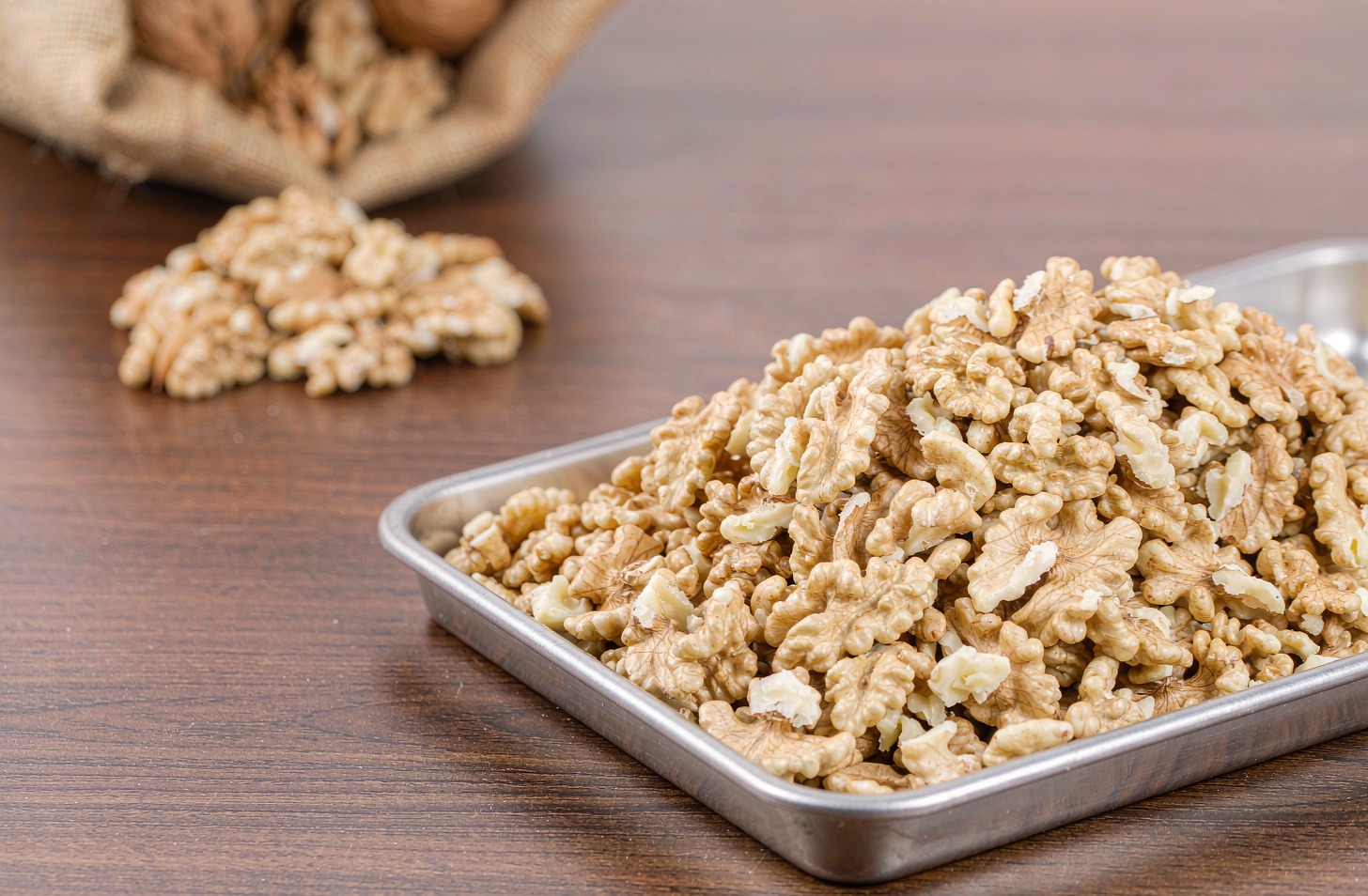
Walnut Pieces Bulk Supplier: Specs, Grades & Buying Guide
Buying walnut pieces in bulk is the smartest way for food manufacturers to cut raw-material costs without sacrificing walnut flavor — pieces deliver the same taste, oil content, and nutrition as whole kernels at a significantly lower price per kilogram. The key is knowing exactly what to specify: color grade, particle size, moisture, and defect limits. This guide explains what walnut pieces are, how they are graded and priced, which specifications matter most for baking, ice cream, and ingredient applications, and how to vet a reliable bulk walnut pieces supplier before you commit to a container.
If you are a bakery, ice cream plant, nut butter producer, or trading company sourcing walnut pieces and broken kernels from China for Europe, the Middle East, North America, or Asia, the framework below applies whether you are ordering a 1-ton trial or a full 20-ton container.
What Are Walnut Pieces?
Walnut pieces are fragments of walnut kernels generated during shelling, sorting, and handling of whole kernels. When walnut kernels are cracked and mechanically separated from the shell, the portion that does not come out as intact halves or quarters is further classified into pieces of defined particle size. Pieces are not a lower-quality product in the nutritional sense — they have the same oil content, protein, and flavor profile as whole kernels; they simply lack intact shape.
For buyers, the commercial distinction matters:
- Walnut halves — intact 50% kernels, sold for retail packs, in-shell presentation, and premium bakery decoration. See our bulk walnut kernels supplier guide for the whole-kernel side of the market.
- Walnut quarters and large pieces — 25% kernels and coarse fragments, used where visible walnut texture matters (granola, premium breads, nut mixes).
- Walnut pieces / broken kernels — smaller fragments passing through defined mesh screens, used for chopping, milling, extraction, and embedding into doughs and batters.
Because pieces come out of the same shelling lines as halves, a supplier’s overall kernel quality directly determines its piece quality. A factory that handles poor raw walnuts will produce pieces with high shell residue, rancid fragments, and inconsistent color — problems that no downstream cleaning can fully fix.
Why Food Manufacturers Buy Walnut Pieces
Across baking, snack, and ingredient manufacturing, pieces are usually the most cost-efficient walnut format. The reasons are practical:
- Lower price per kilogram — pieces typically trade at a meaningful discount to halves of the same color grade, because intact shape commands the premium, not the kernel itself;
- No chopping cost — if your process chops walnuts anyway (bakeries, ice cream inclusions, cereal bars), paying for halves only to break them adds cost with no benefit;
- Uniform distribution — controlled particle size mixes evenly into doughs, batters, and blends, giving consistent texture batch after batch;
- Better yield in processing — pieces flow through dosing and mixing equipment without the bridging issues that large halves sometimes cause;
- Same nutrition and flavor — walnut pieces retain the full omega-3 (ALA) content, protein, and characteristic taste of whole kernels.
The trade-off is shelf life and appearance: smaller particles expose more surface area to oxygen and light, so fresh processing, correct moisture, and proper packaging matter even more for pieces than for halves. This is exactly where supplier selection makes or breaks the product.
Walnut Pieces Specifications and Grades
Professional buyers define walnut pieces by four parameters: color grade, particle size, moisture, and defect limits. A complete specification sheet removes ambiguity and gives you an objective basis for inspection and claims.
Color Grades
Walnut kernels — including pieces — are graded by color, generally following the industry-standard classification:
| Grade | Color Description | Typical Use | Relative Price |
|---|---|---|---|
| Extra Light | Pale straw to light golden | Premium retail ingredients, white bakery products | Highest |
| Light | Light amber | Most food manufacturing, standard bakery | Medium-high |
| Light Amber | Light to medium brown | Baked goods, roasted applications, nut butters | Medium |
| Amber | Medium to dark brown | Extraction, walnut oil, dark bakery, flavoring | Lowest |
For most industrial applications, Light or Light Amber pieces deliver the best cost-performance balance. Amber-grade pieces are often the most economical choice for oil pressing and extraction, where color is irrelevant.
Particle Size
Size is controlled by sieving. Common commercial specifications include:
| Size Specification | Description | Typical Application |
|---|---|---|
| Large pieces / quarters | Retained on coarse screen; visible fragments | Granola, trail mixes, bread decoration |
| Standard pieces | Mixed fragments, roughly 3–10 mm | General bakery, ice cream, cereals |
| Small pieces | Fine fragments passing defined mesh | Nut butters, fillings, coatings |
| Walnut meal / flour | Milled fine powder | Extraction, baking mixes, flavor bases |
Always agree the mesh or screen definition in writing — “pieces” alone is not a specification, and size inconsistency between batches is one of the most common complaints in this trade.
Core Quality Parameters
- Moisture: typically ≤ 5% (commonly 3.5–4.5%) — higher moisture invites mold and shortens shelf life;
- Shell and foreign matter: pieces should be essentially free of shell fragments; workable contracts set a tight ppm or % limit;
- Defective kernels: limits on rancid, shriveled, insect-damaged, and dark fragments;
- Aflatoxin and microbiology: must comply with the destination market’s limits — the US FDA and EU regulations set strict thresholds for tree nuts;
- Free fatty acid (FFA) / peroxide value: indicators of freshness and oxidation, increasingly requested by industrial buyers.
How Walnut Pieces Are Produced and Sorted
Understanding the production flow helps you judge supplier capability. In a modern Chinese processing plant, the flow looks like this:
- Raw walnut intake and storage — in-shell walnuts from Inner Mongolia and neighboring growing regions are cleaned and stored in controlled conditions;
- Cracking and shelling — calibrated cracking machines break the shell without excessive kernel damage;
- Shell separation — airflow and gravity tables remove shell fragments;
- Grading — whole kernels are sorted out as halves/quarters; the remaining flow is sieved into defined piece sizes;
- Color sorting and hand-picking — automatic optical sorters plus manual inspection lines remove dark, rancid, and shell-contaminated fragments;
- Metal detection and packing — inline metal detectors, then vacuum-sealed or lined bags packed into cartons.
When vetting a supplier, ask which of these steps are in-house. Ouji International, for example, runs 2 processing plants with 6 automatic production lines in Hohhot, Inner Mongolia — meaning cracking, sorting, and grading are fully controlled under one quality system rather than outsourced. Since 2013, the company has exported walnuts, walnut kernels, and pieces to Europe, the US, Japan, Korea, the Middle East, North Africa, and South America. You can review the full product range at oujint.com.
Pricing: How Walnut Pieces Compare to Halves
Pieces are priced primarily as a function of the halves market. Key pricing logic every buyer should understand:
- Base correlation: piece prices move with the whole-kernel (halves) market; when halves rise, pieces follow;
- Grade spread: for the same color grade, pieces trade at a discount to halves — the discount widens for smaller particle sizes;
- Color premium: within pieces, Extra Light commands a clear premium over Light Amber and Amber;
- Season and crop cycle: Chinese walnut harvest runs roughly September–October; new-crop supply typically softens prices in Q4, while late-season stocks in Q2–Q3 can tighten;
- Volume and terms: full-container quantities on FOB terms get the best unit rates; LCL and mixed containers carry a premium.
A practical tactic for manufacturers: buy Light-grade pieces for applications where color is masked by baking or roasting, and reserve Extra Light halves only for surfaces where the walnut is visible in the final product.
Packaging, MOQ, and Shipping
Standard export packaging for bulk walnut pieces:
- Inner packaging: vacuum-sealed, food-grade PE/Nylon bags, typically 5 kg, 10 kg, or 12.5 kg — vacuum packing is strongly recommended for pieces due to their higher oxidation surface;
- Outer packaging: export-standard cartons, palletized and stretch-wrapped for container loading;
- Container loading: roughly 18–20 tons in a 20-ft container, 25–28 tons in a 40-ft container depending on carton configuration;
- MOQ: typically 1 ton for trial orders; full containers for contract pricing;
- Storage & shelf life: cool, dry, dark storage; 9–12 months at ≤ 20°C when vacuum-packed; refrigeration extends stability for high-oil applications.
Confirm the packing spec in your contract — switching from vacuum to plain-lined bags is one way low-quality suppliers cut cost invisibly.
How to Vet a Bulk Walnut Pieces Supplier
Use this five-point checklist before placing a bulk order:
- Verify certifications. Minimum: HACCP and ISO 22000 food-safety management; ISO 9001 for quality; HALAL/Kosher where your market requires them. Check the certificate scope covers walnut processing, not just trading. Learn more about the ISO 22000 standard from the International Organization for Standardization.
- Request a specification sheet and counter-sample. Never buy pieces against a verbal description. Ask the supplier to seal a reference sample matching your contract spec.
- Confirm in-house processing. A supplier who controls shelling, sorting, and grading can guarantee piece size consistency; a trader assembling from many small workshops cannot.
- Test with a trial order. Run 500 kg–1 ton through your own production line before committing to container volume.
- Use third-party pre-shipment inspection. SGS, Bureau Veritas, or similar agencies can verify moisture, defects, size distribution, and packaging before loading — a few hundred dollars that protects a five-figure order.
Red flags that should stop a deal: refusal to provide certificates with validity dates, no vacuum packing option, prices far below the prevailing halves-linked market, and unwillingness to accept third-party inspection.
FAQ
What is the difference between walnut pieces and walnut halves?
Halves are intact 50% kernels; pieces are fragments generated during shelling and sorting. Flavor and nutrition are the same — pieces just lack intact shape and sell at a lower price per kilogram.
What color grade of walnut pieces should I buy for baking?
Light or Light Amber pieces are the standard choice for baking. Color darkens during baking anyway, so paying for Extra Light pieces rarely pays off in baked applications.
What moisture content should bulk walnut pieces have?
Typically 3.5–4.5%, with a contractual maximum of 5%. Lower moisture means longer shelf life and lower mold risk during ocean shipping.
How are walnut pieces packaged for export?
Vacuum-sealed food-grade bags (5–12.5 kg) inside export cartons, palletized for container loading. Vacuum packing is essential for pieces because their higher surface area accelerates oxidation.
What documents do I need to import walnut pieces from China?
Commercial invoice, packing list, bill of lading, certificate of origin, phytosanitary certificate, plus market-specific items such as HALAL/Kosher certificates and aflatoxin test reports where required.
Conclusion
Walnut pieces are the workhorse format of industrial walnut use: same kernel, same flavor, lower cost. The buying decision hinges on specification discipline — color grade, particle size, moisture, and defect limits put in writing — and on choosing a supplier with real in-house processing, current certifications, and a genuine export track record.
If you are sourcing bulk walnut pieces, kernels, or in-shell walnuts from China, contact Ouji International for current specifications, samples, and export pricing. With two processing plants and six automatic lines in Inner Mongolia, we supply food manufacturers across Europe, the Middle East, North America, and Asia — and we will help you match the right piece grade to your application and budget.