

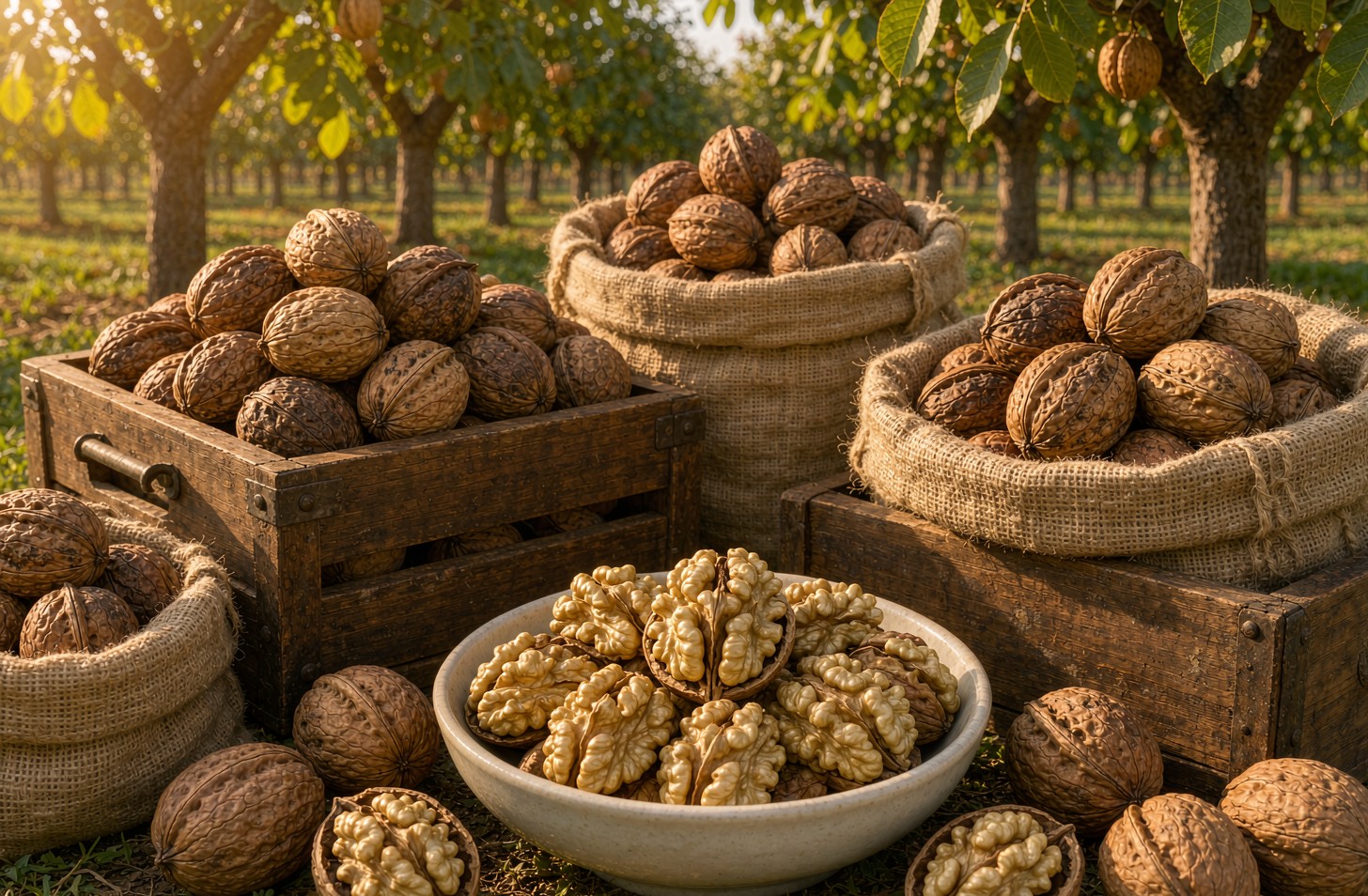
Xinjiang walnuts are widely considered China’s premium walnut origin: thin “paper shells,” kernel yields above 50%, and a naturally sweet, mild flavor that suits both in-shell retail and industrial kernel processing. A reliable Xinjiang walnut exporter is therefore not just a trading company — it is a partner who sources directly from Xinjiang orchards, grades and processes the nuts to contract specification, and handles export documentation for markets in Europe, the Middle East, Japan, Korea, and beyond. This guide explains what makes Xinjiang walnuts distinctive, which varieties and specifications to ask for, and how to vet an exporter before you commit to a container.
Ouji International, based in Hohhot, Inner Mongolia, has been sourcing and exporting Chinese walnuts and walnut kernels since 2013. We run two processing plants with six automatic lines — including shelling, color sorting, and metal detection — and ship walnut products to buyers across Europe, the Middle East, North Africa, East Asia, and South America. The guidance below reflects the questions we answer for buyers every week.
Why Xinjiang Is China’s Leading Walnut Origin
Xinjiang, in China’s far northwest, is the country’s largest walnut-producing region, accounting for roughly half of national output. The region’s conditions are unusually favorable for walnut quality:
- Long sunshine hours and large day-night temperature differences — these concentrate oils and sugars, producing the sweet, mild taste Xinjiang kernels are known for;
- Arid climate — low humidity during harvest and drying reduces mold and aflatoxin risk, a critical advantage for EU and Gulf buyers;
- Thin “paper-shell” varieties — shells crack easily by hand, which raises kernel yield and reduces shell fragments in kernel lots;
- Scale and infrastructure — mature orchards around Aksu, Hotan, and Kashgar support consistent large volumes season after season.
Walnuts are also recognized by nutrition authorities as a nutrient-dense nut rich in omega-3 fatty acids — see the general nutritional profile summarized by FAO food-safety resources — which supports strong retail demand in health-focused markets.
Main Xinjiang Walnut Varieties for Export
| Variety | Shell | Kernel Yield | Typical Export Use |
|---|---|---|---|
| 185 (paper-shell) | Very thin, cracks by hand | 53–56% | In-shell retail, premium kernel production |
| 33 (paper-shell) | Thin, uniform size | 50–53% | In-shell export, halves production |
| 81 | Thin-medium | 48–52% | Kernel processing, mixed lots |
| Xin 2 / local seedlings | Medium | 45–50% | Oil crushing, industrial buyers |
For most buyers, variety 185 in-shell and its kernels are the benchmark export product: large size, light color, and easy cracking. Always confirm the variety, crop year, and growing region on the contract — “Chinese walnut” without an origin statement invites grade substitution.
In-Shell Walnuts vs Walnut Kernels: What to Order
Xinjiang walnuts export in two basic forms, and your application should decide which:
- In-shell walnuts — for retail packs and roasting programs. Sold by size (typically 28–32 mm+ for premium grades) and by shell appearance. Choose variety 185 or 33 for hand-crack quality.
- Walnut kernels — for bakeries, confectionery, cereal and snack manufacturers. Graded by color (light / light amber / amber), integrity (halves, quarters, pieces), and defect tolerance.
A reference specification table for export kernels:
| Parameter | Light Halves (Premium) | Standard Mixed |
|---|---|---|
| Color | Light, natural | Light to light amber |
| Integrity | ≥90% halves | Halves + quarters + pieces |
| Moisture | ≤5% | ≤5% |
| Kernel yield of raw nut | ≥52% (variety 185) | ≥48% |
| Defects & foreign matter | ≤1% | ≤2% |
| Aflatoxin | Per destination regulation (EU limits apply for European ports) | |
| Free fatty acids / rancidity | Within contract limits at destination | Within contract limits |
How to Vet a Xinjiang Walnut Exporter
1. Traceable Sourcing from the Orchard
A genuine Xinjiang walnut exporter can tell you which prefecture (Aksu, Hotan, Kashgar) the current lot came from, the harvest window (September–October), and the crop year. If a supplier cannot link a lot number to an orchard region, you are likely dealing with a reseller buying spot market goods — quality will drift between containers.
2. Processing Capability, Not Just Trading
Kernels are only as good as the line that produced them. Verify the exporter has, or directly controls: cracking and shelling equipment, optical color sorters, manual quality-selection tables, metal detection, and calibrated drying. Ouji International, for example, operates two processing plants with six automatic lines so grading and packing stay under our own QC system.
3. Food-Safety Certification and Lab Testing
Ask for a HACCP or ISO 22000 certificate (the ISO 22000 standard is described on iso.org), recent third-party lab reports covering moisture, aflatoxin, and pesticide residues, and a phytosanitary certificate for each shipment. For EU-bound kernels, confirm the exporter understands the aflatoxin sampling regime for tree nuts.
4. Export Documentation Fluency
Commercial invoice, packing list, bill of lading, certificate of origin, phytosanitary certificate, and — where required — health certificates and fumigation records. An experienced exporter pre-checks destination-specific paperwork before loading, not after problems appear at customs.
5. Sample Discipline and Pre-Shipment Inspection
Insist on: a pre-shipment sample drawn from the actual production lot (not a marketing sample), the right to third-party inspection (SGS or similar) before container sealing, and photo documentation of stuffing. These three controls eliminate most quality disputes before they start.
Pricing, MOQ and Loading Basics
- Harvest window pricing: new-crop walnuts (October–December) offer the best combination of price and freshness; prices typically firm up as stocks age through the year.
- MOQ: most exporters quote from one 20GP container; trial orders of 1–5 tonnes can often be arranged for qualified buyers.
- Loading: a 20GP carries roughly 16–18 tonnes of in-shell walnuts in 25/50 kg bags, or 14–15 tonnes palletized; kernel cartons load 12–14 tonnes. Kernel shipments should use food-grade liners and, for long routes, vacuum or nitrogen-flushed inner bags.
- Terms: FOB Chinese ports (Tianjin/Qingdao) is standard; CIF is quoted on request with confirmed freight.
For kernel-specific pricing and grading detail, see our bulk walnut kernels supplier guide; for the broader supplier-selection process, our China walnut sourcing overview covers the full vetting workflow.
Common Buyer Mistakes with Xinjiang Walnuts
- Buying on price alone without variety confirmation — thin-shell 185 commands a premium for good reason; substituting medium-shell lots halves the eating experience.
- Ignoring color grades on kernels — “light halves” and “mixed” can differ by 10–15% in price; always grade by photo-reference samples.
- Skipping aflatoxin testing for EU ports — this is the most common cause of border rejections for tree nuts.
- Under-specifying packaging — unlined bags on long ocean routes expose kernels to humidity and odor; see our packaging recommendations before contracting.
FAQ
What makes Xinjiang walnuts better than other Chinese origins?
Xinjiang’s arid climate, long sunshine hours, and thin-shell varieties produce higher kernel yields (50%+), a sweeter flavor, and lower mold risk during drying — the key reasons premium buyers specify Xinjiang origin.
Which Xinjiang walnut variety should I import?
Variety 185 is the export benchmark: very thin shell, 53–56% kernel yield, and large light-colored kernels. Variety 33 is a strong alternative for in-shell retail programs.
What is the MOQ for importing Xinjiang walnuts?
Standard quotes start at one 20GP container (about 16–18 tonnes in-shell); many exporters, including Ouji International, can arrange 1–5 tonne trial orders for qualified buyers.
When is the best time to buy Xinjiang walnuts?
Harvest runs September–October, and October–December offers the best prices and freshest crop. Later in the season, prices firm and storage time increases.
How do I verify a Xinjiang walnut exporter is genuine?
Ask for lot-level origin traceability, HACCP/ISO 22000 certification, third-party lab reports, and a pre-shipment sample from the actual production lot — then confirm with a factory audit or third-party inspection.
Conclusion
Xinjiang walnuts offer a rare combination of premium eating quality, high kernel yield, and dependable volume — but capturing that value depends on choosing an exporter with real origin sourcing and processing control. Define your variety, grade, and packaging specification up front, and work with a partner who can trace every lot back to the orchard. Contact Ouji International for current Xinjiang walnut and kernel availability, samples, and an export quotation.