

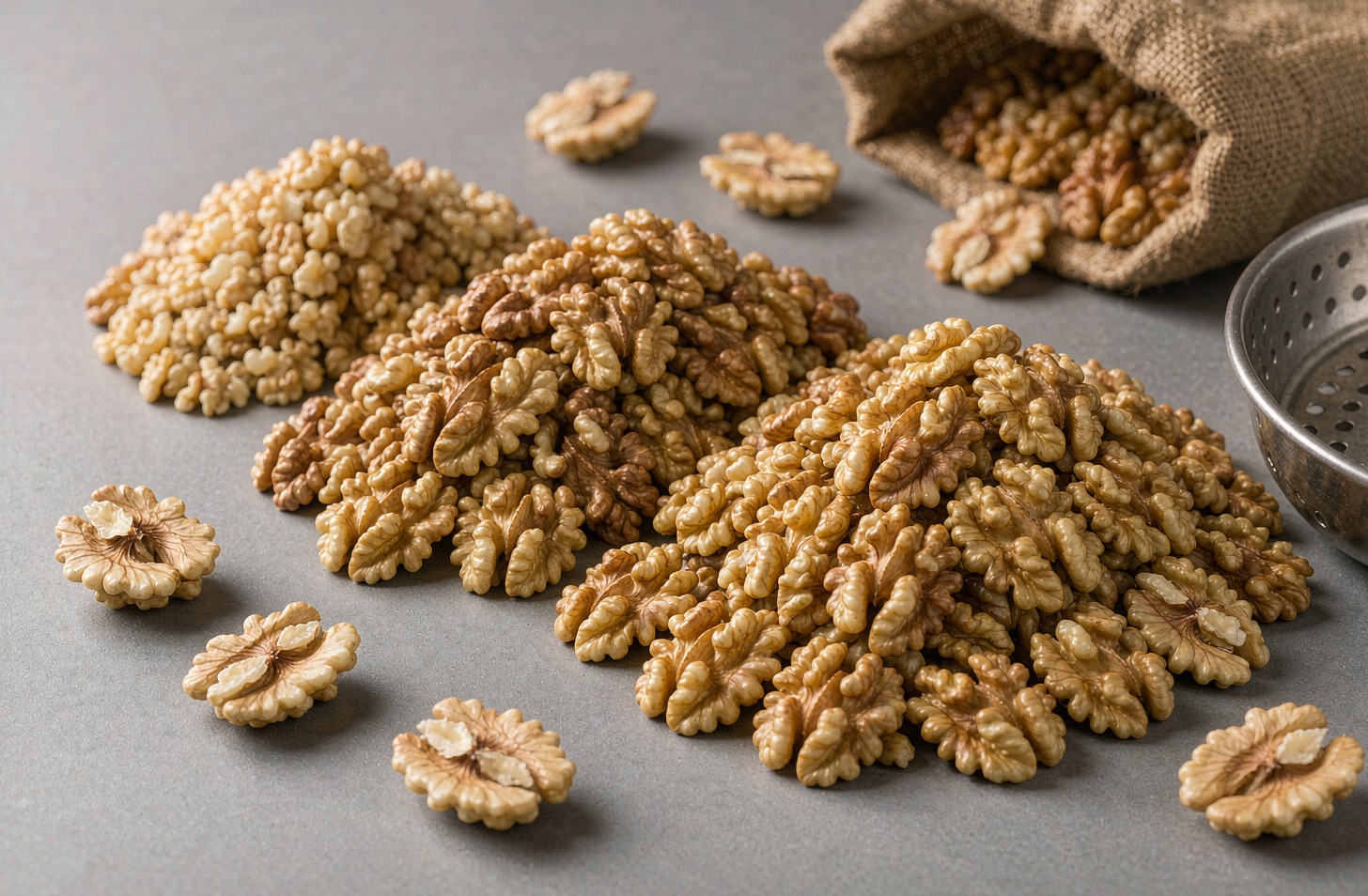
Walnut Quality Grade Guide: Grades, Defects & Inspection
Walnut quality grades are commercial shorthand for three measurable things: kernel colour, half integrity, and freedom from defects. When a buyer writes “Light Amber halves, 95% whole, moisture max 5%, aflatoxin within EU limits”, that single line encodes most of the price. This walnut quality grade guide explains how grades are defined across the USDA, UN/ECE and Chinese systems, which parameters move money, how grading is executed inside a Chinese plant, and how to write a specification that still means what you agreed by the time the container is loaded.
What Walnut Quality Grades Actually Measure
A grade is not one number. Every walnut specification rests on three independent axes, and confusing them is the most common source of claims:
- Colour — how light or dark the kernel skin is, from pale Extra Light through Light Amber to dark Amber. It is the strongest price driver, because retail packs and premium bakery sell on appearance.
- Structural integrity — the share of intact halves versus quarters, pieces and broken kernels. Separate from size: a large kernel can still be a broken one.
- Defect and safety limits — foreign matter, shell fragments, shrivelled or mouldy kernels, insect damage, moisture, free fatty acids, peroxide value and aflatoxin. These are the parameters that stop shipments at the border.
Size (kernels per ounce, or millimetre screens) is a fourth, purely descriptive attribute, often sold alongside a grade — never as a substitute for it.
The Three Grade Systems a Buyer Will Meet
No single global standard governs walnuts. Most contracts blend elements of three systems, so it pays to know what each covers.
| System | Scope | What it regulates | Practical use for importers |
|---|---|---|---|
| USDA Grades of Shelled Walnuts (US No. 1, US No. 2) | United States, widely referenced worldwide | Colour classes, defect tolerances, uniformity of size, moisture | Useful shared vocabulary when a buyer or a US customer already speaks in “US No. 1 halves” |
| UN/ECE DDP-14 Walnut Kernels | Pan-European trade standard | Colour classes, defect tolerances, sizing, marking of packages | The reference most EU importers expect in a contract annex |
| Chinese GB food safety standards (e.g. GB 19300 for nuts and seeds) | China domestic production and export baseline | Contaminants, hygiene, labelling, aflatoxin and moisture limits | The floor your Chinese supplier must meet before your own market requirements are layered on top |
The practical consequence: a Chinese factory can call a lot “grade A” internally while it fails a European buyer’s colour class. Experienced importers therefore never buy on a grade name alone — they buy on a written parameter table with the grade name as a label on top.
Colour Grades: The Biggest Single Price Driver
Kernel colour reflects how carefully the nuts were dried, shelled and stored — heat, moisture and delay between cracking and cold storage all darken the skin. Colour cannot be corrected later, so sorting for it is where a processor spends real labour, and where a buyer pays.
| Colour class | Visual description | Typical application | Relative price |
|---|---|---|---|
| Extra Light | Very pale, near-ivory kernel skin, uniform | Premium retail packs, gift boxes, high-end confectionery | Highest |
| Light | Pale with slight warm tone, still very uniform | Retail packs, chocolate and praline inclusions | High |
| Light Amber | Light golden-brown, the workhorse class | Bakery, ice cream, granola, nut mixes | Baseline |
| Amber | Noticeably darker golden-brown | Industrial use, paste, fillings, chopped lines | Discount |
| Red / dark | Deep brown to reddish skin | Extraction, paste, products where colour is hidden | Lowest |
Insist that colour is assessed under daylight-equivalent lighting, not a warm factory lamp. And remember that optical sorters hold a class consistently but cannot rescue a lot that entered the line too moist.
Half Integrity and Size: The Second Price Axis
Walnut kernels break during shelling. The proportion that survives as intact halves determines whether a lot sells as a premium retail product or as an ingredient. Export specifications are normally written as a ratio:
| Commercial format | Half integrity | Typical buyer |
|---|---|---|
| Halves 95/5 | Minimum 95% intact halves | Retail packers, premium confectionery |
| Halves 90/10 | Minimum 90% intact halves | Retail and food service |
| Quarters / broken halves | Predominantly quarter-kernels | Bakery topping, mixes |
| Pieces (graded by mesh) | Defined particle size bands | Ice cream, fillings, paste, baking |
Size in the half trade is expressed as kernels per ounce or as a screen range in millimetres. Both are defensible; what is not is a contract naming a size without naming the test method. See our walnut halves supplier guide for half-specific specifications, and the walnut pieces guide if your application can absorb broken kernels at lower cost.
Defect Tolerances: What Separates a No. 1 from a No. 2
Defect limits are where claims are won and lost: hardest to verify from a photograph, easiest to check on arrival. The tolerances below are commonly used in Chinese export contracts — a drafting template, not a standard.
| Parameter | Premium spec | Standard spec | Why it matters |
|---|---|---|---|
| Foreign matter (shell, husk, stones) | Max 0.05% | Max 0.10% | Customer complaints, rejected at retail level |
| Shrivelled / immature kernels | Max 1% | Max 2% | Reduces yield, tastes flat |
| Mouldy kernels | Max 0.2% | Max 0.5% | Direct aflatoxin risk indicator |
| Insect damage | Max 0.5% | Max 1% | Quarantine and retail quality |
| Moisture | Max 4.5% | Max 5.0% | Mould, rancidity, weight loss |
| Broken kernels in a halves lot | Max 5% | Max 10% | Direct grade and price impact |
Two drafting rules save money. Specify whether tolerances are by weight or by count, which produce different results on the same lot — and specify the sampling plan: bags drawn, sample reduction, laboratory method.
Safety and Chemical Parameters to Contract Explicitly
Food safety limits are the one part of a grade that is not negotiable, because the destination market sets them. For walnuts entering the EU, Regulation (EU) 2023/915 (which replaced 1881/2006) sets 2 µg/kg for aflatoxin B1 and 4 µg/kg for total aflatoxins in nuts sorted or physically treated before consumption. Write the limit into the contract together with the test method — “within EU limits” means nothing at the port if the shipment was never tested.
Parameters worth putting on paper:
- Moisture — 3.5–5.0% depending on grade and destination climate; above 5% the risk of mould during a 30-day ocean transit rises sharply.
- Free fatty acids (FFA) — typically max 0.5% as oleic acid; a rising FFA number is the first measurable sign of rancidity.
- Peroxide value — commonly max 3 meq O₂/kg at shipment, the oxidation marker that matters most for pieces.
- Aflatoxin B1 / total — as above, with an accredited third-party report per lot.
- Heavy metals and pesticide residues — per destination MRLs, tested on a risk basis.
Certification sits on top of these limits: HACCP-based food safety management (aligned with Codex Alimentarius and ISO 22000) plus, for many markets, HALAL and Kosher are baseline expectations. Ask for the certificate scope, not just the certificate.
How Grading Actually Works Inside a Chinese Walnut Plant
Grade consistency is a process outcome. At a plant handling export volumes, the sequence normally runs like this:
- Receiving and moisture check — incoming lots are tested before unloading; wet lots are diverted, never blended into export stock.
- Cracking and shell separation — mechanical cracking, then air separation and density tables to strip shell and pellicle.
- Size screening — vibrating screens divide kernels into size bands, separating halves from quarters and pieces.
- Colour sorting — optical sorters eject dark, discoloured and foreign kernels against a calibrated colour class.
- Hand picking — manual lines catch what machines cannot: residual shell, mould, insect damage and off-colour kernels.
- Metal detection and, where specified, X-ray — the final barrier before packing, with documented hourly checks.
- Laboratory release and retained samples — moisture, FFA and aflatoxin results release the lot, and a retained sample per batch lets any later dispute be tested against the original material.
Ouji International runs two processing plants with six automatic production lines in Hohhot, Inner Mongolia, and has exported walnuts, walnut kernels, pecans, cashews, pumpkin seeds and sunflower seeds since 2013. The grading discipline above is what a buyer actually pays for when two quotes differ by a few percent.
Writing a Grade Specification That Survives the Container
A specification that cannot be inspected is not a specification. The minimum viable grade annex contains five elements:
- Product and format — e.g. “walnut kernels, halves, Light Amber”.
- Parameter table — colour class, half integrity, size, moisture, defect limits, aflatoxin, FFA, peroxide.
- Methods — the standard or in-house method used per parameter.
- Sampling and acceptance — sample size, AQL or acceptance number, who inspects and when.
- Remedy — what happens if a parameter fails: price adjustment, re-sorting, replacement or rejection, and who pays freight.
Where the shipment value justifies it, appoint a third-party inspector for a pre-shipment check — and require inspection after final packing, not on production-line samples, which are always better than the lot average.
Grade Versus Price: Where the Money Actually Goes
Two quotations for “walnut kernels” can differ by 20% and both be honest. The gap normally sits in four cost centres:
| Cost driver | Effect on price | What a buyer can negotiate |
|---|---|---|
| Colour class | Extra Light carries a clear premium over Light Amber | Match the class to the application; baking rarely needs Extra Light |
| Half integrity | Each 5% step in whole halves raises cost noticeably | Accept 90/10 instead of 95/5 where the product is chopped later |
| Sorting labour | Tighter defect limits mean more hand-picking hours | Relax limits that do not affect your process |
| Origin and crop year | New-crop and specific origins command more | Buy the crop year your shelf life requires, not the newest |
Cutting cost on moisture or aflatoxin testing is a deferred loss, not a saving: border rejection costs multiples of the discount.
Four Costly Mistakes That Importers Make
- Buying from a photograph. Colour photos are edited, lit and selective. Ask for a physical sample couriered from the actual lot.
- Ignoring moisture because the sample felt dry. Moisture is invisible in a sealed bag until mould appears three weeks into transit.
- No retained sample clause. Without one, an arrival dispute becomes an argument about opinions instead of a lab test.
- Assuming certification equals control. A HALAL certificate does not tell you whether the colour sorter was calibrated this week.
Frequently Asked Questions
What is the highest walnut kernel grade?
Extra Light halves with minimum 95% integrity and defects at the tight end of the table above. In the USDA system the top class is US No. 1; under UN/ECE DDP-14 the lightest colour classes rate highest. Neither name guarantees quality — the parameter table does.
Is “US No. 1” the same as “Light Amber”?
No. US No. 1 is a grade combining colour, defect and uniformity requirements and can be met in several colour classes. A contract should state both: “US No. 1, Light Amber, halves 95/5”.
What moisture content should walnut kernels have?
Typically 3.5–4.5% for premium kernels, with a contractual maximum of 5.0%. More moisture accelerates mould and rancidity, especially in vacuum-packed material shipped through tropical routes.
What is the EU aflatoxin limit for walnuts?
For nuts subject to sorting or physical treatment before consumption, 2 µg/kg for aflatoxin B1 and 4 µg/kg for total aflatoxins, per Regulation (EU) 2023/915. Always contract the limit together with an accredited test report per lot.
How many broken kernels are acceptable in a halves lot?
Premium halves are normally sold at 95/5 (max 5% broken), standard export halves at 90/10. Anything looser should be priced and labelled as quarters or pieces, not halves.
Can I get a pre-shipment sample before the container leaves?
Yes — a reputable exporter couriers a sample drawn from the packed lot and holds a retained sample from the same batch. Insist that sampling happens after final packing and that the batch code appears on the shipping documents.
Conclusion: Grade Is a Written Promise, Not a Label
Walnut quality grades only work when every parameter behind the name is measurable, testable and written down. Colour class, half integrity, defect tolerances, moisture and aflatoxin limits decide whether a container arrives as profitable raw material or as a claim. Get them into the contract, agree the sampling method, and buy from a processor whose grading line you can inspect.
If you are sourcing walnut kernels, halves, pieces or in-shell walnuts from China, Ouji International can supply current-crop specifications, grade samples and export pricing, backed by two processing plants and six automatic lines in Inner Mongolia and shipments to Europe, the Middle East, North Africa, Japan, Korea and South America. Send your target specification and we will tell you which grade your budget actually buys.