

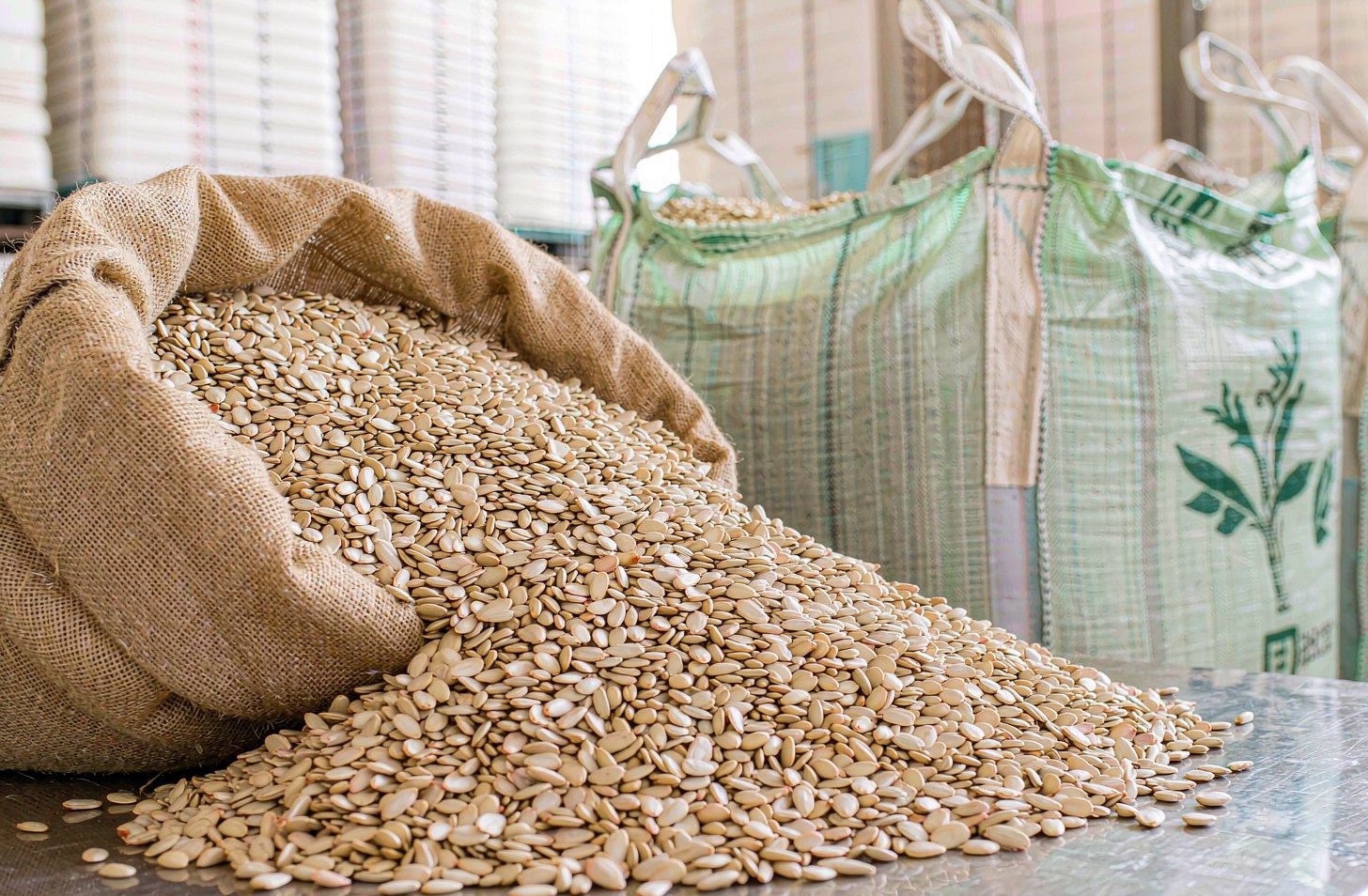
Bulk Sunflower Kernels Supplier: A Complete Volume Guide
A bulk sunflower kernels supplier is a processor that ships hulled sunflower kernels in full-container or multi-container volumes — typically from 20 metric tonnes (one 20ft FCL) up to 500+ tonnes per year on contract. What separates a real bulk supplier from a trader is demonstrated daily output: the ability to repeat the same grade, moisture and purity across consecutive lots, month after month. This guide covers container loading math, volume tiers, packaging formats, capacity checks and contract terms, so you can size an order and a supplier before you negotiate price.
Most first-time importers focus entirely on the FOB number and only later discover that the hard part of bulk buying is consistency at volume. A supplier who can deliver 5 tonnes of beautiful 363 kernels for a sample is not automatically able to deliver 12 containers of the same material across a season. Below is how to tell the difference — and how to structure an order that protects you.
What “Bulk” Means in the Sunflower Kernel Trade
In B2B trade, bulk refers to industrial lot sizes and industrial packaging, not to a lower grade of product. A bulk shipment is normally:
- Hulled kernels — sunflower seeds with the shell removed, food-grade, unroasted unless you specify otherwise
- Packed in 25 kg or 50 kg bags, 1,000 kg big bags, or bulk totes with inner liners
- Shipped as FCL — full container load, usually 20ft or 40ft high cube
- Documented per lot — with lot numbers, production dates, moisture and purity data, and a certificate of analysis
The three grades that dominate bulk trade are 5009, 361 and 363. They differ mainly in size and typical end use: 5009 is the larger confectionery grade used for premium snacking and bakery topping, 361 is a mid-size grade widely used for roasting and retail packing, and 363 is a smaller, high-count grade favoured by bakeries, granola producers and confectionery manufacturers. Specification tables for each grade are covered in our wholesale sunflower kernels buyer guide; this article stays focused on how volume changes the way you buy.
Volume Tiers: What Each Order Size Really Buys You
Supplier behaviour changes with order size, so it helps to know which tier you are actually in. The table below reflects how Chinese processors typically treat each volume band.
| Order Tier | Typical Volume | Packing | What You Get | Typical Lead Time |
|---|---|---|---|---|
| Trial / sample lot | 100 kg – 1 t | 25 kg bags, air or LCL | Spec confirmation, no price advantage | 5–10 days |
| LCL / part container | 3 – 12 t | 25 kg bags on pallets | Higher per-kg freight, co-loaded cargo | 10–18 days |
| Single FCL (20ft) | 18 – 20 t | 25 kg bags or 1 t big bags | Best entry point for real bulk pricing | 12–20 days |
| Single FCL (40ft HC) | 24 – 26 t | 25 kg bags, big bags | Lowest freight per tonne | 15–22 days |
| Annual / seasonal contract | 100 – 1,000+ t | Buyer-specified | Locked specs, priority production slots, staged shipments | Per shipment schedule |
Two practical rules follow from this table. First, crossing from LCL to a 20ft FCL is the single biggest cost improvement most buyers ever make, because ocean freight is charged largely per container rather than per tonne. Second, crossing from spot buying to an annual programme is the biggest risk reduction, because it converts a price negotiation into a supply agreement.
Container Loading Math for Bulk Kernels
Loading capacity is driven by bag weight, kernel bulk density and the destination market’s road weight limits. Hulled sunflower kernels are light — roughly 0.35–0.45 kg per litre — so containers cube out before they weigh out, which means packaging efficiency directly determines your landed cost per kilogram.
| Packaging | 20ft FCL | 40ft HC | Best For |
|---|---|---|---|
| 25 kg PP or paper bags | 18 – 19 t (720–760 bags) | 24 – 25 t (960–1,000 bags) | Roasters, repackers, distributors |
| 50 kg bags | 18 – 19 t (360–380 bags) | 24 – 25 t (480–500 bags) | Industrial processors, further processing |
| 1,000 kg big bags (FIBC) | 16 – 18 t (16–18 bags) | 20 – 22 t (20–22 bags) | High-volume plants with silo or hopper intake |
| Vacuum or nitrogen-flushed retail packs | 12 – 15 t | 18 – 20 t | Private-label brands needing shelf life |
Note the trade-off: big bags cut handling cost and labour at your plant, but reduce payload per container by roughly 10%. If your factory can take FIBC discharge, the labour saving usually wins; if you are a distributor selling 25 kg units onward, bag packing is the correct choice even though it fills the container slightly better.
What a Bulk Supplier Must Prove About Capacity
Capacity is the one claim that is easy to make and hard to verify remotely. Ask for evidence in this order:
- Daily hulling and sorting output — expressed in tonnes per day, per line, not annual marketing figures. A plant running six automatic lines should be able to state output per line and per shift.
- Number of production lines and their function — dehulling, gravity separation, color sorting, metal detection and grading are separate stages; ask which stages sit on which line.
- Raw material sourcing region — Inner Mongolia and neighbouring northern regions supply China’s best confectionery-grade sunflower seed, with harvest arriving from roughly September to November. A supplier in the growing region controls seed quality before it controls kernel quality.
- Storage capability — a bulk supplier must hold raw seed and finished kernels across the off-season. Insufficient warehouse capacity shows up as delayed shipments in Q2 and Q3.
- Photos and video of your actual lot — dated, with lot numbers visible on bags, not stock imagery from a brochure.
- Third-party audit willingness — a serious processor will accept SGS, Bureau Veritas or Intertek inspection at loading, and will not resist a pre-shipment sampling visit.
Quality Control on Large Lots
Sampling discipline is what separates industrial supply from trading. On a 25-tonne lot, a single handful proves nothing. Require:
- AQL-based sampling across bags, not one composite sample from the top of the stack
- Lot-level traceability — every bag marked with lot number, production date and grade
- Moisture ≤ 8% at loading, verified by a meter reading recorded in the shipping documents
- Purity ≥ 99.5% for food-grade kernels, with broken and defect limits agreed in writing
- Metal detection and color sorting on 100% of output, with the reject rate logged
- Aflatoxin and pesticide residue testing to the destination market’s limits — EU MRLs are stricter than most, so confirm the target market before the lot is produced
Certification is the baseline, not the differentiator. HACCP-based food safety management and ISO 22000 are the internationally recognised frameworks, while HALAL and Kosher certificates are effectively mandatory for Middle Eastern, North African and Israeli buyers. Ask for the certificate scope and expiry date, and check that the certified site is the site that will produce your lot.
Packaging Formats That Work at Volume
Packaging decisions made at the quotation stage are expensive to reverse later. Bulk buyers generally choose from four formats:
| Format | Typical Use | Watch Out For |
|---|---|---|
| 25 kg multiwall paper or PP/PE bags | Distribution, repacking, roasting | Bag strength in humid climates; specify laminated liner |
| 50 kg woven PP bags | Industrial processing | Manual handling limits in some markets |
| 1,000 kg FIBC big bags | Plant intake, silo feeding | Requires forklift and discharge equipment on site |
| Vacuum / nitrogen-flushed packs | Retail-ready, extended shelf life | Higher unit cost, lower payload per container |
Whatever the format, specify in the contract: bag weight tolerance, printing requirements, palletisation and fumigation status of any wooden pallets (ISPM 15), and whether inner liners are food-grade virgin material.
Contract Structure: Spot Purchase vs Annual Programme
For repeat volumes, an annual or seasonal programme usually beats repeated spot buying. A workable structure looks like this:
- Fixed specification annex — grade, size count, moisture, purity, defect limits, packing, all locked in writing
- Staggered shipment schedule — for example four containers per quarter, with the right to adjust timing by 30 days
- Quantity tolerance of ±5–10% to absorb crop and vessel variability
- Price mechanism — either a fixed price per shipment window or a formula tied to raw seed cost plus a fixed processing margin
- Incoterms and payment — FOB is most common for experienced importers; CIF/CFR suits buyers who prefer not to manage freight; 30% deposit with 70% against copy of B/L is standard, with an irrevocable L/C at sight for larger contracts
- Quality remedy clause — a defined claims process with sampling at destination and a deadline for notification
Logistics: Ports, Transit and Seasonality
Northern Chinese kernel exports typically move through Tianjin or Qingdao, both of which offer frequent sailings to the Middle East, Europe, North Africa and the Americas. Indicative ocean transit times, port to port, are:
| Destination | Transit (days) |
|---|---|
| Jebel Ali, UAE | 20 – 26 |
| Alexandria, Egypt | 28 – 34 |
| Rotterdam, Netherlands | 30 – 38 |
| Busan, South Korea / Yokohama, Japan | 3 – 7 |
| New York, USA | 32 – 40 |
| Santos, Brazil | 35 – 45 |
Plan around the crop calendar. New-crop seed arrives from September onward, which is when specifications, colour and pricing are most favourable. Demand from European and Middle Eastern buyers typically peaks between October and February. Buyers who place volume contracts before the peak avoid both price escalation and production-queue delays; buyers who order in June are competing for limited off-season inventory.
Red Flags When Vetting a Bulk Supplier
- Cannot state daily output per line, only annual tonnage
- Quotes a price before asking for your grade, size count and destination market
- Sends the same stock photos to every enquiry, with no lot numbers or dates
- Refuses third-party pre-shipment inspection or resists AQL sampling
- Offers a price far below the market without explaining the grade difference
- Has a certificate of analysis that is not traceable to a lot number
- Pushes L/C at sight only, or demands full prepayment on a first bulk order
Why Buyers Source Bulk Kernels from Ouji International
Ouji International has been exporting nuts and seeds from Hohhot, Inner Mongolia since 2013. We operate two processing facilities with six automatic production lines, covering dehulling, gravity separation, color sorting, metal detection and size grading — which is what allows us to hold a specification steady across consecutive containers rather than across a single sample.
Our bulk range covers sunflower kernels and seeds, pumpkin seeds and kernels, walnut kernels, pecan kernels and cashew kernels, supplied to importers, roasters, bakeries and private-label brands across Europe, North America, Japan, South Korea, the Middle East, North Africa and South America. If you are comparing processors rather than traders, our guide to China sunflower kernels suppliers explains the vetting questions we expect from serious buyers.
Explore the full range on our products page, or send your specification and target volume for a quotation with packing options and loading plan.
Conclusion: Fix Specification and Capacity Before You Discuss Price
Bulk sunflower kernel buying rewards preparation. Decide your grade and size count, calculate how many tonnes fit your chosen packaging, confirm the destination market’s residue limits, and ask for daily output figures before you ask for a price. A supplier who can answer those questions precisely is a supplier who can repeat a shipment — and repeatability, not the first quotation, is what protects your production line and your reputation with your own customers.
Ready to price a bulk programme? Send Ouji International your grade, volume per shipment and destination port through our contact page and we will return a specification-matched quotation with a container loading plan.
Frequently Asked Questions
What is the minimum order quantity for bulk sunflower kernels?
Most Chinese processors quote from one 20ft container, around 18–19 tonnes in 25 kg bags. Smaller trial lots of 1–3 tonnes are usually possible but carry higher freight and handling costs per kilogram.
How many tonnes of sunflower kernels fit in a 40ft container?
Approximately 24–25 tonnes in 25 kg bags, and 20–22 tonnes in 1,000 kg big bags. Kernels are light, so containers fill by volume before they reach weight limits.
What is the difference between sunflower seeds and sunflower kernels?
Seeds are the whole product with the shell intact, used for roasting and snacking in-shell. Kernels are the hulled, edible meat inside, used in bakery, confectionery, granola and as an ingredient.
Which grade should a bulk buyer choose: 5009, 361 or 363?
5009 is the largest grade and suits premium snacking and topping. 361 is a mid-size all-purpose grade for roasting and retail packing. 363 is smaller and high-count, preferred for bakery and confectionery use where kernel size matters less than count and cost.
What moisture content should bulk sunflower kernels have?
Generally 8% or lower at loading. Higher moisture accelerates mould and aflatoxin risk during ocean transit, especially in containers routed through humid climates.
What certifications should a bulk supplier hold?
At minimum HACCP-based food safety management, typically under ISO 22000. HALAL and Kosher certificates are required for many Middle Eastern, North African and Israeli buyers, and organic or BRC certification may be needed for European retail supply.
How long do bulk sunflower kernels stay fresh?
Around 12 months when stored below 20°C at low humidity in sealed, food-grade packaging. Vacuum or nitrogen-flushed packing extends this, and cold storage further slows rancidity in the high-oil kernel.
Should I buy on FOB or CIF terms?
FOB gives experienced importers more control and usually a lower total cost. CIF or CFR is simpler for buyers who prefer the supplier to manage ocean freight, but the freight margin is embedded in the price.